
Main course · Slow braise
Braised beef cheeks
Beef cheeks are the masseter, the jaw muscle: two per animal, 250–450 g / 9–16 oz each once trimmed. They are so full of collagen that they are tough when cooked fast, but braised in red wine at 150–160 °C / 300–320 °F for three to four hours they become soft enough to cut with a spoon. Trim off the silverskin, brown them well, keep the liquid at a lazy simmer, and stop when a skewer meets no resistance, typically above 90 °C / 194 °F inside. Allow 250–300 g / 9–11 oz trimmed per person: a cheek loses roughly 20–30 % of its weight as it cooks.
At a glance
- Cut
- Masseter (jaw muscle); two per animal, 250–450 g / 9–16 oz each trimmed
- Per person
- 250–300 g / 9–11 oz trimmed, raw
- Oven
- 150–160 °C / 300–320 °F, covered, 3–4 hours
- Done
- Above 90 °C / 194 °F inside; a skewer meets no resistance
- Key
- Remove the silverskin; never let the liquid boil
The jaw muscle, and its silverskin
The cheek works almost without rest: cattle spend a large part of each day eating and chewing the cud. The result is a compact, dark-red muscle crossed in many directions by connective tissue, with a tough membrane, the silverskin, on the outside. Where it comes from and what it is called in each country is in the beef cheek cut guide.
Cheeks are often sold with the outer fat removed but the silverskin still on. It stays tough even after hours of braising, so take it off: slide a thin knife under the membrane and run the blade along it, angled slightly upward, as with a tenderloin. Leave the thin seam of connective tissue that runs through the center: it melts during cooking and is part of what makes the cheek silky.
The collagen temperature: why it takes three to four hours
Collagen is a protein of three strands wound into a tight helix. Heat first makes its fibers shrink, from about 60 °C / 140 °F, squeezing juice out of the meat; with more time and water, the helices unwind into gelatin. That conversion is slow at around 60–70 °C / 140–160 °F and much faster above about 80 °C / 175 °F. A covered pot in an oven at 150–160 °C / 300–320 °F keeps the liquid at 85–95 °C / 185–203 °F, fast enough to dissolve a cheek's collagen in three to four hours without the boil that dries the fibers.
The cheek is so dense with connective tissue that the gelatin stays inside the meat. That is why a well-braised cheek feels moist even though it has been cooked to over 90 °C / 194 °F, a temperature that would leave a lean cut dry and stringy. More in braising.
| What happens | Temperature | In practice |
|---|---|---|
| Collagen fibers shrink | about 60 °C / 140 °F 140 °F | the cheek tightens and juice is squeezed out |
| Collagen to gelatin, slowly | 60–70 °C / 158 °F 140–160 °F | a day or more (sous-vide range) |
| Collagen to gelatin, fast | above 80 °C / 176 °F 175 °F | hours |
| Braising liquid | 85–95 °C / 203 °F 185–203 °F | a few lazy bubbles |
| Oven, covered pot | 150–160 °C / 320 °F 300–320 °F | keeps the liquid at a simmer |
| Inside the cheek, when tender | above 90 °C / 194 °F 194 °F | a skewer meets no resistance |
| Boiling | 100 °C / 212 °F 212 °F | avoid: dries the fibers, clouds the sauce |
Ingredients
| Ingredient | Amount | Note |
|---|---|---|
| Beef cheeks | 4, about 1–1.2 kg / 2.2–2.6 lb trimmed | 250–300 g / 9–11 oz per person; serves 4 |
| Coarse salt | about 1 % of the weight (10–12 g) | a few hours ahead |
| Black pepper | to taste | |
| Olive oil | 3 tbsp | for browning |
| Onions | 2, about 300 g / 10 oz | chopped |
| Carrots | 2, about 200 g / 7 oz | chopped |
| Celery | 1 stalk, about 50 g / 2 oz | chopped |
| Garlic | 4 cloves | crushed |
| Tomato paste | 1 tbsp | |
| Dry red wine | 750 ml / 3 cups | one bottle |
| Beef stock | 250–500 ml / 1–2 cups | enough to come halfway up the cheeks |
| Bay leaves and thyme or rosemary | 2 leaves, a few sprigs |
Method
- Trim off any outer fat and all the silverskin with a thin knife. Pat the cheeks dry and salt them on all sides with about 1 % of their weight, a few hours ahead if you can. Keep them uncovered in the refrigerator.
- Heat the oven to 150–160 °C / 300–320 °F. In a heavy ovenproof pot that holds the cheeks in one layer, heat the oil over medium-high heat and brown the cheeks well on both sides, about 8–10 minutes in all, in batches if they do not fit with space between them. Set them aside.
- Lower the heat to medium, add the onion, carrot and celery and cook until soft and lightly browned, about 10 minutes. Add the garlic and tomato paste and stir for 2 minutes.
- Pour in the wine, scrape up the brown residue (the fond) and boil until reduced by about half, 10–15 minutes.
- Return the cheeks in one layer with the herbs and add stock until the liquid comes halfway up the meat. Bring it to a bare simmer on the stove, cover with a sheet of parchment pressed onto the surface and then the lid.
- Braise in the oven for 3–4 hours, turning the cheeks once or twice so the tops do not dry out. A few lazy bubbles are right; if the liquid boils, lower the oven to 140 °C / 285 °F.
- Start checking at 3 hours. The cheeks are done when a skewer slides into the thickest part with no resistance and the meat gives under the back of a spoon; inside they are typically above 90 °C / 194 °F. If the skewer still catches, give them more time and check every 30 minutes.
- Let the cheeks cool in the liquid, ideally overnight in the refrigerator: they reabsorb moisture and firm up enough to handle without breaking.
- Lift out the cheeks and the solid fat. Strain the liquid, pressing the vegetables through the sieve for a thicker sauce, and boil it down until it coats a spoon; season it now. Rewarm the cheeks gently in the sauce and serve them whole, with mashed potatoes or polenta.
Times by method
| Method | Temperature | Time |
|---|---|---|
| Oven braise, covered | 150–160 °C / 320 °F 300–320 °F | 3–4 hours |
| Stovetop, bare simmer | liquid at 85–95 °C / 203 °F 185–203 °F | 3–4 hours |
| Sous vide | 68–80 °C / 176 °F 154–176 °F | many hours; keeps the cheek in one piece |
| Reheating (USDA, leftovers) | 74 °C / 165 °F 165 °F | until the sauce simmers |
Common mistakes
Leaving the silverskin on: it does not melt, and it curls the cheek as it shrinks. Cooking it like a steak: a cheek seared and served pink is rubbery; it only works braised or very slowly cooked. A crowded pot: the cheeks steam instead of browning. A boiling braise: even a gelatin-rich cut dries and turns stringy when the liquid boils, and the sauce goes cloudy and greasy. Too much liquid: submerged cheeks taste boiled and the sauce is thin. Stopping too early: a cheek can be cooked through and still tough; the collagen needs the full time. Counting pieces: cheeks range from 250 to 450 g / 9 to 16 oz, so buy by weight.
Storing, reheating and other dishes
Braised cheeks keep their shape and improve overnight. Cool them in their liquid and refrigerate within 2 hours, the USDA limit for perishable food at room temperature; reheat them covered in the sauce, over low heat, until the sauce simmers and the meat reaches 74 °C / 165 °F. Fresh raw cheeks keep one to two days in the refrigerator and freeze well.
The same braise is Spanish carrillada, French joue de bœuf and Italian guancia di manzo brasata. Whole cheeks are also a restaurant version of bœuf bourguignon. Cooked until they shred, cheeks are the prized meat of Mexican barbacoa de cachete, eaten in tacos. For another long braise in red wine, with the bone in, see oxtail stew.
Keep reading
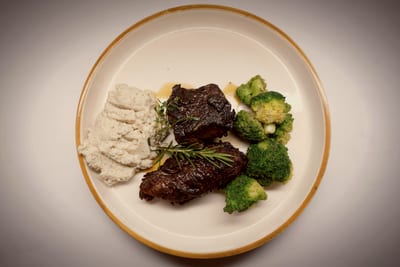 Cut · Head, the chewing muscleBeef cheekThe jaw muscle, laced with collagen: three to four hours of braising make barbacoa de cachete and carrillada.
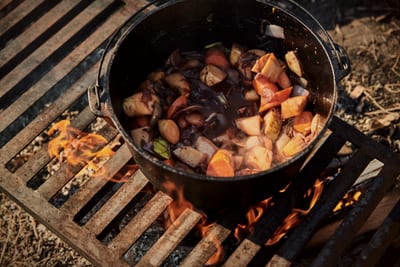 Cooking · Collagen to gelatinBraisingBrown, cover with a little liquid, simmer for hours: collagen turns to gelatin, fastest above 80 °C / 175 °F.
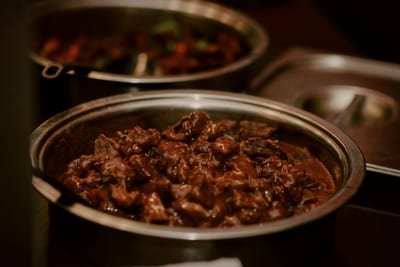 Stew · Burgundy, Pinot NoirBoeuf bourguignonBeef shoulder braised in Pinot Noir until its collagen turns to gelatin, with lardons, mushrooms and onions.
 Main course · Mexico, the pitBarbacoaLamb or beef cheek in maguey leaves, 8 to 12 hours under earth, with consomé from the drippings.
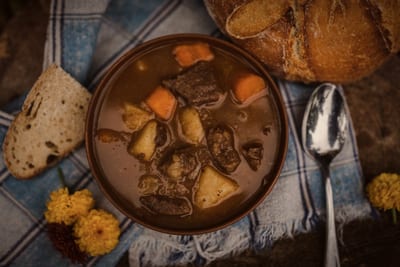 Stew · Córdoba, red wineOxtail stew (rabo de toro)Córdoba's oxtail, braised three hours in red wine until its collagen thickens the sauce and the meat leaves the bone.
 Main course · Oven braise, bone-inBraised short ribsEnglish-cut short ribs braised in red wine: which cut to buy, 3–4 hours at 150–160 °C / 300–320 °F, how to tell when they are done, and the sauce.
Frequently asked questions
How long do beef cheeks take to cook?
About 3–4 hours, covered, at 150–160 °C / 300–320 °F after browning, or at a bare simmer on the stove. Start checking at 3 hours: they are done when a skewer slides in with no resistance.
What internal temperature should beef cheeks reach?
Typically above 90 °C / 194 °F when tender. They are safe long before that (the USDA minimum for whole cuts is 63 °C / 145 °F); the higher number is what the collagen needs to dissolve in hours.
Do you need to remove the silverskin from beef cheeks?
Yes. The outer membrane stays tough after braising and curls the cheek, so trim it off with a thin knife. Leave the seam of connective tissue in the center: it melts.
How many beef cheeks per person?
Usually one. A trimmed cheek weighs 250–450 g / 9–16 oz and loses roughly 20–30 % in cooking, so buy by weight: about 250–300 g / 9–11 oz trimmed, raw, per person.
Why are my beef cheeks still tough?
They need more time: the meat is cooked through long before the collagen has dissolved. If they are tender but dry and stringy, the liquid boiled; keep it at a lazy simmer.
Sources
4
- McGee, Harold. On Food and Cooking: The Science and Lore of the Kitchen, rev. ed. New York: Scribner, 2004.
- Toldrá, Fidel (ed.). Lawrie's Meat Science, 8th ed. Duxford: Woodhead, 2017.
- Larousse Gastronomique, rev. ed. London: Hamlyn, 2009.
- USDA Food Safety and Inspection Service. Safe Minimum Internal Temperature Chart. 2023. www.fsis.usda.gov/food-safety/safe-food-handling-and-preparation/food-safety-basics/safe-temperature-chart