Cooking · Embers, not flames
Grilling over fire
Grilling over fire cooks meat with the radiant heat of embers or flames below a grate. Distance is the main control — moving a steak from 8 to 16 cm above the embers cuts the heat it receives several-fold — and with the fuel and the hot and cool zones it decides the crust, the smoke and how evenly the steak cooks; the Argentine parrilla is the slowest, ember-only version.
At a glance
- Heat
- Mostly radiant, from embers
- Steak distance
- 8–15 cm / 3–6 in (fast) · 15–25 cm / 6–10 in (slow)
- Zones
- Hot, medium, no fire
- Hand test, high heat
- 2–3 s at grate height
- Fuels
- Hardwood · lump charcoal · briquettes · gas
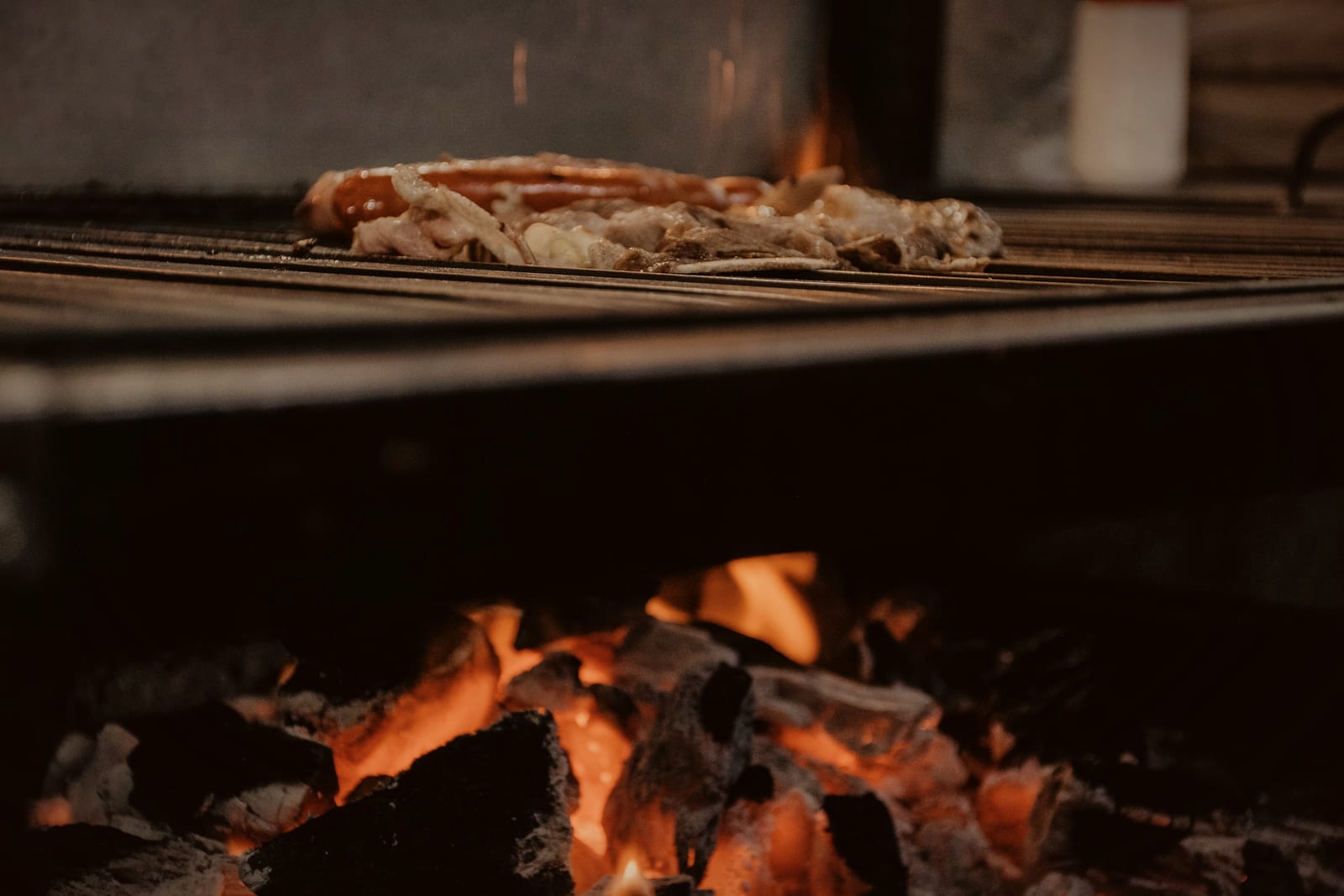
Radiant heat from below
Grilling is the oldest way of cooking meat: exposing it to the heat of a fire, usually on a metal grate. Most of the heat that reaches the steak is infrared radiation from glowing embers or flames, with some convection from the hot gases rising and conduction where the meat touches the bars. Unlike a pan, a grill browns the surface without fat between meat and metal, lets fat drip away, and adds aromas from smoke and from fat vaporising on the coals.
There are two broad traditions. Direct, fast grilling over high heat, close to the fire, as in the North American cookout or the Japanese yakiniku; and the slow, ember-only cooking of South America, in which the Argentine and Uruguayan parrilla keeps the meat far from a moderate bed of embers for a long time.
Why the grate's height matters most
Radiant heat falls off with distance: moving the steak from 8 to 16 cm above the embers reduces the energy it receives several-fold, which is why the height of the grate is the main control on a fire grill. A bed of embers at 600–900 °C / 1,100–1,650 °F radiates intensely without flame; a flame carries soot, which deposits on the meat. Fat dripping on hot coals vaporises and partly burns; the resulting smoke is a large part of the "grilled" flavour, but heavy flare-ups blacken the surface and increase polycyclic aromatic hydrocarbons.
The fuel matters less for flavour than is often believed, but it matters for heat. Gas combustion produces water vapour, so a gas grill cooks in moister air and radiates less than embers, giving a paler crust. Lump charcoal burns hot and fast; briquettes burn more evenly and longer; hardwood must first burn down to embers, which takes time but gives the most aromatic smoke and the most controllable, long-lasting heat.
Fuels compared
| Fuel | Heat | Flavour | Notes |
|---|---|---|---|
| Hardwood embers (quebracho, oak, hickory, mango, longan) | High, long, adjustable by shovelling | Most aromatic smoke | Needs a fire to burn down first, 30–60 min |
| Lump charcoal | Very high, fast | Clean, light smoke | Burns out faster; uneven pieces |
| Briquettes | Medium-high, even, long | Neutral; binders may smell at first | Light fully before cooking |
| Gas | Medium, instant control | No smoke of its own; only from dripping fat | Moist combustion, paler crust |
Heat zones
Arranging the fuel unevenly is the single most useful grilling technique. A hot zone with a deep bed of embers is for searing; a medium zone with a thin layer is for finishing thick steaks; an area with no fire below is a safe place to move meat during flare-ups or to cook slowly with the lid closed (indirect heat). The heat at grate height can be judged by holding the palm about 12 cm / 5 in above the grate and counting how long it can stay there: about 2–3 seconds is high heat, 4–5 medium, 7–8 low.
Distance to the embers
| Cut | Distance from embers | Approach |
|---|---|---|
| Thin steaks, skirt, 1–2 cm / ½–¾ in | 8–12 cm / 3–5 in | Hot zone, fast, turned once or twice |
| Steaks 2.5–4 cm / 1–1½ in | 10–15 cm / 4–6 in | Sear in the hot zone, finish in the medium zone |
| Thick and bone-in steaks, 5 cm / 2 in+ | 15–25 cm / 6–10 in | Slow over moderate embers, then sear |
| Argentine large cuts (short ribs, flank, picanha whole) | 20–30 cm / 8–12 in | Low embers for 1–2 h or more |
The Argentine parrilla
The Argentine and Uruguayan grill is built around embers, not flames. Hardwood, traditionally quebracho or other dense native woods, burns in a separate brazier (brasero) or at one side of the grill; the asador shovels the embers under the meat as needed and adds more as they fade. The grate is often made of V-shaped bars that channel fat to the front, away from the coals, which limits flare-ups, and on many grills it can be raised and lowered with a crank. Cooking is long and moderate: large cuts such as asado de tira (cross-cut short ribs) or vacío (flank) cook for an hour or more far from the embers, and steaks are taken through gentle heat rather than seared fast. Coarse salt is applied before or during cooking. See Salting steak.
Step by step
- Light the fuel well in advance: wood until it has burnt down to glowing embers, charcoal until it is covered in fine grey ash.
- Spread the embers into a hot zone, a medium zone and an empty zone; set the grate and let it heat for 5–10 minutes, then brush it clean.
- Dry the steaks and salt them; oil the meat lightly, not the grate.
- Sear over the hot zone until well browned, turning as needed and moving away from any flare-up.
- Move to the medium zone, or raise the grate, to finish the interior; close the lid on a kettle grill for very thick steaks.
- Check the core with a probe, pull a few degrees early according to the temperature chart, and rest briefly.
Flames, an even fire, a grate too low
Cooking over flames instead of embers, which coats the meat in soot. Spreading the fuel evenly, which leaves nowhere to escape from flare-ups or too much heat. Starting before briquettes or wood have burnt down. Cooking thick steaks too close to the fire, burning the outside before the centre is warm. Pressing the steaks against the grate. And opening and closing the lid on a covered grill so often that the temperature never settles.
Frequently asked questions
Is charcoal or gas better for grilling steak?
Charcoal and wood embers radiate more heat in drier air and give a darker crust and more smoke; gas is easier to control but produces a paler crust.
How far should a steak be from the coals?
About 10–15 cm / 4–6 in for a 2.5–4 cm / 1–1½ in steak; closer for thin steaks, 15–25 cm / 6–10 in for thick or bone-in ones.
What is two-zone grilling?
Arranging the fire so one side is hot and the other has little or no fuel: the hot side sears, the cooler side finishes cooking or rescues meat from flare-ups.
How is an Argentine parrilla different?
It cooks only over hardwood embers shovelled under the meat, usually at a distance and for a long time, on a grate that can be raised and lowered and channels fat away from the fire.
Sources
4
- Mallmann, Francis; Kaminsky, Peter. Seven Fires: Grilling the Argentine Way. New York: Artisan, 2009.
- McGee, Harold. On Food and Cooking: The Science and Lore of the Kitchen, rev. ed. New York: Scribner, 2004.
- Myhrvold, Nathan; Young, Chris; Bilet, Maxime. Modernist Cuisine: The Art and Science of Cooking. Bellevue: The Cooking Lab, 2011.
- Goldwyn, Meathead; Blonder, Greg. Meathead: The Science of Great Barbecue and Grilling. Boston: Houghton Mifflin Harcourt, 2016.
Related