Breed group · Japan, BMS 1–12
Wagyu
Wagyu (和牛, “Japanese cattle”) is the name for four native Japanese breeds — Japanese Black, Brown, Shorthorn and Polled — whose beef carries fat woven through the muscle. That fat melts at a lower temperature than the fat of most European breeds, which gives the meat its soft, buttery texture; Japan grades it on a 12-point marbling scale.
At a glance
- Origin
- Japan
- Breeds
- Japanese Black, Brown, Shorthorn, Polled
- Top grade
- A5 (BMS 8–12)
- Grader
- Japan Meat Grading Association
- Typical slaughter age
- about 28–30 months
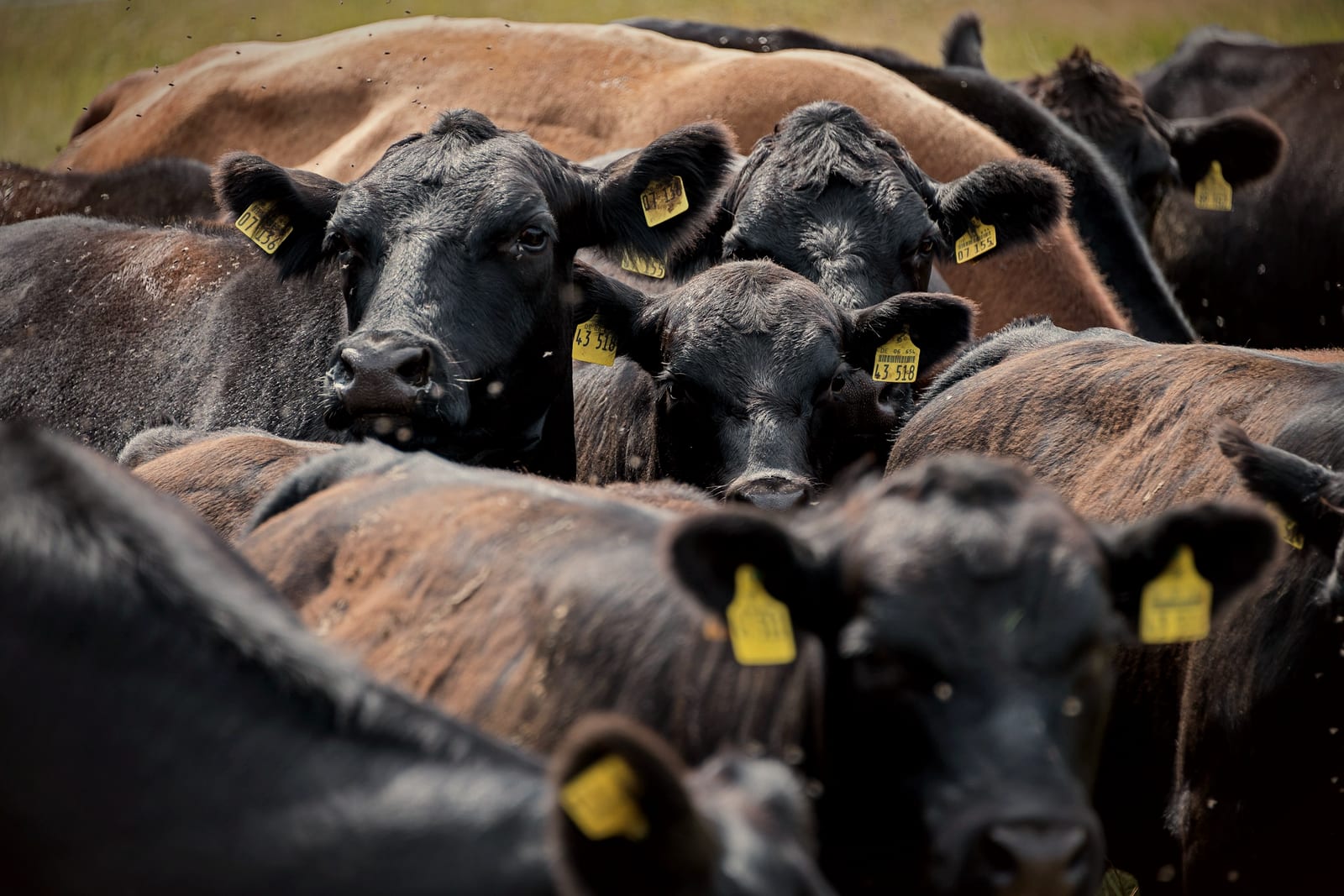
A breed group, not a grade
Wagyu is not a single breed and not a grade: it is a breed group. Japanese law reserves the word, on beef produced in Japan, for the four native breeds and for crosses between them. Outside Japan the word is used more loosely and may describe animals with as little as 50 % Japanese genetics.
What sets Wagyu apart is the fat. Selection over the twentieth century, above all in the Japanese Black, produced cattle that deposit fat inside the muscle in fine flecks rather than only around it. That fat is rich in monounsaturated fatty acids, especially oleic acid, and melts at a lower temperature than the fat of most European breeds — part of why highly marbled Wagyu feels soft, almost liquid, in the mouth.
The four breeds
| Breed | Japanese name | Notes |
|---|---|---|
| Japanese Black | Kuroge Washu (黒毛和種) | The vast majority of Wagyu; the most marbled. Regional lines include Tajima (Hyōgo). |
| Japanese Brown | Akage Washu (褐毛和種) | Also called Akaushi (“red cattle”); Kumamoto and Kōchi strains; leaner, with more beefy flavour. |
| Japanese Shorthorn | Nihon Tankaku Washu (日本短角種) | Northern Japan (Iwate, Aomori, Hokkaido); grass-reared, lean; a small population. |
| Japanese Polled | Mukaku Washu (無角和種) | Yamaguchi Prefecture; hornless; very rare. |
History
Cattle in Japan were draught animals for centuries; eating beef was uncommon and at times discouraged. After the Meiji Restoration (1868) beef entered the urban diet, and in the late nineteenth and early twentieth centuries native cattle were crossed with imported breeds such as Brown Swiss, Devon, Shorthorn and Simmental to make them larger. The results were uneven, and from the 1910s breeding turned back toward selecting and fixing the native type. The Japanese Black, Brown and Polled were recognised as breeds in 1944; the Shorthorn followed in 1957.
When farm mechanisation ended the cattle’s working role after the Second World War, breeders selected for meat — above all for marbling. Isolated regional bloodlines, kept apart by Japan’s mountains, gave rise to the local strains that still matter today.
Small numbers of Wagyu cattle and genetics left Japan between 1976 and the late 1990s, mainly to the United States and from there to Australia. Japan then restricted the export of live Wagyu and genetic material, which is why every Wagyu herd outside Japan descends from a limited founder group.
How it’s graded
Carcasses in Japan are graded by the Japan Meat Grading Association (JMGA) at the cut between the sixth and seventh ribs. The grade has two parts. A letter, A, B or C, is the yield grade: an estimate of how much saleable meat the carcass gives (A is the highest, around 72 % or more). A number, 1 to 5, is the meat quality grade.
The quality number is decided by four criteria — marbling, meat colour and brightness, firmness and texture, and fat colour and quality — and the carcass receives the lowest of the four. Marbling is measured on the Beef Marbling Standard (BMS), from 1 (almost none) to 12 (extremely abundant).
A5, the grade most often quoted on menus, therefore means the highest yield band plus top marks in all four quality criteria, with BMS between 8 and 12. A5 says nothing about breed alone: in principle any carcass graded in Japan can earn it, though in practice it is almost always Japanese Black. See Grading systems for how this compares with USDA, MSA and Korea.
| Quality grade | BMS | Marbling |
|---|---|---|
| 5 | 8–12 | Excellent |
| 4 | 5–7 | Good |
| 3 | 3–4 | Average |
| 2 | 2 | Below average |
| 1 | 1 | Poor |
Twenty months of slow fattening
Calves are typically raised by breeding farms for eight to ten months and then sold at auction to fattening farms. Fattening is long: commonly around 20 months on a high-energy ration of rice straw, grains and concentrates, with slaughter at about 28–30 months — roughly twice as long as a typical feedlot steer. Restricting vitamin A during part of fattening is a widespread practice associated with higher marbling.
Names and labels
Regional brands such as Kobe beef (Hyōgo), Matsusaka (Mie) and Ōmi (Shiga) are not breeds. They are protected names for Japanese Black cattle of a given bloodline, raised and slaughtered in a given place and meeting the brand’s own grade thresholds. Japan has well over a hundred such regional brands.
Outside Japan, labels follow genetics. In Australia and the United States, fullblood means 100 % Japanese ancestry traceable to Japan; purebred usually means at least 93.75 % (four generations of grading up); and F1 is a first cross, typically a Wagyu sire on an Angus or Holstein dam, giving 50 % Wagyu. Much of what is sold as “American Wagyu” is F1 or similar crossbred beef. Australian Wagyu is graded on the AUS-MEAT marble score (0–9, sometimes extended to 9+) or the breed society’s own scale, not on BMS.
Massage, beer and music
Massages and beer. Stories of cattle being massaged, fed beer or played music circulate widely. A few farms have experimented with such practices, but they are not standard, not required by any grading scheme, and there is no good evidence they affect marbling, which is driven mainly by genetics, feed, age and fattening time.
“Wagyu” means Kobe. Kobe is one regional brand of Japanese Black cattle; most Wagyu is not Kobe.
All Wagyu is A5. A5 is a grade, and a large share of Japanese Wagyu grades A4 or A3. Outside Japan, A5 is meaningless unless the carcass was graded in Japan.
Frequently asked questions
What does A5 Wagyu mean?
A is the yield grade (the highest proportion of usable meat) and 5 is the top meat-quality grade, which requires a Beef Marbling Standard score of 8 to 12 plus top marks for colour, texture and fat.
Is Wagyu the same as Kobe beef?
No. Wagyu is the group of four Japanese breeds; Kobe is a protected brand for Tajima-line Japanese Black cattle raised and slaughtered in Hyōgo Prefecture that meet strict grade criteria.
Why is Wagyu so expensive?
Long fattening (around 20 months), slow growth, limited genetics and high grading thresholds mean fewer, costlier carcasses; the top grades are a small share even in Japan.
What is the difference between fullblood, purebred and F1 Wagyu?
Fullblood is 100 % Japanese genetics; purebred is usually at least 93.75 %; F1 is a 50 % first cross, most often with Angus.
Do Wagyu cattle drink beer and get massages?
Not as a rule. It is a popular story; marbling comes from genetics, feed and long fattening, not from beer or massage.
Sources
5
- Japan Meat Grading Association. Beef Carcass Grading Standard. Tokyo, 1988 (rev. 2014). www.jmga.or.jp
- Polkinghorne, R. J.; Thompson, J. M. "Meat standards and grading: a world view." Meat Science 86, no. 1 (2010): 227–235.
- AUS-MEAT Limited. Handbook of Australian Meat, 7th ed. (International Red Meat Manual). Brisbane, 2005. www.ausmeat.com.au
- Gotoh, Takafumi; Nishimura, Takanori; Kuchida, Keigo; Mannen, Hideyuki. "The Japanese Wagyu beef industry: current situation and future prospects — A review." Asian-Australasian Journal of Animal Sciences 31, no. 7 (2018): 933–950.
- Australian Wagyu Association. Wagyu breed information and content definitions (fullblood, purebred, crossbred). www.wagyu.org.au
Related