Cooking · Cold air, 14–60 days
Dry aging
Dry aging is the maturing of beef by holding it uncovered in cold, moving air for weeks, usually 14 to 60 days at 0–4 °C / 32–39 °F. Enzymes tenderise the muscle, evaporation concentrates it, and the slow breakdown of proteins and fats gives nutty, savoury and, in long-aged pieces, blue-cheese notes, at the cost of 15–30 % of the starting weight.
At a glance
- Temperature
- 0–4 °C / 32–39 °F
- Humidity
- 75–85 % relative
- Airflow
- 0.5–2 m/s
- Typical time
- 14–60 days
- Weight lost
- 15–30 % (evaporation + trim)
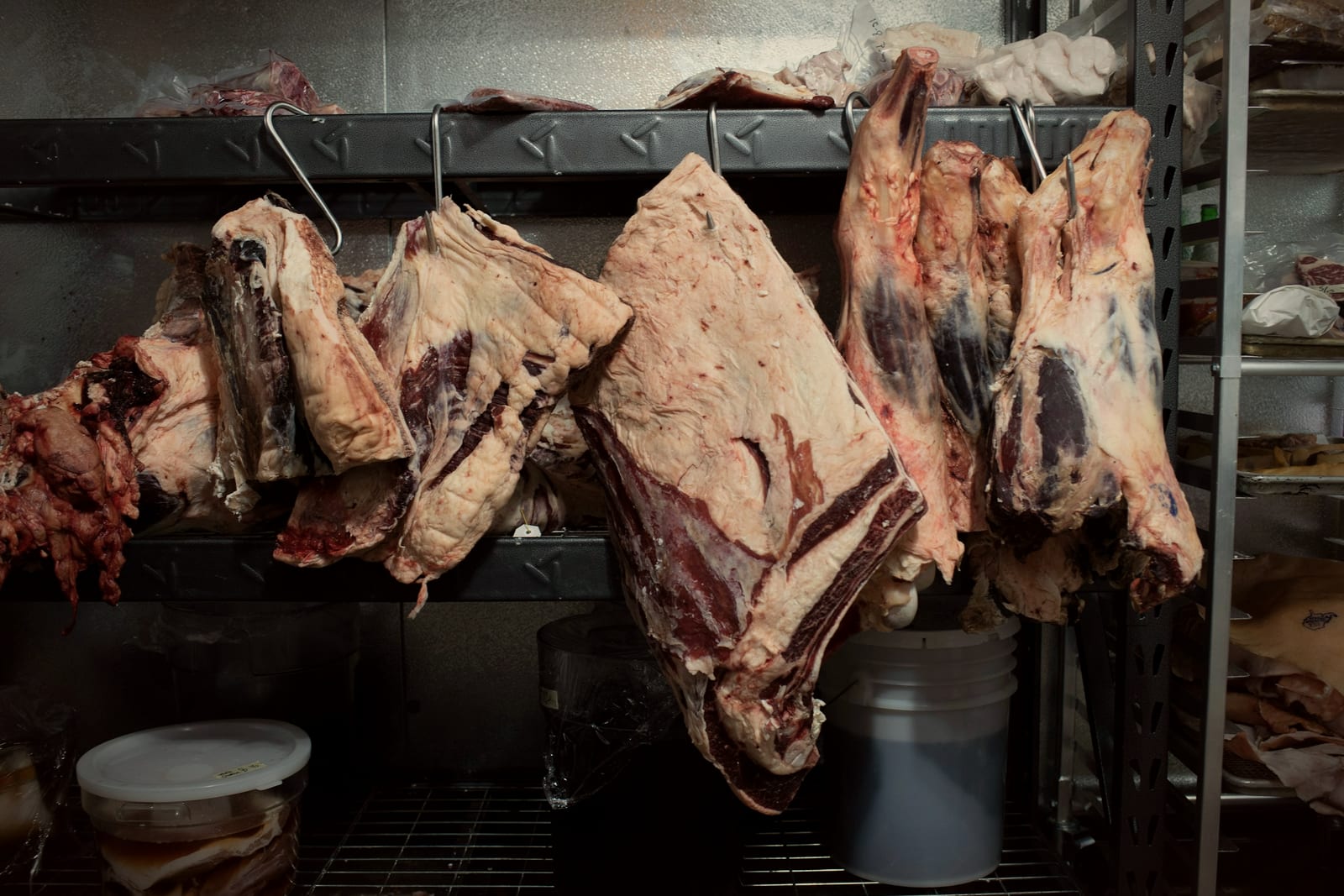
Unwrapped, in cold moving air
Dry aging is the oldest way of maturing beef. Whole primals or sub-primals, bone-in or boneless, are held unwrapped in a refrigerated room or cabinet at 0–4 °C / 32–39 °F, with controlled humidity (typically 75–85 %) and constant air movement, for anything from 14 to 60 days and occasionally much longer. The surface dries into a hard, dark crust; inside, the meat tenderises and its flavour concentrates and changes.
It is distinct from wet aging, the industry norm since the spread of vacuum packaging in the 1960s and 1970s, in which cuts are sealed in plastic and aged in their own juices, often during shipping. Wet aging delivers most of the tenderising effect with almost no weight loss; dry aging adds the flavour, at the cost of weight and time. Reviews of the literature put the evaporated and trimmed loss of dry aging at roughly 15–30 % of the starting piece, against 1–3 % for wet aging.
Enzymes, evaporation, breakdown
Three things happen at once. First, enzymes already present in the muscle, chiefly the calpains and, later and more slowly, the cathepsins, break down the proteins that hold the muscle fibres rigid after rigor mortis. This is the tenderising, and most of it is done within the first two to three weeks. Second, water evaporates from the surface, so the same amount of flavour compounds sits in less water. Third, proteins and fats slowly break down into smaller molecules (free amino acids, peptides, fatty acids and nucleotides such as inosinic acid) which register as savoury, nutty, buttery and, in long-aged pieces, blue-cheese notes; when the steak is seared, these same molecules feed a richer Maillard reaction.
Moulds and yeasts that grow on the crust in traditional rooms, notably Thamnidium, contribute proteolytic enzymes of their own and are thought to add to the characteristic aroma. Tenderness gains flatten after about 21 days; flavour keeps changing. Trained panels in controlled studies consistently distinguish dry-aged from wet-aged beef at 21 days and beyond, describing it as beefier, more brown-roasted and nutty, with less of the sour, metallic note that vacuum-aged beef can carry.
Time and what it gives
| Days | Tenderness | Flavour | Typical loss, boneless loin |
|---|---|---|---|
| 0–7 | Rigor resolving; still firm | Fresh, mild, slightly metallic | 2–5 % |
| 14 | Clearly more tender | Beefier, first nutty notes | 8–12 % |
| 21–28 | Near its plateau | Roasted, nutty, savoury | 12–18 % |
| 35–45 | Plateau | Intense, buttery, a trace of funk | 18–22 % |
| 60+ | Plateau; crust very deep | Blue-cheese, fermented notes | 22 % and more |
What is lost
The loss has two parts. Evaporation removes water through the surface: a boneless striploin typically loses 10–15 % of its weight in three weeks and 20 % or more in six, and the rate depends on the surface-to-volume ratio, so small or boneless pieces lose proportionally more than bone-in ones with a fat cover. Trimming then removes the dried, oxidised crust, usually another 5–15 % depending on the piece and the butcher. A 60-day piece can return barely half its starting weight as saleable steak.
This is why dry-aged beef costs what it does, and why the process is applied to large, fat-covered, bone-in pieces (rib sets, short loins, whole striploins) rather than to tenderloins or small boneless cuts: bone and fat act as a shield and the losses are proportionally smaller.
Step by step
- Choose a large primal with an intact fat cover, ideally bone-in, from well-marbled beef; lean or small pieces dry out before they gain flavour.
- Place it unwrapped on a rack or hang it, with air on every side and nothing touching it; never stack pieces.
- Hold the chamber at 0–2 °C / 32–36 °F, 75–85 % relative humidity, with continuous airflow of 0.5–2 m/s across the surface.
- Weigh the piece on entry and at intervals to follow the loss; do not cut into it until it comes out.
- At the end, trim the dried crust from every face, then portion and cook as fresh steak; the steaks themselves can be wrapped and refrigerated for a few days.
Conditions and risk
A temperature just above freezing keeps spoilage bacteria slow while the enzymes continue to work; humidity around 80 % balances drying against an excessively thick crust; steady airflow keeps the surface dry, so that its microbiology stays dominated by harmless moulds and yeasts rather than putrefactive bacteria. The process cannot be done safely by leaving beef uncovered in a domestic refrigerator: the humidity and airflow are wrong, the door is opened constantly, and the risk of off-odours and of pathogens on cut faces is real. Purpose-built cabinets and moisture-permeable aging bags are the domestic alternatives.
Small steaks and misread mould
Aging small steaks instead of whole pieces, which leaves little to eat after trimming. Expecting more tenderness from 60 days than from 30: past the plateau the gain is flavour, not texture. Cooking dry-aged steak exactly like fresh: with less water it browns faster and can overcook sooner, so it benefits from moderate heat and a probe. And treating a white, dry bloom as spoilage while ignoring the real warning signs, which are slime, a sour or ammoniacal smell, and wet patches.
Frequently asked questions
What does dry-aged beef taste like?
Beefier and more concentrated than fresh beef, with roasted, nutty and buttery notes; long-aged pieces develop blue-cheese or fermented aromas.
How long should beef be dry aged?
Most of the tenderising is done by 21–28 days; 28–45 days is the common range for flavour, and longer aging is a matter of taste.
Why is dry-aged steak so expensive?
The piece loses 15–30 % of its weight to evaporation and trimming, ties up refrigerated space for weeks, and only suits large, high-grade primals.
Can you dry age beef in a normal fridge?
Not safely by simply leaving it uncovered: humidity and airflow are uncontrolled. Dedicated aging cabinets or moisture-permeable aging bags are the home options.
What is the difference between dry and wet aging?
Wet aging matures beef in a vacuum bag in its own juices, with almost no weight loss and little flavour change; dry aging exposes it to air, losing weight but gaining flavour.
Sources
5
- Savell, Jeffrey W. Dry-Aging of Beef: Executive Summary. Centennial, CO: National Cattlemen's Beef Association, 2008.
- Dashdorj, Dashmaa; Tripathi, Vinay K.; Cho, Soohyun; Kim, Younghoon; Hwang, Inho. "Dry aging of beef; review." Journal of Animal Science and Technology 58 (2016): 20. doi.org/10.1186/s40781-016-0101-9
- Toldrá, Fidel (ed.). Lawrie's Meat Science, 8th ed. Duxford: Woodhead, 2017.
- McGee, Harold. On Food and Cooking: The Science and Lore of the Kitchen, rev. ed. New York: Scribner, 2004.
- Myhrvold, Nathan; Young, Chris; Bilet, Maxime. Modernist Cuisine: The Art and Science of Cooking. Bellevue: The Cooking Lab, 2011.
Related