Cut · Plate, chuck & rib
Short ribs
Short ribs are the lower ends of the beef ribs with the meat between and over the bones, taken from the plate, the chuck and the rib. Cut across the bones they become the Argentine asado de tira and Korean LA galbi; cut between them, the English-cut ribs of braises and Texas barbecue.
At a glance
- Primal
- Plate, chuck and rib (the lower part of the ribs)
- Muscles
- Intercostals between the bones; serratus ventralis and others over them
- Forms
- Asado de tira · English cut · flanken / LA galbi
- Best cooked
- Slow: grill, smoke or braise until the collagen melts
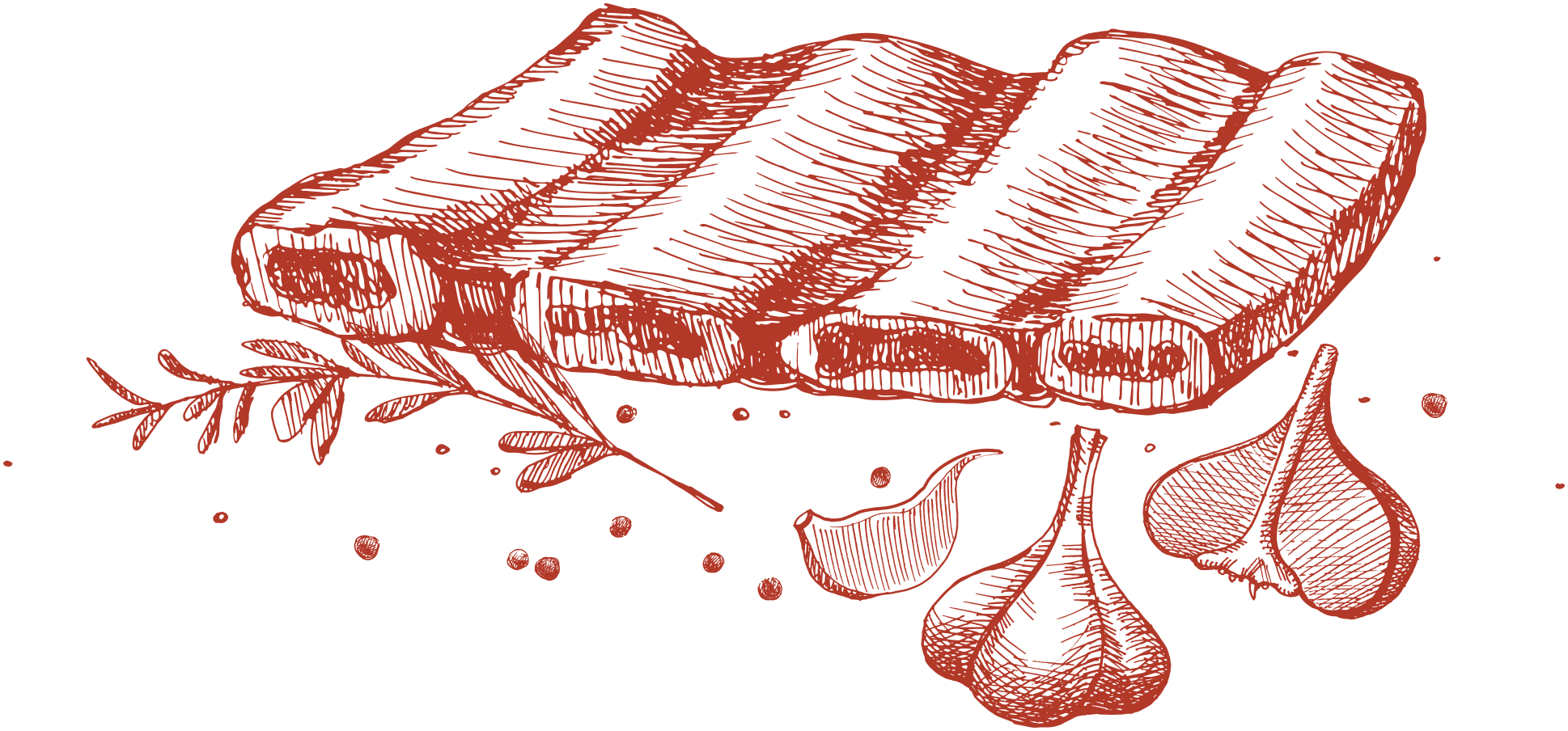 Beef short ribs
What it is
Short ribs are not a single muscle but a section of the rib cage: lengths of rib bone with the intercostal muscles between them and, on top, a layer of meat and fat that varies with the position on the animal. On the chuck ribs much of that top layer is the serratus ventralis, the muscle that also gives the Denver steak. The meat is rich in fat and collagen, which is why short ribs are among the most flavourful cuts and why most of them need long cooking.
What a cook buys as short ribs depends on how the saw runs. Across the bones, in strips that show a row of small bone sections, the cut is the Argentine asado de tira (3–5 cm wide, for the grill), or, sliced thin (0.5–1 cm), the flanken of Jewish butchery and the LA galbi of Korean barbecue. Between the bones, in blocks with one long bone each, it is the English cut, the form used for braising and for Texas-style smoked beef ribs.
In Japan karubi, a word borrowed from Korean galbi, usually means boneless, well-marbled meat from the belly rather than ribs on the bone; the bone-in cut is sold as ショートリブ.
Where it comes from
The ribs run the whole length of the rib cage, and short ribs can be cut from three primals. The chuck gives the chuck short ribs from roughly ribs two to five (IMPS 130); the plate, below the rib primal, gives the plate short ribs from ribs six to eight (IMPS 123A), the largest and meatiest, often called "dino ribs"; and when the rib primal is shortened for roasting, the lower bone ends trimmed from it are sold as short ribs too. IMPS 123 is the general short-rib item. Next to the plate, in front, lies the brisket.
Argentine butchery does not separate primals in the same way. The whole rib cage, the costillar, is either cooked entire on an iron cross beside the fire (asado a la cruz) or sawn across into the long strips called tira de asado, sold as asado de tira. The matambre is peeled from the outside of the costillar and the vacío continues it towards the flank.
English cut, flanken or galbi: short rib names by country
The same rib section is sold under a dozen names, and the name rarely says how it was sawn, which is what decides how it cooks. In Korea and Japan the most common words are not cut names at all: galbi means any rib, and Japanese karubi is a yakiniku word for fatty rib-and-belly meat, usually without bone.
| Name | Where | What you get |
|---|---|---|
| English cut | US, UK, Australia | One bone per piece, cut between the ribs: a thick block for braising or smoking |
| Flanken | United States | Cut across the bones: a thin strip with several small bone sections |
| LA galbi · LA갈비 | South Korea, Korean-American | Flanken-style strip, thin, usually three bones, marinated and grilled |
| 갈비 galbi | South Korea | Any beef rib; at barbecue, often a single bone opened into a long ribbon of meat |
| 갈비살 galbisal | South Korea | Boneless strips of meat from between the ribs |
| Asado de tira | Argentina, Uruguay | Cut across the bones in strips 3–5 cm wide, for the parrilla |
| Plate short ribs · “dino ribs” | United States | Ribs 6–8 from the plate, a three-bone slab (IMPS 123A): the meatiest |
| Chuck short ribs | United States | Ribs 2–5 from the chuck (IMPS 130; 130A boneless): smaller, a little leaner |
| Back ribs | United States | A different cut: the bones left when the ribeye is taken off, little meat on top |
| Jacob's ladder | United Kingdom | Short ribs as a slab of several bones |
| Querrippe | Germany | Short ribs |
| Agujas | Northern Mexico | Chuck ribs cut thin across the bones, for the grill |
| カルビ karubi | Japan | Yakiniku word for fatty rib and belly meat, usually boneless: not one cut |
| 骨付きカルビ honetsuki karubi | Japan | Bone-in short rib for yakiniku |
| 中落ちカルビ nakaochi karubi | Japan | Meat from between the ribs, like Korean galbisal |
| 牛小排 niú xiǎopái | Taiwan, China, Singapore | Short ribs, bone-in or boneless, often sliced for steak or barbecue |
| 牛仔骨 niúzǎi gǔ | Hong Kong, southern China | Thin cross-cut short ribs (flanken), pan-fried |
| Plat de côtes | France | A slab of short ribs, for pot-au-feu |
How it's cooked
Asado de tira goes on the parrilla over moderate embers, bone side down first, so the bone shields the meat while the fat renders. It is salted coarsely, turned once and cooked for about 40 minutes to an hour depending on thickness, until the meat pulls away from the bones. The whole costillar on a cross takes several hours at a distance from the fire.
English-cut ribs are braised: browned, then cooked covered in liquid at about 150–160 °C / 300–320 °F for three to four hours, until the core reaches 90–95 °C / 194–203 °F and the collagen has turned to gelatin. Korean galbi-jjim, French plat de côtes in a pot-au-feu and the red-wine braises of American restaurants follow this pattern. Texas pitmasters smoke whole plate ribs at 120–135 °C / 250–275 °F for many hours and pull them when a probe slides in without resistance, usually around 93–96 °C / 200–205 °F.
Flanken and LA galbi, thin enough to cook through in minutes, are marinated (in Korea typically soy sauce, sugar, garlic, sesame oil and grated Asian pear) and grilled fast over high heat, so the sugar caramelises before the thin meat dries out.
Guest chef’s notes: asado de tira
Ask for the width, not just the cut. A wide strip of about four fingers is for slow cooking with the bone down; the thin banderita, one finger or about 1–1.5 cm, is for fast, hot cooking and dries out if you treat it like the wide one.
Bone down, and leave it. The bones work as a griddle and a shield: the meat cooks gently on top of them while the fat renders. Most of the time on the grill is spent this way; the strip is turned once, near the end, only to colour the meat side.
Embers, never flame. Spread a moderate bed of embers under the grill and keep feeding it from the side. If you can hold your hand at grill height for about eight seconds, the heat is right for a wide strip; for banderita, closer to four.
Coarse salt just before it goes on. Salt the meat side generously right before grilling; there is no need for marinades, the fat and the bone give the flavour.
It is ready when the meat lets go of the bone and the fat is golden and crisp. Serve it straight onto a wooden board: a cold metal tray takes the heat out of the meat in a minute.
Buying it
Look for a thick, even layer of meat over the bone, at least 2–3 cm on English-cut ribs, with fine marbling rather than one thick cap of hard fat. Plate short ribs give the most meat per bone; chuck short ribs are easier to find and often a little leaner.
For asado de tira, the strips should be cut evenly, all of the same width, and show a good proportion of meat to bone across the whole length; the end nearest the brisket is usually fattier. Ask for the cut by its form, not just its name: "short ribs" can mean a cross-cut strip, a single bone or a thin galbi slice, and each one cooks differently.
Names around the world
24
The same muscle, named by language and by trade system.
| English | Short ribs |
| Tiếng Việt | Sườn bò |
| Español | Asado de tira · costillar |
| 한국어 | 갈비 |
| 日本語 | ショートリブ · カルビ |
| Français | Plat de côtes |
| Italiano | Costine |
| Русский | Короткие рёбра |
| 中文 | 牛小排 (niú xiǎopái) · 牛仔骨 (niúzǎi gǔ, cross-cut) |
| Deutsch | Querrippe |
| Português | Costela |
All the cuts' names, country by country →
Trade and national systems
| System | Name | Reference |
|---|---|---|
| United States | Short ribs (plate) · chuck short ribs · English cut · flanken | IMPS 123 / 123A / 130 / 130A |
| United Kingdom | Short rib · Jacob's ladder | AHDB |
| Australia / NZ | Short ribs · rib plate | HAM |
| Argentina | Asado de tira (cross-cut strip) · costillar (whole rib cage) | IPCVA |
| Brazil | Costela · ponta de agulha | Portaria 5/88 |
| France | Plat de côtes | Larousse |
| Korea | 갈비 (galbi) · LA galbi (thin cross-cut) | KAPE |
| Japan | ショートリブ · カルビ (karubi, usually boneless belly meat) | JMGA |
| China · Taiwan · Hong Kong · Singapore | 牛小排 niú xiǎopái (short ribs) · 牛仔骨 niúzǎi gǔ (Cantonese, thin cross-cut) | |
| Uruguay | Asado de tira · costillar | |
| Mexico | Agujas (northern Mexico, thin cross-cut chuck ribs) · costilla | |
| Germany | Querrippe | |
| Vietnam | Sườn bò · sườn bò Mỹ (US short ribs, usually cut thin) |
Frequently asked questions
What are short ribs?
The lower sections of the beef ribs with the meat between and over the bones, from the chuck, plate and rib. They are rich in fat and collagen and are usually grilled slowly, smoked or braised.
Is asado de tira the same as short ribs?
It is one form of short ribs: the rib cage sawn across the bones into strips 3–5 cm wide, grilled on the parrilla. Flanken and LA galbi are the same cut sliced much thinner.
What is the difference between English cut and flanken short ribs?
English cut runs between the bones, giving thick blocks with one long bone, for braising or smoking. Flanken runs across the bones, giving thin strips with several small bone sections, for marinating and grilling fast.
What temperature are short ribs done?
For braised or smoked short ribs, when the core reaches about 90–96 °C / 194–205 °F and the meat is tender to a probe. Thin galbi is simply grilled through in a few minutes.
What is the difference between short ribs and beef ribs?
“Beef ribs” in the United States usually means back ribs, the bones left after the ribeye is removed, with meat mostly between the bones. Short ribs come from lower down, from the plate and chuck, and carry a thick layer of meat on top of the bone.
Are short ribs a cheap cut?
Less so than they used to be. They cost less per kilo than premium steaks, but much of the weight is bone and fat, so per kilo of meat on the plate they are far from cheap.
Why is it called LA galbi?
There are two common explanations: the cut was popularised by Korean butchers in Los Angeles, who sawed American short ribs across the bones, or “LA” stands for “lateral”, the direction of the cut. Neither is firmly documented.
What is the difference between galbi and LA galbi?
Traditional Korean galbi is cut along one bone and opened into a long ribbon of meat. LA galbi is cut across the bones into a thin strip with three small bone sections, which is quicker to prepare and to grill.
How do you cook short ribs in the oven?
Brown them well, half-cover them with stock or red wine in a heavy covered pot and cook at about 150–160 °C / 300–320 °F for three to four hours, until a probe slides in easily (about 90–95 °C / 194–203 °F inside). Let them rest in the liquid, skim off the fat and reduce the liquid into a sauce.
How many short ribs per person?
Bone-in English-cut ribs are roughly half bone and fat, so count about 400–500 g (around 1 lb) raw per person; one large plate-rib bone feeds one to two. For asado de tira or thin galbi, about 300–400 g raw per person.
What is karubi in Japan?
Karubi, borrowed from Korean galbi, is a yakiniku menu word for fatty rib and belly meat, usually boneless; it does not name one cut. Bone-in short rib is honetsuki karubi, and the meat between the ribs is nakaochi karubi.
Sources
5
- USDA Agricultural Marketing Service. Institutional Meat Purchase Specifications: Fresh Beef Series 100. Washington, DC, 2014. www.ams.usda.gov/sites/default/files/media/IMPS_100_Fresh_Beef%5B1%5D.pdf
- Instituto de Promoción de la Carne Vacuna Argentina (IPCVA). Cortes de carne vacuna argentina — nomenclatura y usos. Buenos Aires. www.ipcva.com.ar
- Mallmann, Francis; Kaminsky, Peter. Seven Fires: Grilling the Argentine Way. New York: Artisan, 2009.
- Korea Institute for Animal Products Quality Evaluation (KAPE). Beef cuts and grading. www.ekape.or.kr
- Franklin, Aaron; Mackay, Jordan. Franklin Barbecue: A Meat-Smoking Manifesto. Berkeley: Ten Speed Press, 2015.
Related