Regional brand · Tajima, Hyōgo
Kobe beef
Kobe beef (神戸ビーフ) is a protected brand of Japanese Black cattle of the Tajima bloodline, born, raised and slaughtered in Hyōgo Prefecture, Japan. A carcass earns the name only at meat grade 4 or 5 with marbling of BMS 6 or higher, under rules set by the Kobe Beef Marketing & Distribution Promotion Association.
At a glance
- Region
- Hyōgo Prefecture, Japan
- Breed
- Japanese Black, Tajima line
- Minimum grade
- Quality 4 or 5, BMS 6+
- Certifier
- Kobe Beef Marketing & Distribution Promotion Association
- Legal protection
- Geographical Indication, Japan (2015)
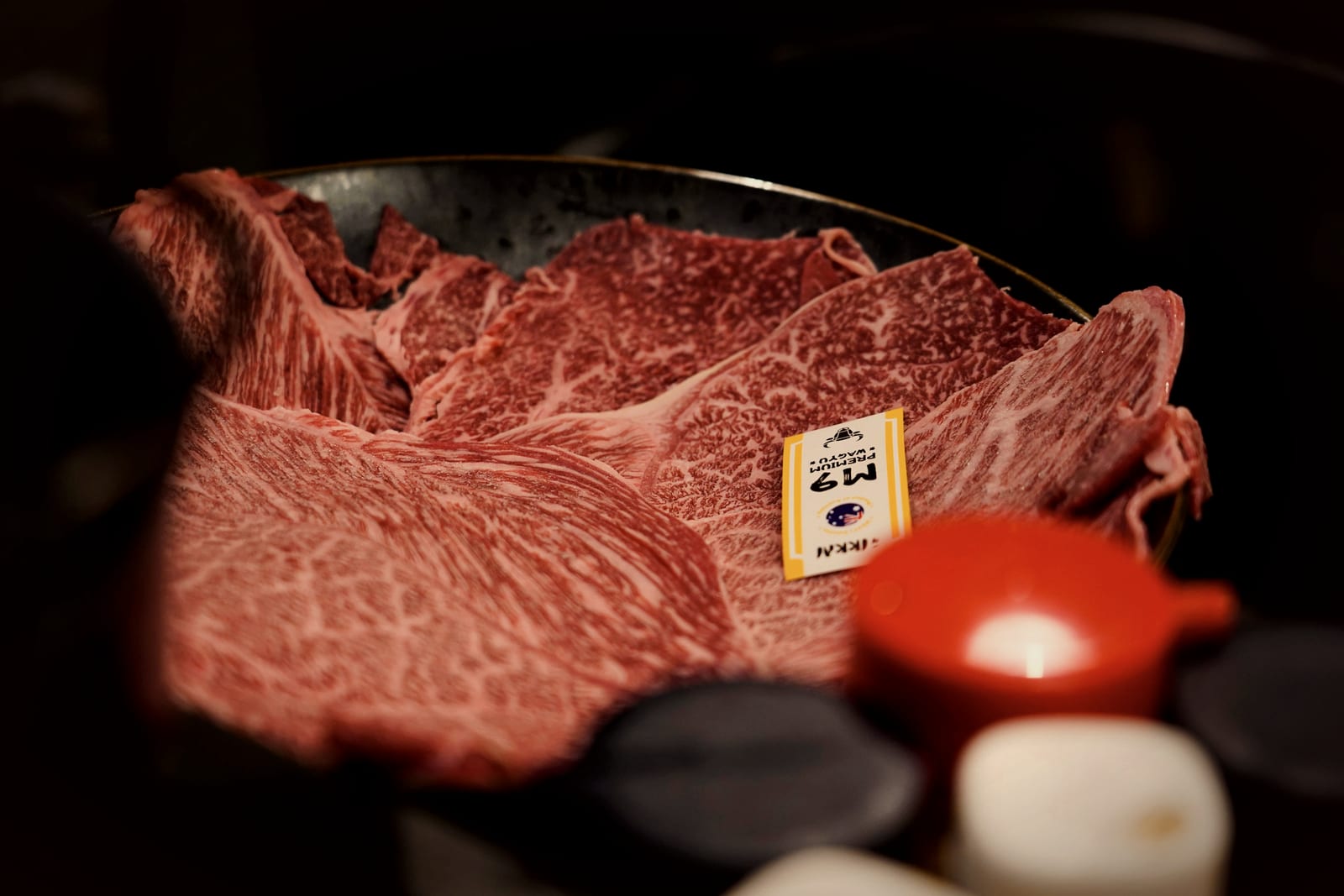
A brand, not a breed or a grade
Kobe is not a breed and not a grade. It is a regional brand — one of more than a hundred in Japan — applied to a narrow subset of Wagyu. The name comes from the port city of Kobe, the capital of Hyōgo Prefecture, where foreign residents in the late nineteenth century helped make local beef famous.
The animals are Tajima cattle, a strain of Japanese Black long bred in the mountainous north of Hyōgo. Isolated valleys and strict local breeding kept the line closed for generations, and Tajima bulls later became foundation sires for many other Japanese brands, including Matsusaka and Ōmi. The meat is known for very fine marbling, a low fat melting point and a sweet, rich aroma when cooked.
A port name since 1868, exported from 2012
Tajima cattle were draught animals for rice farming for centuries. When Kobe opened to foreign trade in 1868, residents from Britain and elsewhere sought out local cattle for meat, and “Kobe beef” became the name for cattle shipped through the port. In the twentieth century the Tajima line was selected for meat quality, and in 1983 producers, meat traders and local government founded the Kobe Beef Marketing & Distribution Promotion Association to define and protect the name.
For most of its history Kobe beef was not exported at all. The first exports began in 2012, and since then only small volumes have gone to a limited list of approved markets. Japan registered Kobe beef under its Geographical Indication Act in 2015, and the brand has trademark protection in a number of other countries.
How it’s certified
To carry the name, an animal and its carcass must satisfy every one of the association’s criteria. The main rules are summarised below; the association publishes the authoritative version.
| Criterion | Requirement |
|---|---|
| Bloodline | Purebred Tajima cattle with a registered pedigree |
| Birth and rearing | Born and fattened in Hyōgo by a registered producer |
| Sex | Heifer (cow that has not calved) or steer |
| Slaughter | At a designated slaughterhouse in Hyōgo Prefecture |
| Yield grade | A or B (JMGA) |
| Meat quality | Grade 4 or 5, with a Beef Marbling Standard (BMS) of 6 or higher |
| Carcass weight | Within the association’s upper limit (around 500 kg) |
The Nojigiku stamp and a ten-digit number
Certified carcasses receive the association’s chrysanthemum stamp, the Nojigiku, the prefectural flower of Hyōgo. Each animal carries a ten-digit individual identification number used in Japan’s national cattle traceability system; with it, anyone can look up the animal’s birth date, farm and slaughter date. Restaurants and shops authorised to sell Kobe beef usually display a certificate and, often, a bronze statue of a bull.
Within Japan, “Tajima beef” (Tajima-gyu) is the broader name for Tajima-line cattle raised in Hyōgo; Kobe beef is the share of it that meets the higher grade thresholds. “Kobe-style”, “Kobe-type” or “American Kobe” are not Kobe beef: the terms are marketing language for Wagyu or Wagyu-cross cattle raised elsewhere.
Among the most counterfeited food names
Kobe is among the most counterfeited food names in the world. Between 2010 and 2012, for example, the United States did not allow imports of Japanese beef at all, yet “Kobe” burgers, sliders and steaks were widely sold there. In many countries the word was, and sometimes still is, applied to Wagyu crossbreds or to any highly marbled beef.
The only reliable checks are documentary: the ten-digit identification number, a certificate from the association, and a seller on the association’s list of authorised outlets. Price is a weak guide; genuine Kobe is costly, but high price does not prove authenticity.
Not all A5 is Kobe
All A5 is Kobe. A5 is a grade from the Japan Meat Grading Association that any carcass in Japan can earn. Kobe requires a specific bloodline, place and minimum grade; much A5 beef is not Kobe, and some Kobe beef is graded 4 rather than 5.
Kobe cattle are fed beer and massaged. These are stories rather than standard practice; nothing in the certification rules involves them.
Frequently asked questions
Is Kobe beef the same as Wagyu?
All Kobe beef is Wagyu, but very little Wagyu is Kobe. Kobe is a protected brand for Tajima-line Japanese Black cattle from Hyōgo that meet strict grade criteria.
How can you tell if Kobe beef is real?
Ask for the ten-digit identification number and the association’s certificate; genuine carcasses bear the Nojigiku chrysanthemum stamp and are sold through authorised outlets.
Can you buy real Kobe beef outside Japan?
Yes, in small quantities, since exports began in 2012, but only through approved importers and registered restaurants or shops.
Is Kobe beef always A5?
No. Kobe requires quality grade 4 or 5 with BMS 6 or higher and yield grade A or B, so a Kobe carcass can be A4, B4, A5 or B5.
Sources
4
- Japan Meat Grading Association. Beef Carcass Grading Standard. Tokyo, 1988 (rev. 2014). www.jmga.or.jp
- Kobe Beef Marketing & Distribution Promotion Association. Definition of Kobe Beef (certification criteria). Kobe.
- Ministry of Agriculture, Forestry and Fisheries of Japan (MAFF). Geographical Indication Protection System: registered products — Kobe Beef. Tokyo, 2015.
- Gotoh, Takafumi; Nishimura, Takanori; Kuchida, Keigo; Mannen, Hideyuki. "The Japanese Wagyu beef industry: current situation and future prospects — A review." Asian-Australasian Journal of Animal Sciences 31, no. 7 (2018): 933–950.
Related