Main course · France, the bistro
Steak au poivre
Steak au poivre is a pan-seared steak pressed into coarsely crushed black peppercorns, with a sauce built in the same pan from its browned juices, cognac, stock and cream. The pepper toasts in the fat; the cream rounds off its heat.
At a glance
- Origin
- France, early 20th century
- Cut
- Tenderloin, striploin or ribeye
- Serves
- 2
- Time
- 25 min
- Medium-rare
- 54–57 °C / 129–135 °F core
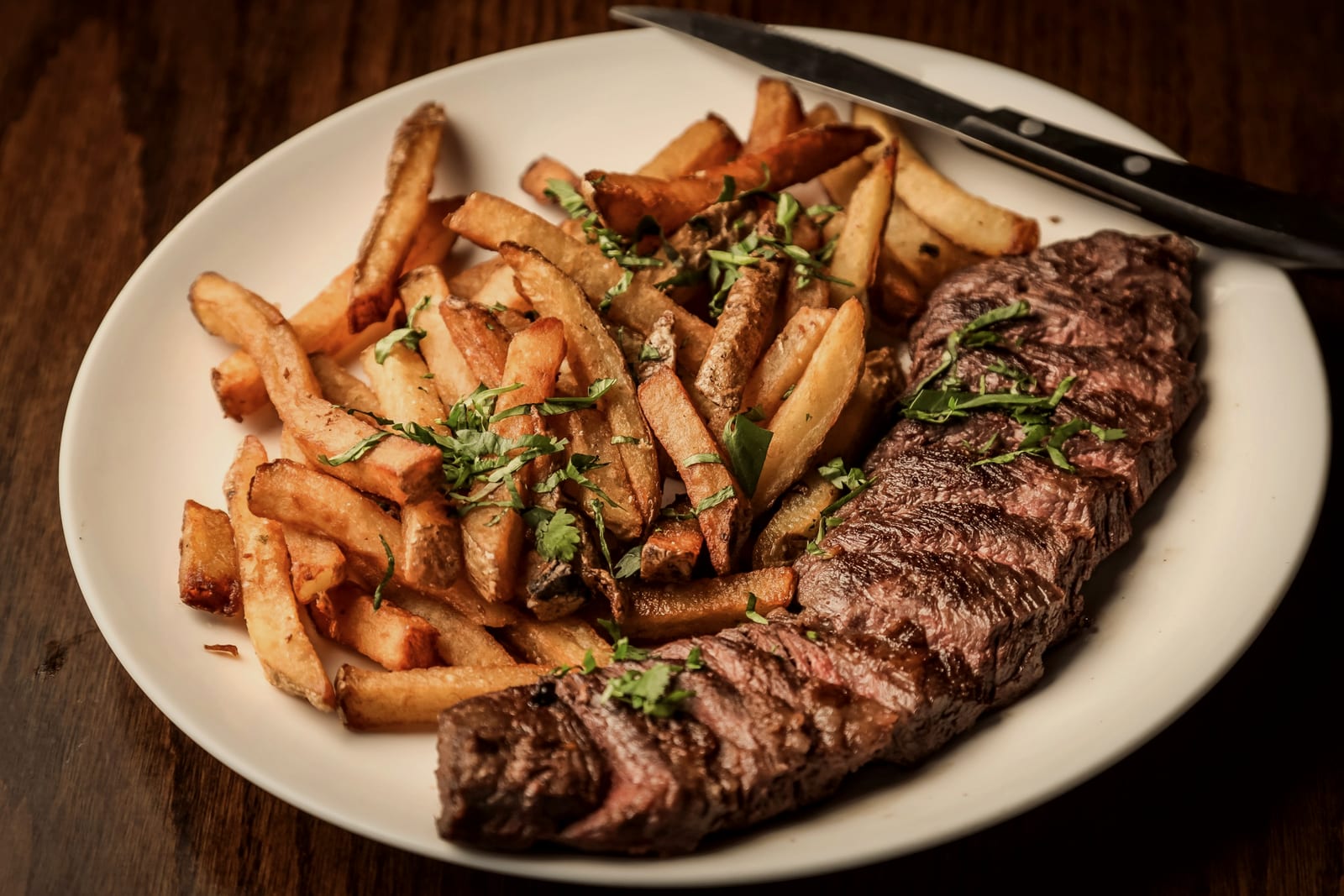
A crust of crushed pepper
The dish is defined by its crust: whole black peppercorns, crushed coarsely rather than ground, pressed onto both faces of the steak before it is seared. The pepper toasts in the fat and the pan juices become the base of the sauce, which is flamed or reduced with cognac and finished with cream or stock.
It is a bistro dish, cooked to order in a heavy frying pan. The usual cuts are tenderloin (filet au poivre), striploin (contre-filet) or ribeye (entrecôte), 2.5–4 cm / 1–1½ in thick.
Paris, early 1900s — or so it is told
Several Parisian restaurants of the early 20th century claimed the invention, and none of those claims is documented beyond the restaurants' own accounts. Peppered beef is much older; what is new in the 20th-century dish is the pan sauce of cognac and cream.
Larousse Gastronomique records steak au poivre as a classic of French cookery, and Julia Child, Louisette Bertholle and Simone Beck included it in Mastering the Art of French Cooking (1961), which spread it to English-speaking kitchens. In the United States it was a fixture of mid-century French restaurants.
Ingredients
| Ingredient | Amount | Note |
|---|---|---|
| Beef steaks | 2 × 250 g / 9 oz | about 3 cm / 1¼ in thick |
| Black peppercorns | 2 tbsp / 15 g | crushed coarsely |
| Coarse salt | to taste | |
| Neutral oil | 1 tbsp / 15 ml | high smoke point |
| Butter | 30 g / 1 oz | divided |
| Shallot | 1, about 40 g / 1½ oz | finely chopped |
| Cognac or brandy | 60 ml / ¼ cup | |
| Beef or veal stock | 120 ml / ½ cup | or demi-glace, 60 ml / ¼ cup |
| Double (heavy) cream | 120 ml / ½ cup | |
| Dijon mustard | 1 tsp | optional |
Method
- Take the steaks out of the refrigerator 30 minutes before cooking. Crush the peppercorns in a mortar or under a heavy pan; sift out the fine powder, which burns and makes the sauce bitter.
- Salt the steaks and press the crushed pepper firmly into both faces.
- Heat the oil in a heavy pan over high heat. Sear the steaks 3–4 minutes per side for medium-rare, adding half the butter for the last minute and basting. Check with a thermometer: 52 °C / 126 °F in the pan reaches about 55 °C / 131 °F after resting. Transfer to a warm plate.
- Pour off most of the fat, lower the heat and soften the shallot for 1 minute in the remaining butter.
- Off the heat, add the cognac; return to the heat and flame it carefully, or simply let it reduce by half.
- Add the stock and reduce by half, then the cream and the mustard; simmer until the sauce coats a spoon, about 2 minutes. Add the resting juices from the plate and adjust the salt.
- Serve the steaks with the sauce poured over or alongside.
Green, white and pink pepper
Green peppercorns (poivre vert), brined or dried, give a milder, fruitier sauce and were popularized in France in the 1970s. A mixed-pepper version adds white and pink berries (the latter are not true pepper). Some cooks omit the cream and finish with butter and veal stock for a lighter sauce au poivre. The same sauce is served on its own with grilled steak as a sauce au poivre, alongside béarnaise as one of the steakhouse's standard sauces.
Frites, salad and a hot plate
The classic accompaniment is frites or sautéed potatoes and a green salad or green beans. Common mistakes: ground pepper instead of crushed (the crust burns and the sauce turns harsh), a pan that is not hot enough (the pepper falls off before the crust forms), and flaming the cognac with the pan on the flame and the bottle open.
Frequently asked questions
What cut is best for steak au poivre?
Tenderloin is the traditional choice; striploin and ribeye are equally classic and have more beefy flavor.
Do you have to flambé steak au poivre?
No. Flaming burns off alcohol quickly, but reducing the cognac by half gives the same result more safely.
Why is my peppercorn sauce bitter?
Usually because the pepper was ground too fine and burned, or the pan was too hot when the shallot and cognac went in.
Can steak au poivre be made without cognac?
Yes: brandy, bourbon or simply more stock can replace it; the flavor will be less fruity.
Sources
3
- Larousse Gastronomique, rev. ed. London: Hamlyn, 2009.
- McGee, Harold. On Food and Cooking: The Science and Lore of the Kitchen, rev. ed. New York: Scribner, 2004.
- Child, Julia; Bertholle, Louisette; Beck, Simone. Mastering the Art of French Cooking, vol. 1. New York: Knopf, 1961.
Related