Cut · Rib, the marbled steak
Ribeye
The ribeye is cut from the rib: the eye of the longissimus, the spinalis cap curled over it and a seam of fat between the two. That fat bastes the steak from inside as it cooks — the reason the cap is the most prized bite, and the reason most grading systems judge the whole carcass on this cut.
Key takeaways
- 83.9 % of each whole piece ended up usable: the highest of the 7 cuts we have measured.
- Per kilo bought it gives about 810 g of portions (81 % of the weight).
- 9.4 % is fat trimmed off. Measured on 61 pieces, 341.2 kg in total.
Measured by Steakpedia · Steakpedia Field Kitchen
At a glance
- Primal
- Rib (ribs 6–12)
- Muscles
- Longissimus dorsi (eye), spinalis dorsi (cap), complexus
- Steak weight
- 250–400 g boneless · 500 g–1 kg bone-in
- Best cooked
- Medium-rare to medium, 54–57 °C / 129–135 °F
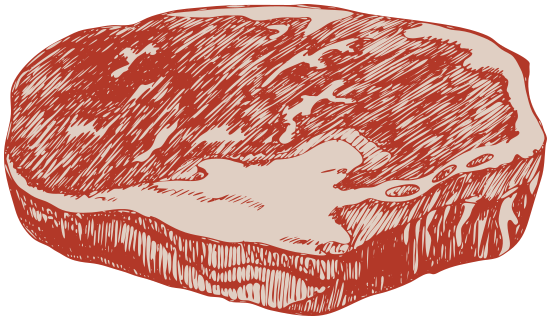 Ribeye
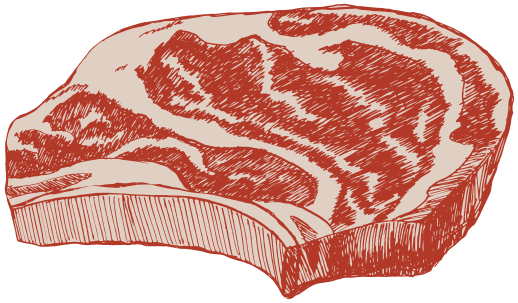 Cowboy steak
Eye, cap and seam
The ribeye is cut from the rib primal, the section between the chuck and the short loin, usually ribs six to twelve. Its centre is the longissimus dorsi, the long back muscle that does little work and stays tender. Around the top sits the spinalis dorsi, the thin, intensely marbled cap that many cooks rank above the eye itself. Between the two runs a seam of fat that bastes the steak as it cooks.
Because it carries more intramuscular fat than any other steak muscle, the ribeye is the reference cut for grading: the USDA assigns quality grades on the ribeye surface between the twelfth and thirteenth ribs, and the Japanese BMS scale reads marbling on the same muscle between the sixth and seventh ribs. When a grader says a carcass is Prime or BMS 10, they are describing this cross-section.
Boneless, the whole muscle is called a ribeye roll or cube roll and is sliced into steaks of 250–400 g. Bone-in, the same steak is a rib steak or côte de bœuf; with the full rib bone left long and cleaned it becomes a tomahawk.
Ribs six to twelve
The rib primal sits on the back of the animal between the shoulder (chuck) and the loin. Ribeye from the chuck end (ribs 6–8) has a larger cap, the complexus and more seams of fat; towards the loin end (ribs 10–12) the eye grows and the cap thins, until past the thirteenth rib the muscle continues as the striploin. Butchers speak of the “chuck end” and the “loin end”, and a loin-end steak can look almost like a striploin with a small cap.
In American butchery the rib is one of the eight primals and is sold as a ribeye roll (IMPS 112A) or as bone-in rib steaks (IMPS 1103). In the Australian system it arrives as a cube roll (boneless) or a rib set (bone-in). In the Argentine cut map the same region yields the bife ancho, cut bone-in across the ribs, and its boneless version, the ojo de bife.
The ribeye cap (spinalis)
The cap is the thin, curved muscle that wraps the top of the ribeye, the spinalis dorsi. It is widest at the chuck end and thins towards the loin; lifted off a whole ribeye roll in one piece, it is roughly 40 cm long, 20 cm wide and 2–3 cm thick. It carries the most marbling of any part of the steak and is the reason many cooks prefer chuck-end ribeyes.
Taken off whole, it is rolled and tied into rib cap steaks or a small roast, and it sells for more per kilo than the ribeye it came from; the eye left behind is sold as a cap-off ribeye or ribeye filet. Names on menus and labels: rib cap, cap of ribeye or spinalis (United States), かぶり kaburi or リブキャップ (Japan), 새우살 saeu-sal (Korea). Being thin, it cooks hot and fast, to medium-rare.
How many steaks in a whole ribeye
Across 61 boneless ribeye rolls broken down by the Steakpedia Field Kitchen between July and October 2026, 341 kg in total, the average roll weighed 5.6 kg and 81% of its weight became steaks. That is about 18 steaks of 250 g, 15 of 300 g or 11 of 400 g per roll. The rest was 9.4% fat, 2.3% trim that is still usable (for burgers or stock) and small losses: counting the trim, 83.9% of the roll was usable.
The figure moves with the specification and the grade: a lip-on roll with heavy fat cover yields less, a closely trimmed export cube roll yields more, and the more cap left on each steak, the fewer steaks per roll. Bone-in, the steak count drops: 14 frenched bone-in rib sections cut as tomahawks in the same kitchen gave 71% of their weight as steaks, at an average of 1.1 kg each.
Fig. 1
Where one kilo of ribeye goes
Share of the whole piece by weight, %. 61 pieces measured.
Portions 81 %Other usable meat 2.9 %Fat 9.4 %Silverskin, sinew, loss 6.7 %
| Part | % | Per kg | Used for |
|---|---|---|---|
| Steaks | 81% | ≈ 810 g | Ribeye steaks |
| Other usable meat | 2.9% | ≈ 29 g | Trim for burgers, mince, stock |
| Fat | 9.4% | ≈ 94 g | Rendered or discarded |
| Silverskin, sinew, loss | 6.7% | ≈ 67 g | Discarded |
Ribeye vs striploin vs tenderloin
The three premium steaks come from two muscles. Ribeye and striploin are the same long back muscle at two points along the spine; the tenderloin is a different muscle that lies under the backbone and does almost no work. The usable share below is measured on whole pieces broken down in the same kitchen: the tenderloin loses more because its side muscle and tail are trimmed off.
Fig. 2
Usable meat, cut by cut
Usable share of each whole piece after trimming, %. n = pieces measured.
| Ribeye | Striploin | Tenderloin | |
|---|---|---|---|
| Muscle | Longissimus + spinalis cap | Longissimus | Psoas major |
| Where | Rib, ribs 6–12 | Short loin, behind the ribs | Under the backbone, loin |
| Fat | Highest: cap and seam | Medium: fat edge | Lowest |
| Eating | Juicy, rich, tender | Firmer, beefier chew | Softest, mildest |
| Usable (measured) | 83.9% · 61 rolls | 78.2% · 11 loins | 72.2% · 38 whole tenderloins |
| Steaks per kg bought (measured) | ≈ 810 g | ≈ 772 g | ≈ 570 g |
| Other names | Scotch fillet, entrecôte, Delmonico | New York strip, sirloin (UK), porterhouse (AU) | Filet mignon, fillet, eye fillet (AU) |
Cooking it: high heat, then a rest
The ribeye forgives heat. Its fat protects the muscle, so it is the steak most often cooked to medium rather than rare: intramuscular fat begins to soften and render around 50–55 °C / 122–131 °F, and a ribeye pulled at 54–57 °C / 129–135 °F core, after a rest, eats more generously than one pulled at 50 °C / 122 °F, where the fat is still waxy.
Thick steaks (3 cm and up) benefit from a two-stage cook: a gentle start in a low oven, over indirect coals or in a water bath, and a hard sear at the end to brown the surface. Thin steaks go straight onto a very hot grill or pan. The cap and the eye finish at different rates; carving the cap off and slicing it separately is a common restaurant practice.
On an Argentine parrilla the bife ancho is cooked bone-in over embers, salted coarsely before it goes on, turned once and served without sauce. In Japan the same muscle, cut thin, is a standard cut for sukiyaki and shabu-shabu.
The tomahawk
The tomahawk is a bone-in ribeye with the rib bone left 12–20 cm long and scraped clean (frenched). The meat is the same as a rib steak; the long bone adds weight and presentation, not flavour. It is usually cut 5–6 cm thick, weighs 1–1.5 kg and is cooked like any thick ribeye: slowly first, seared at the end, carved off the bone.
Choosing one at the counter
Marbling is the main thing to look at, and every system reads it on this muscle: USDA Prime and Choice, MSA marbling scores in Australia, BMS 1–12 in Japan. Beyond the grade, look for an even, cream-white fat seam, a well-formed cap and firm, dry-looking meat; a steak sitting in purge (red liquid) has lost moisture.
Thickness matters more than weight: a ribeye under 2.5 cm is hard to sear without overcooking the centre, and 3–4 cm is the usual restaurant thickness. Ask for the end you want: chuck-end steaks for more cap and fat, loin-end steaks for a larger, leaner eye. Dry-aged ribeye (21–45 days) loses moisture and gains a deeper, nutty flavour; the trimmed crust is part of its price.
Names around the world
25
The same muscle, named by language and by trade system.
| English | Ribeye · rib-eye · Delmonico · tomahawk (long bone) |
| Tiếng Việt | Thăn lưng (ribeye) · tomahawk |
| Español | Ojo de bife · bife ancho · tomahawk |
| 한국어 | 꽃등심 (kkotdeungsim) · 립아이 |
| 日本語 | リブロース (ribu rōsu) · リブアイ |
| Français | Entrecôte · côte de bœuf (avec os) |
| Italiano | Costata · entrecôte |
| Русский | Рибай |
| 中文 | 肉眼 (ròuyǎn) · 眼肉 · 肉眼扒 |
| Português | Bife ancho · entrecôte |
| Deutsch | Ribeye · Entrecôte · Hochrippe (mit Knochen) |
| ไทย | ริบอาย (rip-ai) |
| العربية | ريب آي (rib āy) |
All the cuts' names, country by country →
Trade and national systems
| System | Name | Reference |
|---|---|---|
| United States | Ribeye · Delmonico · rib steak (bone-in) · cowboy / tomahawk (long bone) | IMPS 112A / 1103 |
| United Kingdom | Rib-eye · fore rib (bone-in roast) | AHDB |
| Australia / NZ | Cube roll · scotch fillet · rib eye (bone-in: rib set, OP rib) | HAM 2244 |
| Argentina | Ojo de bife · bife ancho (bone-in rib steak) · ancho | IPCVA |
| Brazil | Bife ancho · entrecôte · ancho | Portaria 5/88 |
| France | Entrecôte (boneless) · côte de bœuf (bone-in) | Larousse |
| Japan | リブロース (ribu rōsu) · リブアイ | JMGA |
| Canada | Rib eye · rib steak (bone-in) · prime rib (roast) | Canada Beef |
| South Africa | Rib-eye · prime rib (bone-in) | |
| South Korea | 꽃등심 kkot-deungsim (front) · 아랫등심 (rear) · 새우살 saeu-sal (cap) | KAPE |
| China · Hong Kong · Taiwan | 肉眼 ròuyǎn · 眼肉 (trade) · 肉眼扒 (Hong Kong menus) | |
| Gulf (UAE, Saudi Arabia) | ريب آي (rib āy) · ribeye / scotch fillet on imported labels |
Field data
Numbers measured in a working kitchen, piece by piece, not taken from a table. Another kitchen, another trimming specification, another number. How field data is collected.
Field data
Ribeye (cube roll)
Steakpedia Field Kitchen1 Jul 2026 – 21 Oct 2026
Field data
Ribeye, bone-in (tomahawk)
Steakpedia Field Kitchen1 Jul 2026 – 20 Oct 2026
Frequently asked questions
Ribeye vs striploin: what is the difference?
Both are the same long back muscle, the longissimus. The ribeye comes from the rib section and carries a marbled cap and a fat seam; the striploin comes from behind the ribs and is a single, firmer, leaner muscle.
What is the ribeye cap?
The spinalis dorsi, the thin muscle that curves around the top of the ribeye. It is the most marbled part of the steak and is sometimes sold on its own as ribeye cap or rib cap steak.
Is a tomahawk a ribeye?
Yes. A tomahawk is a bone-in ribeye with the whole rib bone left long and cleaned. The meat is identical; only the bone and the thickness change.
What is a Delmonico steak?
A historic American name, from the New York restaurant, used today mostly for a boneless ribeye. It has been applied to other cuts over time, so the name alone does not define the steak.
Is ribeye a good cut of steak?
It is the most marbled of the premium steaks and the muscle graders use to judge the whole carcass, so it is the safest choice for flavour and juiciness. For a leaner, firmer steak choose striploin; for the softest and mildest, tenderloin.
What is the “poor man's ribeye”?
Usually the chuck eye: the same back muscle continued into the chuck, just in front of the ribeye. It tastes similar and costs less, but it is less even and a whole chuck gives only a few of them.
Is scotch fillet the same as ribeye?
Yes. In Australia and New Zealand the boneless ribeye is sold as scotch fillet (trade name cube roll, HAM 2244); there, “rib eye” often means the bone-in steak.
Ribeye vs rib steak: what is the difference?
The meat is the same. A ribeye is boneless; a rib steak, bone-in ribeye or côte de bœuf keeps the rib bone, and a tomahawk keeps it long and cleaned.
How many steaks are in a whole ribeye?
About 18 steaks of 250 g from an average 5.6 kg boneless roll, measured across 61 rolls; or 15 of 300 g, or 11 of 400 g. 81% of the roll's weight became steaks.
Ribeye or filet mignon?
Ribeye for flavour and juiciness; tenderloin (filet mignon) for the softest texture. The ribeye carries far more intramuscular fat; the tenderloin is the leanest of the premium steaks.
Sources
7
- USDA Agricultural Marketing Service. Institutional Meat Purchase Specifications: Fresh Beef Series 100. Washington, DC, 2014. www.ams.usda.gov/sites/default/files/media/IMPS_100_Fresh_Beef%5B1%5D.pdf
- AUS-MEAT Limited. Handbook of Australian Meat, 7th ed. (International Red Meat Manual). Brisbane, 2005. www.ausmeat.com.au
- USDA Agricultural Marketing Service. United States Standards for Grades of Carcass Beef. 2017. www.ams.usda.gov/grades-standards/carcass-beef-grades-and-standards
- Japan Meat Grading Association. Beef Carcass Grading Standard. Tokyo, 1988 (rev. 2014). www.jmga.or.jp
- Instituto de Promoción de la Carne Vacuna Argentina (IPCVA). Cortes de carne vacuna argentina — nomenclatura y usos. Buenos Aires. www.ipcva.com.ar
- McGee, Harold. On Food and Cooking: The Science and Lore of the Kitchen, rev. ed. New York: Scribner, 2004.
- Steakpedia Field Kitchen. Butchery records, July–October 2026: 279 sheets, 1,604.6 kg of meat processed, weighed piece by piece on a calibrated scale and logged per cut. Open data, CC BY 4.0. steakpedia.com/field-data
Related