Cut · Rump cap, fat on
Picanha
Picanha is the cap of the rump — the biceps femoris, cooked under its own layer of fat. Over the fire the fat renders, crisps and seasons the lean meat beneath; it is the first cut carved at a Brazilian churrascaria, and in the United States it is sold as top sirloin cap or coulotte.
Key takeaways
- 63.8 % of each whole piece ended up usable: number 7 of the 7 cuts we have measured.
- Per kilo bought it gives about 577 g of portions (57.7 % of the weight).
- 16.9 % is fat trimmed off. Measured on 28 pieces, 139.8 kg in total.
Measured by Steakpedia · Steakpedia Field Kitchen
At a glance
- Primal
- Sirloin / rump (top sirloin butt)
- Muscles
- Biceps femoris (the cap), with its external fat
- Weight
- 1–1.5 kg (2.2–3.3 lb) trimmed
- Fat cap
- 1–2 cm, left on
- Best cooked
- Grill, skewer, roast; up to medium
A triangle under a cap of fat
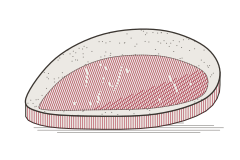
The picanha is the triangular muscle that covers the top of the rump, the biceps femoris cap, with its layer of fat left on. A trimmed piece weighs 1–1.5 kg (2.2–3.3 lb). The fat cap, 1–2 cm thick, is the point of the cut: it renders onto the meat as it cooks and is served with it.
The cut became famous in Brazil, where it is the first thing a churrascaria carves at the table, curved onto a skewer with the fat outside. Argentina calls it tapa de cuadril and treats it as a grill cut. In the United States it was usually left attached to the top sirloin or sold as a coulotte roast until Brazilian steakhouses made the name picanha familiar in the 1990s and 2000s.
The grain runs the length of the triangle, so the piece is cut into steaks across it, 3–4 cm thick, each with its own strip of fat. It is often compared with the tri-tip, its neighbour at the base of the rump: both are triangular, both are grill cuts, but the tri-tip has no fat cap and a grain that changes direction.
On top of the rump
The rump sits over the hip, between the loin and the round. The picanha is its uppermost layer, the muscle under the hand placed on top of the animal just in front of the tail. Below it lies the rump proper (gluteus medius), sold as rump steak in Australia and the United Kingdom and as top sirloin in the United States; in front of it is the striploin; at its lower edge, towards the belly, the tri-tip.
In Australian and British butchery it is separated as the rump cap (HAM 2091). In American boxed beef it is a sub-primal of the top sirloin butt, specified as IMPS 184D. In Argentina it is lifted off the cuadril as a single piece, and in Brazil the federal standard for beef cuts lists it separately from the alcatra, the Brazilian rump.
Cooking it: fat side to the fire first
The fat cap decides the method. Whole, the piece is roasted or grilled fat side towards the heat first, until the fat is rendered and crisp, then turned. On a rotisserie or a Brazilian skewer the fat bastes the meat continuously: the classic churrascaria preparation cuts the piece into three or four thick slices, folds each into a C shape with the fat outside, and skewers them over hot coals. Cut into individual steaks, each is grilled over strong heat with the fat edge rendered first.
Under its fat it is a lean muscle, so it should not go past medium: 52–56 °C / 126–133 °F at the core after a rest, which is medium-rare. Thick pieces carry over several degrees off the heat. The meat is sliced across the grain in thin slices. Coarse salt alone is the tradition in both Brazil and Argentina, often applied only just before or during cooking.
Choosing one: size and fat
Size is the first check. A picanha above about 1.5 kg usually includes part of the muscle beneath it, which is tougher, and experienced buyers reject it; Brazilian butchers describe a good piece as one whose fat cap is even and whose meat ends in a clean point. The fat should be white to cream, 1–2 cm thick and continuous across the surface, without deep cuts made during boning.
Outside Brazil and Argentina the cut may be labelled rump cap, top sirloin cap, coulotte or culotte. Steaks sold as coulotte steak are sometimes trimmed of their fat, which removes most of what defines the cut. In vacuum packs from Australia and South America it travels well and is commonly sold chilled, whole and untrimmed, which leaves the choice of fat thickness to the cook.
How much steak a picanha gives
Across 28 butchery sheets kept by the Steakpedia Field Kitchen between July and October 2026, 140 kg of picanha in total, 57.7% of the weight became steaks and 16.9% came off as fat; counting usable trim, 63.8% was usable.
Put per kilo bought, a picanha gives less steak than the loin cuts, which matters when comparing prices: a picanha at the same price per kilo as a ribeye roll is the more expensive steak on the plate. Per kilo bought, a ribeye roll gives about 810 g of steaks, a striploin 772 g, a picanha 577 g and a tenderloin 570 g. A 1.2 kg picanha gives about 700 g of steaks and some 70 g of trim.
Fig. 1
Where one kilo of picanha goes
Share of the whole piece by weight, %. 28 pieces measured.
Portions 57.7 %Other usable meat 6.1 %Fat 16.9 %Silverskin, sinew, loss 19.3 %
| Part | % | Per kg | Used for |
|---|---|---|---|
| Steaks | 57.7% | ≈ 577 g | Picanha steaks, skewers |
| Other usable meat | 6.1% | ≈ 61 g | Trim for skewers, burgers, mince |
| Fat | 16.9% | ≈ 169 g | Rendered or discarded |
| Silverskin, sinew, loss | 19.3% | ≈ 193 g | Discarded |
Fig. 2
Usable meat, cut by cut
Usable share of each whole piece after trimming, %. n = pieces measured.
Names around the world
19
The same muscle, named by language and by trade system.
| English | Picanha |
| Tiếng Việt | Picanha |
| Español | Picaña |
| 한국어 | 피카냐 |
| 日本語 | ピッカーニャ |
| Français | Picanha |
| Italiano | Picanha |
| Русский | Пиканья |
| 中文 | 臀盖 |
All the cuts' names, country by country →
Trade and national systems
| System | Name | Reference |
|---|---|---|
| United States | Top sirloin cap · coulotte / culotte · picanha | IMPS 184D |
| United Kingdom | Rump cap · picanha | AHDB |
| Australia / NZ | Rump cap · picanha | HAM 2091 |
| Argentina | Tapa de cuadril · picaña | IPCVA |
| Brazil | Picanha | Portaria 5/88 |
| France | Aiguillette de rumsteck (approx.) | Larousse |
| Japan | イチボ (ichibo) | JMGA |
| Canada | Top sirloin cap · picanha | Canada Beef |
| Uruguay | Picaña · tapa de cuadril | INAC |
| Portugal | Picanha |
Field data
Numbers measured in a working kitchen, piece by piece, not taken from a table. Another kitchen, another trimming specification, another number. How field data is collected.
Field data
Picanha (rump cap)
Steakpedia Field Kitchen3 Jul 2026 – 17 Oct 2026
Frequently asked questions
What is picanha?
The cap muscle on top of the beef rump (biceps femoris), sold with its fat layer on. It is the best-known cut of Brazilian churrasco.
Picanha vs tri-tip: what is the difference?
Both come from the rump. Picanha is the top cap, with a thick fat layer and a single grain direction; tri-tip is at the bottom of the rump, lean, with a grain that changes direction across the piece.
Is picanha the same as sirloin cap or coulotte?
Yes. Top sirloin cap and coulotte are American names for the same muscle; in Britain and Australia it is the rump cap.
Should you cut the fat off picanha?
Not before cooking. The fat cap protects the lean muscle and seasons it as it renders; it can be trimmed on the plate.
What is picanha called in the US?
Top sirloin cap or coulotte (also culotte), from the IMPS 184D specification. Supermarkets and warehouse clubs, Costco included, usually label it top sirloin cap; Brazilian steakhouses and specialist butchers use picanha.
Is picanha a good cut of steak?
Yes, for grilling and roasting with its fat on: it is tender for a rump muscle and very flavourful. Without its fat cap, or cooked past medium, it is an ordinary lean steak.
Picanha vs ribeye: which is better?
Ribeye is more marbled and more tender inside the muscle; picanha is leaner meat under a thick cap of fat, with a stronger beef flavour. Measured per kilo bought, a ribeye roll gives about 810 g of steaks and a picanha about 577 g.
Why is picanha expensive?
Each animal has only two, of 1–1.5 kg each, and demand from Brazilian-style restaurants is high. A fair share of the piece is fat: 16.9% of the weight came off as fat in our measurements.
How many people does a picanha feed?
A whole 1.2 kg picanha gives about 700 g of steaks once trimmed, enough for three or four people as a main course; as part of a churrasco with other meats, it goes further.
Sources
6
- USDA Agricultural Marketing Service. Institutional Meat Purchase Specifications: Fresh Beef Series 100. Washington, DC, 2014. www.ams.usda.gov/sites/default/files/media/IMPS_100_Fresh_Beef%5B1%5D.pdf
- AUS-MEAT Limited. Handbook of Australian Meat, 7th ed. (International Red Meat Manual). Brisbane, 2005. www.ausmeat.com.au
- Instituto de Promoción de la Carne Vacuna Argentina (IPCVA). Cortes de carne vacuna argentina — nomenclatura y usos. Buenos Aires. www.ipcva.com.ar
- Brasil, Ministério da Agricultura, SIPA. Portaria nº 5, de 8 de novembro de 1988 — Padronização de cortes de carne bovina.
- McGee, Harold. On Food and Cooking: The Science and Lore of the Kitchen, rev. ed. New York: Scribner, 2004.
- Steakpedia Field Kitchen. Butchery records, July–October 2026: 279 sheets, 1,604.6 kg of meat processed, weighed piece by piece on a calibrated scale and logged per cut. Open data, CC BY 4.0. steakpedia.com/field-data
Related