Main course · Britain, en croûte
Beef Wellington
Beef Wellington is a tenderloin coated in mushroom duxelles, wrapped in prosciutto or a crêpe, enclosed in puff pastry and baked. The pastry needs a hot oven and the beef must stay medium-rare, so it goes in chilled and out by thermometer.
At a glance
- Origin
- Britain / USA, 20th century
- Cut
- Centre-cut beef tenderloin
- Serves
- 6
- Time
- 1 h active + 1 h chilling + 40 min oven
- Target core
- 52 °C / 126 °F out of the oven
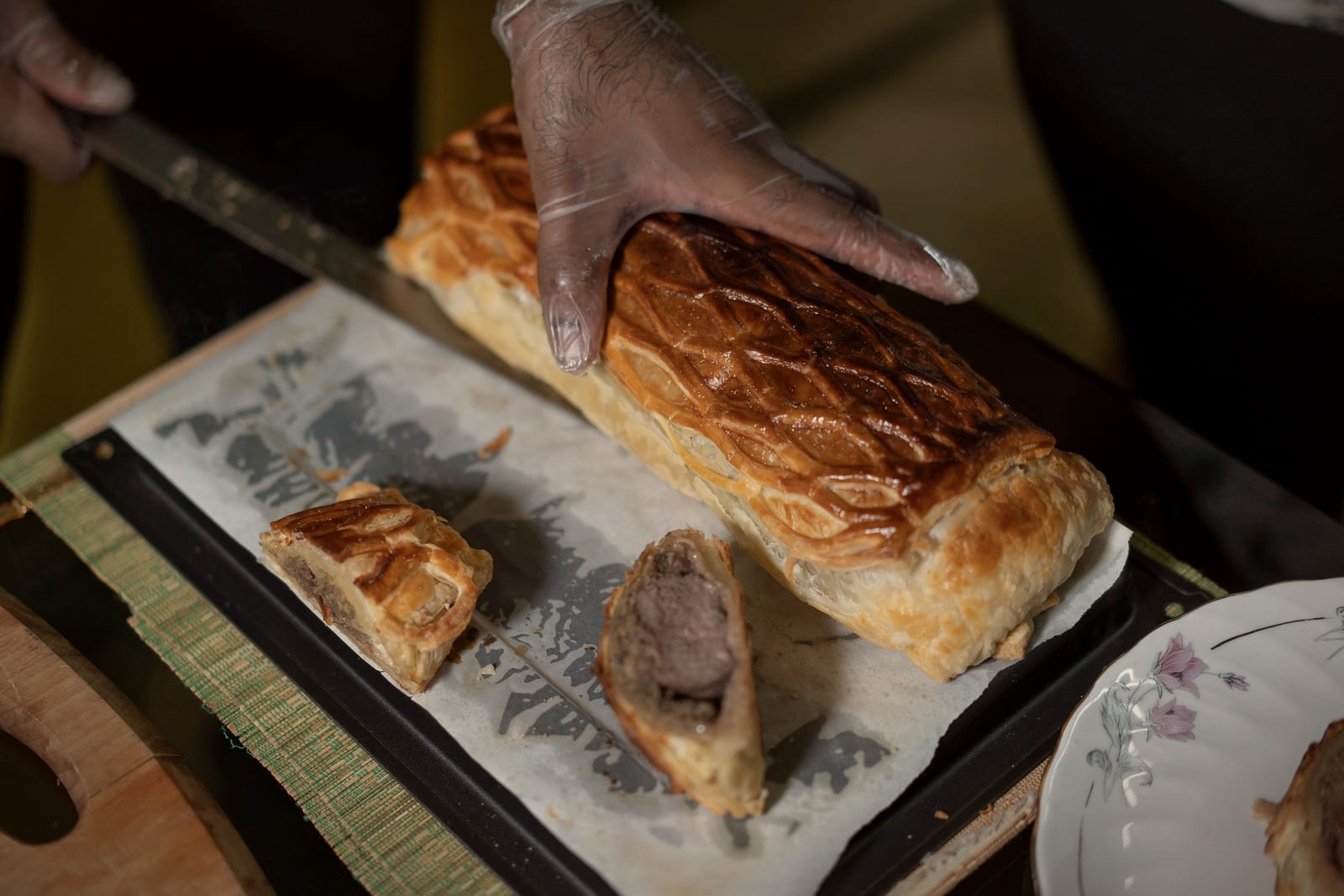
Pastry, ham, duxelles, beef
A Wellington is a piece of tenderloin of even thickness, seared, brushed with mustard, covered with a dry paste of mushrooms and shallots (duxelles), wrapped in a moisture barrier — cured ham or a thin crêpe — and baked inside puff pastry. It is sliced at the table into thick rounds, each one a ring of pastry around rosy beef.
The challenge is technical: the pastry needs a hot oven, while the meat inside must not pass medium-rare. The dish is therefore built cold, chilled before baking and checked with a probe thermometer.
Not the Duke's, and French at heart
Despite the name, there is no documentary evidence that the dish was created for Arthur Wellesley, 1st Duke of Wellington, after Waterloo (1815). Food historians, including the Oxford Companion to Food, note that the name appears in print only in the 20th century, and the dish became fashionable in the United States in the 1960s.
Its technique is older and French: meat baked in a crust (en croûte) appears in classical cookery, and Larousse Gastronomique describes filet de bœuf en croûte. The duxelles itself is a French preparation attributed to the 17th-century cook La Varenne.
Ingredients
| Ingredient | Amount | Note |
|---|---|---|
| Beef tenderloin, centre cut | 1 kg / 2.2 lb | trimmed of silverskin, even thickness |
| Button or chestnut mushrooms | 500 g / 1.1 lb | for the duxelles |
| Shallots | 2, about 60 g / 2 oz | finely chopped |
| Thyme | 2 sprigs | leaves only |
| Prosciutto or thin crêpes | 8–10 slices / 2 crêpes | moisture barrier |
| English or Dijon mustard | 2 tbsp / 30 g | brushed on the seared beef |
| All-butter puff pastry | 500 g / 1.1 lb | rolled to 3–4 mm |
| Egg yolks | 2 | beaten with 1 tbsp water, for glazing |
| Salt, black pepper, oil | as needed |
Method
- Season the tenderloin with salt and pepper and sear it on all sides in a very hot pan, 1 minute per side. Cool and brush with mustard.
- For the duxelles, chop the mushrooms finely and cook them with the shallots and thyme in a dry pan until all liquid has evaporated and the paste holds together, 15–20 minutes. Cool completely.
- On plastic film, lay out the prosciutto (or crêpes) in overlapping rows, spread the duxelles over it, place the beef on top and roll tightly. Twist the ends and chill for 30 minutes.
- Roll out the pastry, unwrap the beef, place it on the pastry and enclose it, sealing the seam underneath. Trim the excess so the ends are not thick. Chill for another 30 minutes.
- Glaze with egg yolk, score the top lightly and sprinkle with coarse salt. Bake at 200 °C / 400 °F for 35–40 minutes, until the pastry is deep golden and the core reads 52 °C / 126 °F.
- Rest for 10 minutes; carryover cooking brings the centre to about 55–57 °C / 131–135 °F (medium-rare). Slice with a serrated knife, 2–3 cm / 1 in thick.
Single portions, foie gras, salmon
Individual Wellingtons use tenderloin steaks of 180–200 g / 6–7 oz and bake for 18–25 minutes. Some versions add a layer of pâté de foie gras over the beef, as in filet de bœuf en croûte à la française. Lamb, venison and salmon are prepared the same way; vegetarian versions replace the beef with beetroot or mushrooms.
Madeira sauce and something green
Serve with a red wine or Madeira sauce, or a simple jus, and a green vegetable. Common mistakes: a wet duxelles, which makes the pastry soggy; a tenderloin of uneven thickness, which cooks unevenly; skipping the chilling; and judging doneness by time alone instead of with a thermometer (see the doneness temperatures above).
Frequently asked questions
How do you keep the bottom of a beef Wellington from getting soggy?
Cook the duxelles until completely dry, use a barrier of prosciutto or crêpe, chill the parcel before baking and bake on a preheated tray.
What temperature should beef Wellington be?
Take it out of the oven at about 52 °C / 126 °F; after resting it reaches 55–57 °C / 131–135 °F, medium-rare.
Was beef Wellington named after the Duke of Wellington?
That is the common story, but there is no 19th-century evidence; the name is documented only in the 20th century.
Can beef Wellington be made ahead?
It can be assembled and refrigerated, wrapped, up to 24 hours before baking. Add a few minutes to the baking time if it goes into the oven cold.
Sources
4
- Larousse Gastronomique, rev. ed. London: Hamlyn, 2009.
- McGee, Harold. On Food and Cooking: The Science and Lore of the Kitchen, rev. ed. New York: Scribner, 2004.
- USDA Food Safety and Inspection Service. Safe Minimum Internal Temperature Chart. 2023. www.fsis.usda.gov/food-safety/safe-food-handling-and-preparation/food-safety-basics/safe-temperature-chart
- Davidson, Alan. The Oxford Companion to Food, 3rd ed. (ed. Tom Jaine). Oxford: Oxford University Press, 2014.
Related