Buying guide · One bone, two widths
T-bone vs porterhouse
A T-bone and a porterhouse are the same cut: a steak sawn across the short loin, with the striploin on one side of the vertebra and the tenderloin on the other. What separates them is one measurement. Under the USDA purchase specifications, a porterhouse has a tenderloin at least 1.25 in (32 mm) wide and a T-bone at least 0.5 in (13 mm), which places the porterhouse at the hip end of the loin.
Buying guides written to the same standard as the rest of Steakpedia: tested or sourced, never ranked by payment. Some links may earn a commission; it never changes what we recommend.
At a glance
- T-bone
- Short loin, middle; tenderloin ≥ 13 mm (IMPS 1174)
- Porterhouse
- Short loin, hip end; tenderloin ≥ 32 mm (IMPS 1173)
- Measured
- Widest point of the tenderloin, parallel to the backbone
- Australia / NZ
- “Porterhouse” = boneless striploin steak
- Pull at
- 50–54 °C / 122–129 °F in the strip side (both)
- Field data
- Bone-in short loin: 77.4 % steaks, bone included (28 loins)
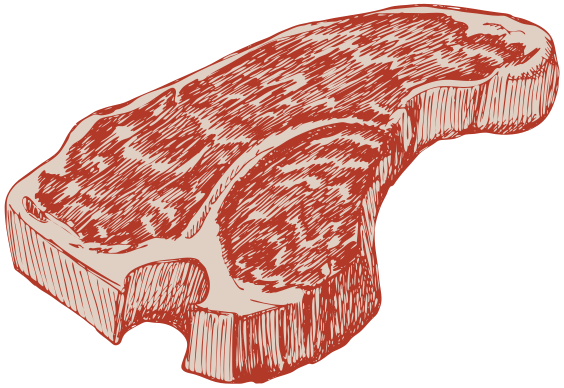 T-bone
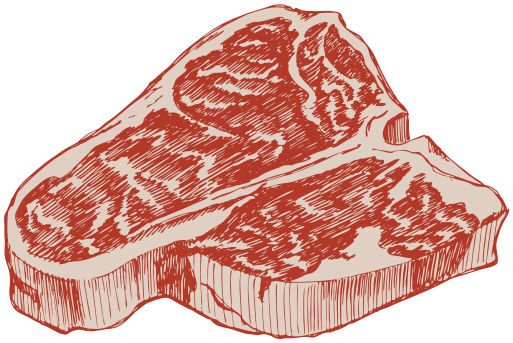 Porterhouse
What is the rule that separates them?
The line is drawn by the Institutional Meat Purchase Specifications (IMPS) of the United States Department of Agriculture. Both steaks “shall be prepared from any IMPS short loin item”, and the only difference in their descriptions is the width of the tenderloin, taken at its widest point and measured parallel to the length of the backbone.
The striploin side does not count: it is about the same size in both. A steak whose tenderloin is narrower than 13 mm meets neither description and is normally sold as a bone-in strip steak or club steak (IMPS 1179 covers the bone-in strip loin steak).
| T-bone | Porterhouse | |
|---|---|---|
| IMPS item | 1174 · Beef Loin, T-Bone Steak | 1173 · Beef Loin, Porterhouse Steak |
| Tenderloin width | 0.5 in / 13 mm or more, under 1.25 in | 1.25 in / 32 mm or more |
| How it is measured | Widest point, parallel to the backbone | Widest point, parallel to the backbone |
| Muscles | Longissimus lumborum + psoas major | Longissimus lumborum + psoas major |
| Position in the short loin | Middle, towards the ribs | Hip end |
| Usually sold as | A steak for one | A larger steak, often sold for two |
| Price, relative | Lower per kilo | Usually higher per kilo |
Where along the short loin is each one cut?
The short loin runs from the 13th rib to the front of the hip. The tenderloin under the backbone is thick at the hip end and tapers towards the ribs, so the same loin gives three kinds of bone-in steak in a row.
From the rib end, the first steaks carry little or no tenderloin and are sold as bone-in strip or club steaks; the middle gives T-bones, with a small round of tenderloin; the hip end gives porterhouses, with a large one. Only the few steaks from that end of each loin meet the 32 mm width, which is why a porterhouse is scarcer than a T-bone and usually costs more: the extra weight is in the tenderloin, the most expensive muscle of the animal.
The rule says nothing about thickness. Porterhouses are often cut thicker because they are sold as a steak for two, but a thin steak from the hip end is still a porterhouse, and a thick one from the middle is still a T-bone.
Does “porterhouse” mean the same steak everywhere?
No. The 32 mm rule is an American purchasing specification; elsewhere the word follows local usage, and in Australia and New Zealand it names a different steak altogether.
In Australian and New Zealand butchery a “porterhouse” is a boneless striploin steak, cut from the striploin (HAM 2140) that Americans call New York strip; the bone-in steak with the tenderloin attached is sold there as a T-bone. In Britain, where the striploin is the sirloin and the tenderloin the fillet, the bone-in steak is sold as T-bone or porterhouse, and the name has historically been used for both sizes.
| Name | Where | What it is |
|---|---|---|
| T-bone · porterhouse | United States, Canada | Bone-in short loin; the porterhouse has a tenderloin of 32 mm or more |
| T-bone · porterhouse | United Kingdom, Ireland | Bone-in short loin, sirloin and fillet on the bone |
| T-bone | Australia, NZ | Bone-in short loin |
| Porterhouse | Australia, NZ | A boneless striploin steak, with no bone and no tenderloin |
| Bistecca alla fiorentina | Italy (Tuscany) | A T-bone or porterhouse 4–5 cm thick, 1–1.5 kg |
| T-bone · bife con lomo | Argentina | Bone-in short loin |
| Chuletón | Spain | Not a T-bone: a thick bone-in rib steak |
Are they cooked differently?
No: both are cooked the same way and taken off at 50–54 °C / 122–129 °F, measured in the striploin side close to the bone. The difficulty is the same in both, only larger in the porterhouse, which has more tenderloin to protect.
The lean tenderloin cooks faster than the striploin, and the bone slows the meat next to it. The usual answer is to place the steak with the tenderloin side away from the strongest heat. Steaks 4 cm or thicker do well with a two-stage cook, gentle heat first and a hard sear at the end, as in the reverse sear; thinner ones go straight onto a hot grill or pan. The Tuscan bistecca alla fiorentina, 4–5 cm thick, is grilled over embers and served rare.
To serve, each muscle is cut off the bone in one piece, sliced across the grain and laid back against the bone. Doneness targets for each muscle are in Steak temperatures.
How much steak does a short loin give?
Across 28 bone-in short loins (266.5 kg) broken down by the Steakpedia Field Kitchen, 77.4 % of the weight bought became steaks, weighed with their bone: T-bones and porterhouses from the centre and boneless strip steaks from the ends.
Per kilo of short loin, that is about 775 g of bone-in steak; 8.9 % was fat and about 11.5 % was trimmed bone, sinew and loss. The records do not separate T-bones from porterhouses, so there is no measured figure for the share of each. Because the vertebra stays in the steak, a kilo of either gives noticeably less meat on the plate than a kilo of boneless steak.
Frequently asked questions
What is the difference between a T-bone and a porterhouse?
Only the size of the tenderloin. Both are cut across the short loin with the bone in; under the USDA specification a porterhouse has a tenderloin at least 1.25 in (32 mm) wide and a T-bone at least 0.5 in (13 mm).
Is a porterhouse just a big T-bone?
Yes, in the American sense: it is a T-bone from the hip end of the short loin, where the tenderloin is widest. It is often cut thicker as well, but thickness is not part of the rule.
What is a porterhouse in Australia?
A boneless striploin steak, the cut Americans call New York strip. The bone-in steak with the tenderloin is sold in Australia and New Zealand as a T-bone.
Is a fiorentina a T-bone or a porterhouse?
It can be either. The bistecca alla fiorentina is defined by thickness and weight, 4–5 cm and 1–1.5 kg, and is cut across the short loin with the bone in.
Which costs more, T-bone or porterhouse?
Usually the porterhouse, because it carries more tenderloin and only the few steaks from the hip end of each short loin qualify.
Keep reading
- Cut · Short loin, two musclesT-boneStriploin and tenderloin on one bone — the porterhouse and the fiorentina.
- Cut · Short loin, one muscleStriploinOne muscle, one grain, one strip of fat — the New York strip, UK sirloin and bife de chorizo.
- Cut · Loin, the psoasTenderloinThe psoas: the most tender, leanest premium cut — filet mignon, chateaubriand, lomo.
- Buying guide · One thick pieceSteak for two: cuts to share and how to cook themChateaubriand, côte de bœuf, porterhouse, tomahawk: weights, reverse-sear temperatures and carving.
Sources
8
- USDA Agricultural Marketing Service. Institutional Meat Purchase Specifications: Fresh Beef Series 100. Washington, DC, 2014. www.ams.usda.gov/sites/default/files/media/IMPS_100_Fresh_Beef%5B1%5D.pdf
- AUS-MEAT Limited. Handbook of Australian Meat, 7th ed. (International Red Meat Manual). Brisbane, 2005. www.ausmeat.com.au
- Meat & Livestock Australia. Australian Beef — cuts and cooking methods. www.australianbeef.com.au/know-your-meat/beef-cuts (archive.org)
- Agriculture and Horticulture Development Board (UK). Beef Meat Purchasing Guide. Kenilworth, 2016. ahdb.org.uk
- Accademia della Fiorentina. Disciplinare della Bistecca alla Fiorentina. Florence.
- Instituto de Promoción de la Carne Vacuna Argentina (IPCVA). Cortes de carne vacuna argentina — nomenclatura y usos. Buenos Aires. www.ipcva.com.ar
- McGee, Harold. On Food and Cooking: The Science and Lore of the Kitchen, rev. ed. New York: Scribner, 2004.
- Steakpedia Field Kitchen. Butchery records, July–October 2026: 279 sheets, 1,604.6 kg of meat processed, weighed piece by piece on a calibrated scale and logged per cut. Open data, CC BY 4.0. steakpedia.com/field-data