Cooking · Five to ten minutes
Resting steak
Resting is leaving a steak off the heat for a few minutes before cutting it. As the heat evens out between surface and centre the core rises by 1–8 °C / 2–14 °F, and less juice runs onto the board when the steak is sliced; the gain is real but smaller than often claimed, levels off after 5–10 minutes and costs some crust.
At a glance
- Typical rest
- 3–10 min, by thickness
- Core rise
- 1–8 °C / 2–14 °F
- Where
- On a rack, uncovered or loosely tented
- Not needed after
- Sous vide, reverse sear
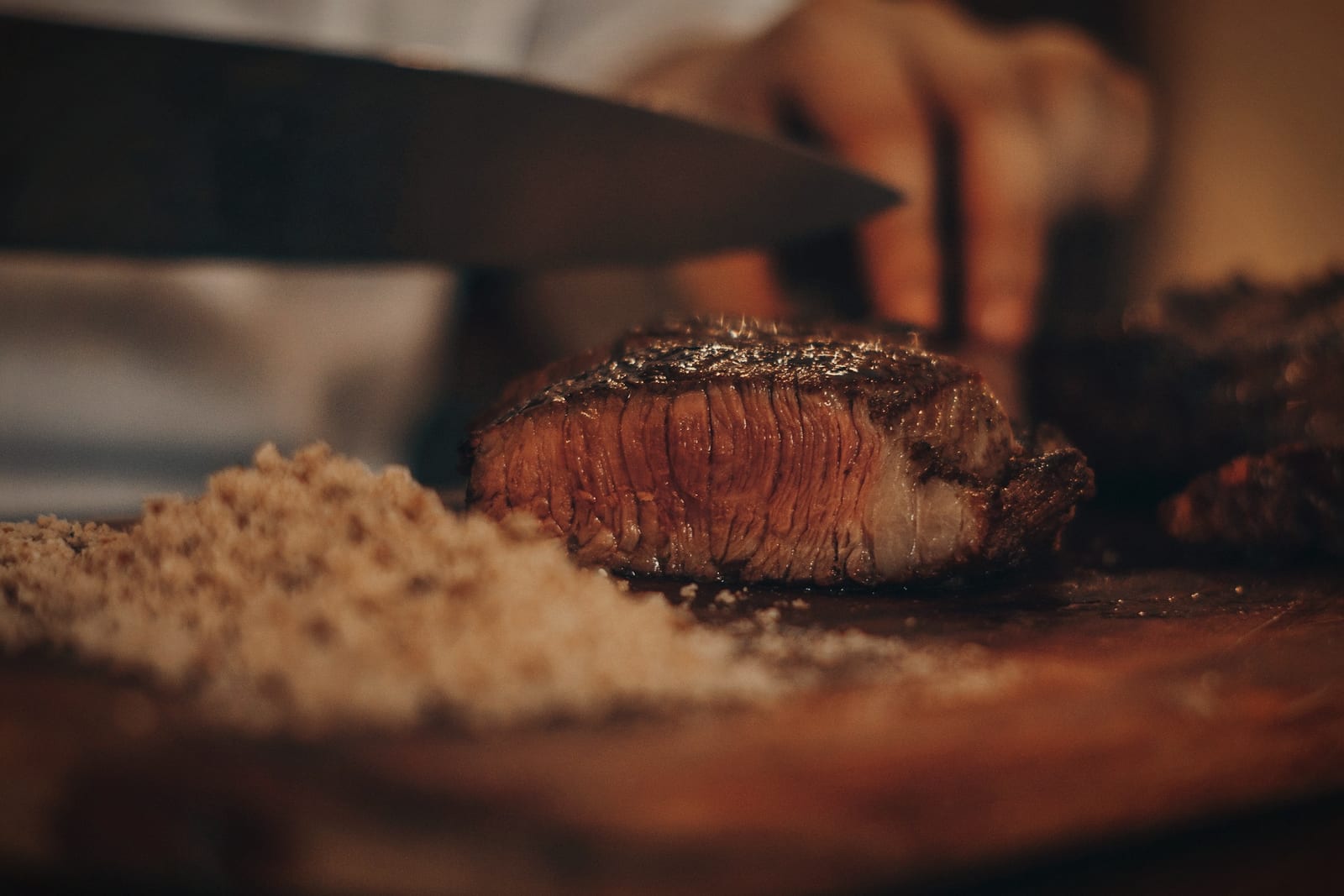
A pause towards an even temperature
Resting is the pause between taking a steak off the heat and cutting it. It is among the most repeated pieces of kitchen advice, usually justified by the claim that the juices "redistribute" or are "reabsorbed". The underlying physics is simpler: a steak just off the heat is far from equilibrium, with a very hot surface and a cooler centre, and resting lets it move towards an even temperature before it is cut.
Heat moves in, juices thicken
Two things happen. First, heat moves inward. The outer layers keep giving heat to the centre, which is the carryover that pushes the core up by 1–2 °C / 2–4 °F in a thin steak and up to 5–8 °C / 9–14 °F in a thick one cooked over fierce heat, while the surface cools. The rest is therefore part of cooking, and it is the reason steaks are pulled before their target.
Second, the juices thicken slightly as they cool. The liquid in cooked meat is water carrying dissolved proteins, gelatin and salts; as the outer layers cool from well above 70 °C / 158 °F, that liquid becomes a little more viscous and the contracted fibres relax a little, so less of it flows out when the meat is cut. There is no significant "reabsorption" in the literal sense: what has left the cells does not go back in, but more of it stays where it is.
What measurements show
Controlled kitchen tests, including those published by J. Kenji López-Alt, consistently find that a steak cut straight from the pan loses visibly more juice on the board than an identical steak rested for several minutes, and that the difference shrinks the longer the rest lasts, levelling off after about 5–10 minutes for a typical steak. Other writers, notably Meathead Goldwyn, point out that the steak also drips while resting, that the total weight lost by cooking is decided mainly by the core temperature reached, and that a long rest softens the crust and lets the steak cool. Both observations are correct: resting reduces juice on the plate, not the overall cooking loss, and the gain is modest compared with the effect of not overcooking.
How long
| Steak | Rest | Note |
|---|---|---|
| Thin, 1–2 cm / ½–¾ in | 2–3 min | Little carryover; serve quickly or it cools |
| Medium, 2.5–4 cm / 1–1½ in | 5 min | The usual case |
| Thick, 5 cm / 2 in and bone-in | 8–10 min | Watch the core: rest until it stops rising |
| Large roasts | 15–30 min | Carryover can exceed 8 °C 14 °F |
| After sous vide or reverse sear | 0–2 min | Already even; little stored heat |
Step by step
- Pull the steak a few degrees below the target, according to its thickness and the heat used.
- Set it on a wire rack, not flat on a board or plate, so that the underside does not steam in its own juice and soften.
- Leave it uncovered, or tent it loosely with foil if the room is cold; wrapping it tightly traps steam and spoils the crust.
- Rest until the core has stopped rising, about 5 minutes for a typical steak; a probe left in shows the moment.
- If the crust has softened, return the steak to a very hot pan for 15–30 seconds per side just before slicing.
- Slice across the grain, and pour any juice from the tray over the slices.
Foil, cold plates and long waits
Resting the steak on a cold plate in a pool of its juice, which softens the underside. Wrapping it tightly in foil. Pulling it at the final temperature and resting it, which carries it past the target. Resting a thin steak for ten minutes until it is lukewarm. Resting steaks cooked by sous vide or reverse sear, which gains nothing. And believing the rest will rescue an overcooked steak: the juice that matters was lost in the pan.
Frequently asked questions
How long should you rest a steak?
About 5 minutes for a 2.5–4 cm / 1–1½ in steak, 2–3 minutes for thin steaks and 8–10 minutes for very thick or bone-in ones.
Why do you rest steak?
So that the temperature evens out and the juices thicken slightly as the outside cools; less juice runs out when the steak is cut.
Should you cover a resting steak with foil?
Only loosely, if at all. Wrapping it tightly traps steam and softens the crust; a rack and no cover is usually best.
Does a steak keep cooking while resting?
Yes. The core rises by 1–2 °C / 2–4 °F in thin steaks and up to 5–8 °C / 9–14 °F in thick steaks cooked over high heat.
Sources
4
- McGee, Harold. On Food and Cooking: The Science and Lore of the Kitchen, rev. ed. New York: Scribner, 2004.
- Myhrvold, Nathan; Young, Chris; Bilet, Maxime. Modernist Cuisine: The Art and Science of Cooking. Bellevue: The Cooking Lab, 2011.
- López-Alt, J. Kenji. The Food Lab: Better Home Cooking Through Science. New York: W. W. Norton, 2015.
- Goldwyn, Meathead; Blonder, Greg. Meathead: The Science of Great Barbecue and Grilling. Boston: Houghton Mifflin Harcourt, 2016.
Related