Cut · Loin, the psoas
Tenderloin
The tenderloin is the psoas, a muscle that barely works: fine grain, little connective tissue, the most tender on the animal. Lean and mild, it is best rare to medium-rare — filet mignon, chateaubriand, the Argentine lomo.
Key takeaways
- 72.2 % of each whole piece ended up usable: number 6 of the 7 cuts we have measured.
- Per kilo bought it gives about 570 g of portions (57 % of the weight).
- 8.7 % is fat trimmed off. Measured on 38 pieces, 226.3 kg in total.
Measured by Steakpedia · Steakpedia Field Kitchen
At a glance
- Primal
- Loin (inside the short loin and sirloin, under the spine)
- Muscles
- Psoas major, with psoas minor and iliacus (the side muscle or “chain”)
- Weight
- Whole 2–3.5 kg trimmed · steaks 150–250 g
- Best cooked
- Rare to medium-rare, 48–54 °C / 118–129 °F
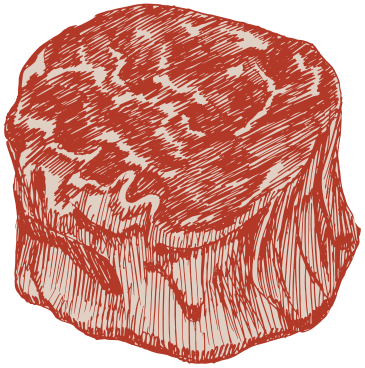 Filet mignon
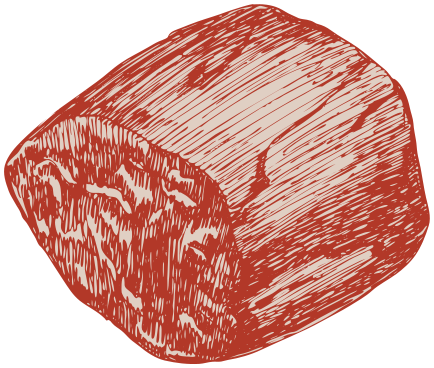 Chateaubriand
Tender because it barely works
The tenderloin is the psoas major, a long tapering muscle that lies inside the carcass along the underside of the lumbar vertebrae, from the hip to the thirteenth rib. It is not a locomotion muscle, so it has very little connective tissue and a fine grain; this is what makes it tender, and also what makes it mild. It carries little marbling in most breeds, and even in highly marbled Wagyu it is the leanest of the premium steaks.
A whole tenderloin weighs 2–3.5 kg trimmed and has three parts: the head (butt end, the thick end near the hip, with the iliacus attached), the centre (the even cylinder that becomes filet mignon and chateaubriand), and the tail (the thin end, usually folded back and tied, or used for medallions and tartare). Along its length runs the chain, a strip of side muscle that is removed and used for mince, stir-fries or stock.
Because it is the least abundant premium cut, around 2 per cent of carcass weight, it has long been the most expensive per kilo. It is also the cut where trimming matters most: the silverskin, the chain and the fat around the head take a significant share of the untrimmed piece.
Inside the backbone
The muscle lies on the inside of the backbone, so it never appears on the outside of the carcass. When the short loin is cut bone-in, the tenderloin is the small round eye on the inner side of a T-bone or porterhouse; the porterhouse is defined by having a larger cross-section of tenderloin than a T-bone. Its thick head end continues back under the sirloin, which is why taking out T-bones and porterhouses leaves only the head and tail of the tenderloin to sell whole.
Removed whole, it is sold as a full tenderloin with or without the side muscle (IMPS 189A is side muscle on, defatted) or in Australia as a tenderloin or eye fillet (HAM 2150). In Argentina the lomo is removed whole and cooked whole or in thick medallions; in France the centre is cut into tournedos and filets, and the thick part roasted as chateaubriand.
Filet mignon, fillet or eye fillet: one muscle, many names
The tenderloin is the same muscle everywhere, but the names on menus and butcher counters describe different pieces of it, and one Australian name means a different steak altogether. In the United States “tenderloin” is the whole muscle and “filet mignon” a steak cut from it; in the UK both are “fillet”; in Australia and New Zealand it is the “eye fillet”, while a “Scotch fillet” is the ribeye.
Fig. 1
Where one kilo of tenderloin goes
Share of the whole piece by weight, %. 38 pieces measured.
Portions 57 %Other usable meat 15.2 %Fat 8.7 %Silverskin, sinew, loss 19.1 %
| Name | Where | What you get |
|---|---|---|
| Tenderloin | United States, Canada, Singapore | The whole muscle, or a roast from it |
| Filet mignon | United States, Canada | A round steak from the centre or the thinner end |
| Chateaubriand | France, and menus worldwide | A thick piece from the centre, for two or more |
| Tournedos | France | Small thick steaks from the centre |
| Fillet · fillet steak | UK, Ireland | The tenderloin, or steaks from it |
| Eye fillet | Australia, NZ | The tenderloin |
| Scotch fillet | Australia, NZ | A different cut: the ribeye |
| Lomo | Argentina, Uruguay | The tenderloin |
| Solomillo | Spain | The tenderloin |
| Filete | Mexico | The tenderloin |
| Filé mignon | Brazil | The whole tenderloin |
| Filet · Rinderfilet | France, Germany | The tenderloin |
| ヒレ hire | Japan | The tenderloin |
| 안심 ansim | South Korea | The tenderloin |
| 牛柳 niúliǔ · 菲力 fēilì | China · Hong Kong, Taiwan, Singapore | The tenderloin (菲力 on steak menus) |
How much steak a whole tenderloin gives
Across 38 breakdowns of whole, untrimmed tenderloin (side muscle on) by the Steakpedia Field Kitchen between July and October 2026, 226.3 kg in total, 57% of the weight bought became steaks, the lowest share of any cut measured (a boneless striploin gives 77.2%). The muscle itself is not wasted: what costs weight is everything around it.
Fig. 2
Usable meat, cut by cut
Usable share of each whole piece after trimming, %. n = pieces measured.
| Part | % | Per kg | Used for |
|---|---|---|---|
| Steaks | 57% | ≈ 570 g | Filet mignon, medallions, chateaubriand |
| Other usable meat | 15.2% | ≈ 150 g | Chain, tail and head trim: tartare, carpaccio, stir-fries, mince |
| Fat | 8.7% | ≈ 90 g | Rendered or discarded |
| Silverskin, sinew, loss | ≈ 19% | ≈ 190 g | Discarded |
A little over half of it as steak
Count on a little over half the weight as steak and about another sixth as meat for raw and quick dishes. A 7 lb (3.2 kg) untrimmed tenderloin gives about 1.8 kg of steaks, eight of 8 oz, and about 500 g of trim, enough for tartare or carpaccio for four to six.
The yield varies widely, between 31.5% and 95.7% of steaks per breakdown, depending on how much fat and side muscle the piece arrives with. This is why the price per kilo of an untrimmed tenderloin means little until the trimming is counted: a whole tenderloin pays only if it costs well under 60% of the price per kilo of ready-cut steaks, or if the trim is used rather than thrown away.
Cooking it: rare, before it dries out
With little fat and little collagen, the tenderloin has nothing to gain from long or hot cooking: it is best rare to medium-rare (48–54 °C / 118–129 °F core) and dries out quickly past medium. Thick steaks, 4–5 cm, are seared hard on all faces and finished gently; the whole muscle, tied to an even thickness, is roasted at moderate heat or cooked in a water bath and then browned.
Its mild flavour is why the classic preparations add fat and salt from outside: bacon-wrapped filet, beef Wellington, tournedos Rossini, béarnaise. Raw, it is the standard cut for steak tartare and carpaccio. In Vietnam and much of East Asia thin slices are flash-cooked in hot broth or stir-fried; on an Argentine parrilla the lomo is cooked whole or butterflied, sometimes wrapped in its own fat or in caul.
Three ways to buy it
Tenderloin is sold in three states, and the price per kilo differs for each: untrimmed (PSMO, peeled side muscle on, still with fat and silverskin), trimmed with the chain removed, and as ready-cut centre steaks. The untrimmed piece is cheaper per kilo, but the trimming loss has to be counted before comparing prices.
Look for a fine grain, a deep red colour and firm meat; marbling is less important here than on a ribeye or striploin, though grade still shows in juiciness. For even steaks, ask for the centre: the head is wider and looser, the tail thin. A tenderloin is rarely dry-aged on its own, since it has no fat cover to protect it; aged tenderloin usually comes from a short loin aged on the bone.
Names around the world
21
The same muscle, named by language and by trade system.
| English | Tenderloin · fillet · eye fillet · filet mignon |
| Tiếng Việt | Thăn nội (tenderloin) |
| Español | Lomo (Argentina) · solomillo (España) · filete (México) |
| 한국어 | 안심 (ansim) |
| 日本語 | ヒレ (hire) · テンダーロイン |
| Français | Filet |
| Italiano | Filetto |
| Русский | Вырезка |
| 中文 | 牛柳 (niúliǔ) · 菲力 (fēilì) |
| Português | Filé mignon |
All the cuts' names, country by country →
Trade and national systems
| System | Name | Reference |
|---|---|---|
| United States | Tenderloin · filet mignon (centre steaks) · chateaubriand (centre roast) | IMPS 189A |
| United Kingdom | Fillet · fillet steak | AHDB |
| Australia / NZ | Tenderloin · eye fillet | HAM 2150 |
| Argentina | Lomo | IPCVA |
| Brazil | Filé mignon | Portaria 5/88 |
| France | Filet · tournedos · chateaubriand | Larousse |
| Japan | ヒレ (hire) · テンダーロイン | JMGA |
| South Korea | 안심 (ansim) | KAPE |
| China · Hong Kong · Singapore | 牛柳 niúliǔ (trade) · 菲力 fēilì (menus, from “fillet”) | |
| Spain | Solomillo | |
| Germany | Filet · Rinderfilet |
Field data
Numbers measured in a working kitchen, piece by piece, not taken from a table. Another kitchen, another trimming specification, another number. How field data is collected.
Field data
Tenderloin
Steakpedia Field Kitchen1 Jul 2026 – 20 Oct 2026
Frequently asked questions
Is filet mignon the same as tenderloin?
Filet mignon is a steak cut from the tenderloin, usually from the thinner centre-to-tail section, 3–5 cm thick. All filet mignon is tenderloin; not every piece of tenderloin is filet mignon.
What is chateaubriand?
A thick roast or steak for two or more cut from the centre of the tenderloin, traditionally 400–600 g, roasted or grilled and carved at the table, classically served with béarnaise.
Tenderloin vs ribeye: which is better?
They are different. The tenderloin is the most tender and the leanest; the ribeye is fattier and has more flavour. The choice depends on whether tenderness or richness matters more.
Why is tenderloin so expensive?
Each animal has only two, about 2 per cent of carcass weight together, and they lose a significant share of weight in trimming. Demand for the most tender cut is high everywhere.
How many filet mignon steaks are in a whole tenderloin?
Measured across 38 untrimmed tenderloins, 57% of the weight becomes steaks, about 570 g per kilo, and another 15% is trim for tartare, carpaccio or stir-fries. A 7 lb (3.2 kg) tenderloin gives about eight 8 oz steaks.
How many people will a whole tenderloin feed?
Count about 570 g of steak per kilo of untrimmed tenderloin. A 7 lb (3.2 kg) piece serves about 8 people as steaks, or 10–12 as a roast, with a starter of tartare or carpaccio from the trim.
Is buying a whole tenderloin worth it?
Only if the price gap covers the trimming. Measured, 57% of an untrimmed tenderloin becomes steaks, so it pays when it costs well under 60% of the price per kilo of ready-cut filets, or when the chain and tail are used for tartare, stir-fries or mince.
What is eye fillet called in America?
Tenderloin; the steaks cut from it are filet mignon. Do not confuse it with the Australian Scotch fillet, which is the ribeye.
What is the best way to cook a beef tenderloin?
Tie it to an even thickness, sear it hard on all sides and finish it at moderate heat, in the oven or on the indirect side of the grill, until the core reaches 50–52 °C (122–126 °F); rest it before slicing. Past medium it dries out, because it has almost no fat.
Sources
7
- USDA Agricultural Marketing Service. Institutional Meat Purchase Specifications: Fresh Beef Series 100. Washington, DC, 2014. www.ams.usda.gov/sites/default/files/media/IMPS_100_Fresh_Beef%5B1%5D.pdf
- AUS-MEAT Limited. Handbook of Australian Meat, 7th ed. (International Red Meat Manual). Brisbane, 2005. www.ausmeat.com.au
- Instituto de Promoción de la Carne Vacuna Argentina (IPCVA). Cortes de carne vacuna argentina — nomenclatura y usos. Buenos Aires. www.ipcva.com.ar
- Larousse Gastronomique, rev. ed. London: Hamlyn, 2009.
- McGee, Harold. On Food and Cooking: The Science and Lore of the Kitchen, rev. ed. New York: Scribner, 2004.
- Toldrá, Fidel (ed.). Lawrie's Meat Science, 8th ed. Duxford: Woodhead, 2017.
- Steakpedia Field Kitchen. Butchery records, July–October 2026: 279 sheets, 1,604.6 kg of meat processed, weighed piece by piece on a calibrated scale and logged per cut. Open data, CC BY 4.0. steakpedia.com/field-data
Related