Stew · Córdoba, red wine
Oxtail stew (rabo de toro)
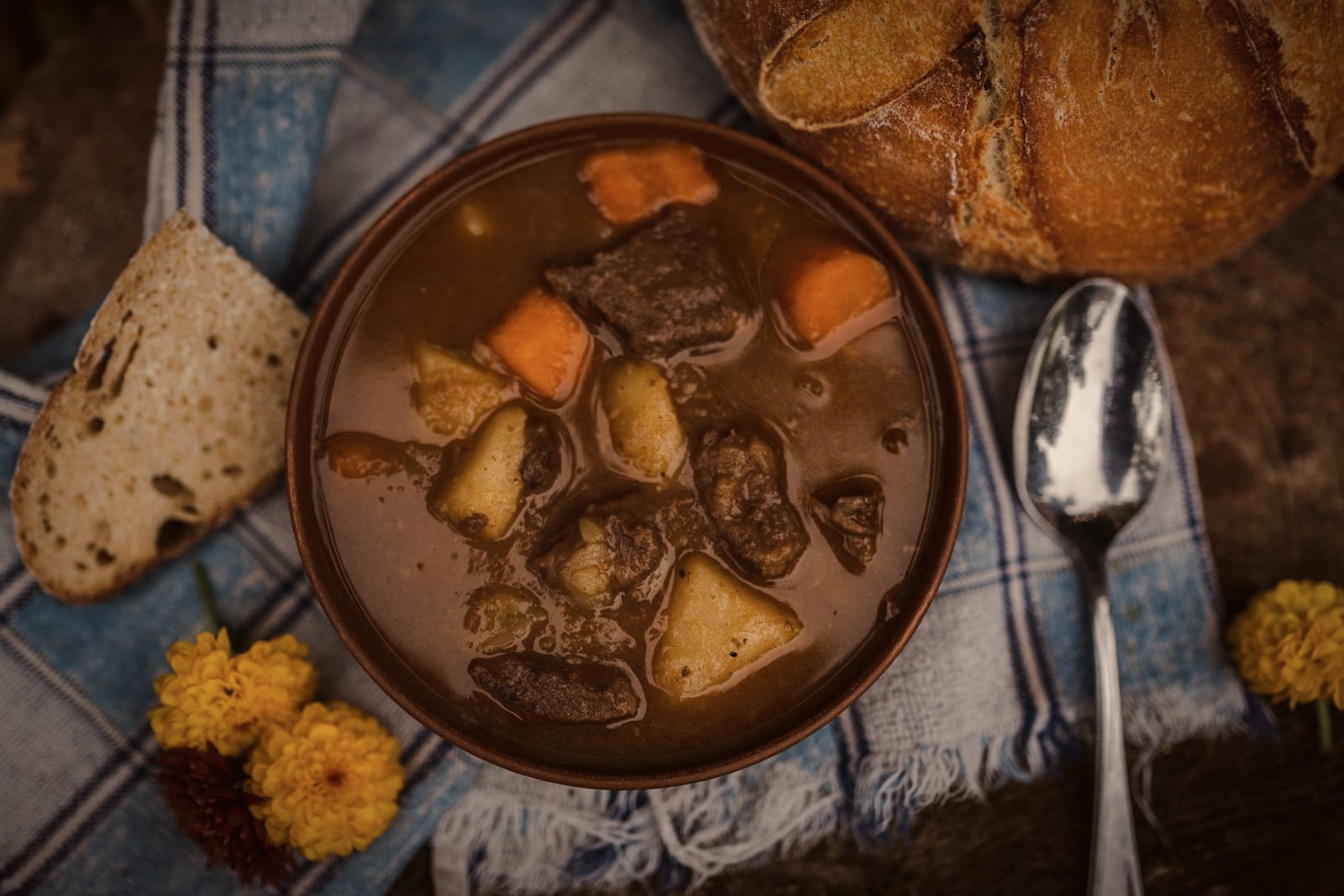
Rabo de toro is a Spanish stew, closely associated with Córdoba, of oxtail browned and braised for hours in red wine with onion, carrot, pepper and tomato. After three hours or more the tail's collagen turns to gelatin: the meat falls from the bone and the sauce grows so rich it sets when cold.
At a glance
- Origin
- Córdoba, Andalusia (rabo de toro)
- Cut
- Oxtail, cut at the joints
- Liquid
- Red wine and stock
- Braise
- 3–4 h at a bare simmer
- Serves
- 6
- Time
- 50 min active, about 4½ h total
Bone, meat and collagen
Oxtail is the tail of beef cattle, sold cut into sections at the joints. Each piece has a round vertebra surrounded by meat, fat and a large amount of collagen. That makes it unsuitable for quick cooking but ideal for long braising: after three hours or more, the collagen turns into gelatin and the sauce becomes so rich that it sets when cold.
Rabo de toro means "bull's tail". The name refers to the bulls of the bullring, whose tails were once the meat of the dish; today it is usually made with tails from ordinary beef cattle, and in Spain these are sold as rabo de vaca or rabo de añojo, although menus keep the old name.
Córdoba and the bullring
The dish is associated above all with Córdoba, in Andalusia, where it is a standard of taverns and restaurants, and with the bullfighting cities of southern Spain, where meat from fighting bulls was sold after the corrida. Recipes for stewed oxtail appear in Spanish cookery long before the modern dish took its name, but there is no single documented origin; Córdoba's claim rests on custom rather than a dated text.
Oxtail stews are found wherever cattle are slaughtered and no part is wasted. The British have their oxtail soup, the French their queue de bœuf braised or in a hochepot, and the Caribbean, Korea and the Philippines each have a well-known oxtail dish, described below.
Ingredients
| Ingredient | Amount | Note |
|---|---|---|
| Oxtail, in sections | 2 kg / 4.4 lb | thick pieces from the base of the tail are meatiest |
| Salt and black pepper | to taste | |
| Plain flour | 40 g / ⅓ cup | for dredging |
| Olive oil | 80 ml / ⅓ cup | |
| Onions | 2, about 300 g / 10 oz | chopped |
| Carrots | 2, about 200 g / 7 oz | sliced |
| Leek | 1, about 150 g / 5 oz | white part, sliced |
| Red bell pepper | 1, about 200 g / 7 oz | chopped |
| Garlic | 4 cloves | chopped |
| Ripe tomatoes | 2, about 250 g / 9 oz | grated, skins discarded |
| Brandy | 50 ml / 3½ tbsp | optional |
| Red wine | 750 ml / 3 cups | one bottle |
| Beef stock | 500 ml / 2 cups | or water |
| Bay leaves, sweet paprika | 2 leaves, 1 tsp |
Method
- Season the oxtail with salt and pepper and dredge it lightly in flour.
- Heat the oil in a heavy casserole and brown the pieces well on all sides in batches, 8–10 minutes per batch. Set aside.
- In the same oil, cook the onion, carrot, leek and pepper over medium heat until soft and lightly colored, about 15 minutes. Add the garlic, then the tomato and paprika, and cook 5 minutes more.
- Add the brandy, if using, and let it evaporate. Return the oxtail, pour in the wine and let it boil for 5 minutes, then add stock until the meat is just covered, and the bay leaves.
- Cover and cook at a bare simmer for 3–4 hours, on the stove or in the oven at 150 °C / 300 °F, turning the pieces occasionally, until the meat comes away from the bone at a touch.
- Lift out the oxtail. Remove the bay leaves and pass the sauce through a food mill or blend it until smooth; reduce it if thin and adjust the seasoning. Return the meat to the sauce.
- For the best result, cool overnight, lift off the solidified fat and reheat gently before serving.
Jamaica, Korea, the Philippines
In Andalusia some cooks use the local Montilla-Moriles wine, a fortified wine, or add a splash of sherry; others leave the vegetables whole in the sauce rather than puréeing them. Boned oxtail meat is also used to fill croquettes, cannelloni and small pastries in contemporary Spanish restaurants.
Jamaican oxtail is browned, often darkened with a little caramel "browning", and stewed with onion, garlic, thyme, allspice, scallion and Scotch bonnet pepper, with butter beans added at the end; it is served with rice and peas. Kkori gomtang (Korea) is a clear soup: the oxtail is soaked, blanched and simmered for hours in water until the broth is milky and rich, then seasoned at the table with salt and scallion. Kare-kare (Philippines) is oxtail, often with tripe, stewed in a sauce thickened with ground peanuts and toasted rice, colored with annatto, cooked with eggplant, string beans and banana blossom and served with bagoong, fermented shrimp paste. For other slow beef stews, see beef stew, ossobuco and bò kho.
Fries, bread, 300–350 g a head
In Córdoba, rabo de toro is served as a main course or as a ración to share, with fried potatoes and bread for the sauce; mashed potatoes and rice are common alternatives. Oxtail yields roughly 40–50 % of its weight in meat once the bone and fat are removed, so about 300–350 g / 10–12 oz raw per person is usual. Common mistakes: cooking it too briefly, so the meat clings to the bone; boiling hard, which dries it; leaving the abundant fat in the sauce; and adding too much liquid, so the sauce never reduces to its characteristic glossy, sticky texture.
Frequently asked questions
Is rabo de toro made from bull's tail?
Historically it was made with the tails of fighting bulls; today it is usually made with oxtail from ordinary beef cattle, though the traditional name is kept.
How long does oxtail take to cook?
Usually 3–4 hours at a bare simmer, until the meat comes away from the bone easily. A pressure cooker reduces this to about 1 hour.
Why is oxtail so expensive?
Each animal has only one tail, about 1.5–2 kg / 3–4½ lb, and demand from many cuisines has grown, so supply is limited.
What is the difference between oxtail stew and oxtail soup?
A stew is braised in a small amount of liquid that reduces to a thick sauce; a soup such as kkori gomtang is simmered in plenty of water for a clear broth.
Sources
4
- McGee, Harold. On Food and Cooking: The Science and Lore of the Kitchen, rev. ed. New York: Scribner, 2004.
- Larousse Gastronomique, rev. ed. London: Hamlyn, 2009.
- Roden, Claudia. The Food of Spain. New York: Ecco, 2011.
- Davidson, Alan. The Oxford Companion to Food. Oxford: Oxford University Press, 1999.
Related