Soup · Vietnam, the broth
Phở bò
Phở bò is the Vietnamese beef noodle soup: flat rice noodles and sliced beef in a clear broth of long-simmered bones, charred onion and ginger, star anise, cinnamon and black cardamom, born in northern Vietnam in the early 20th century. Poured boiling, the broth cooks the raw tái in the bowl.
At a glance
- Origin
- Northern Vietnam (Nam Định, Hanoi), early 20th century
- Cuts
- Bones; brisket, flank, tendon; tenderloin or round for rare slices
- Spices
- Charred onion and ginger, star anise, cinnamon, black cardamom
- Serves
- 6 bowls
- Time
- 1 h active, 6–8 h simmering
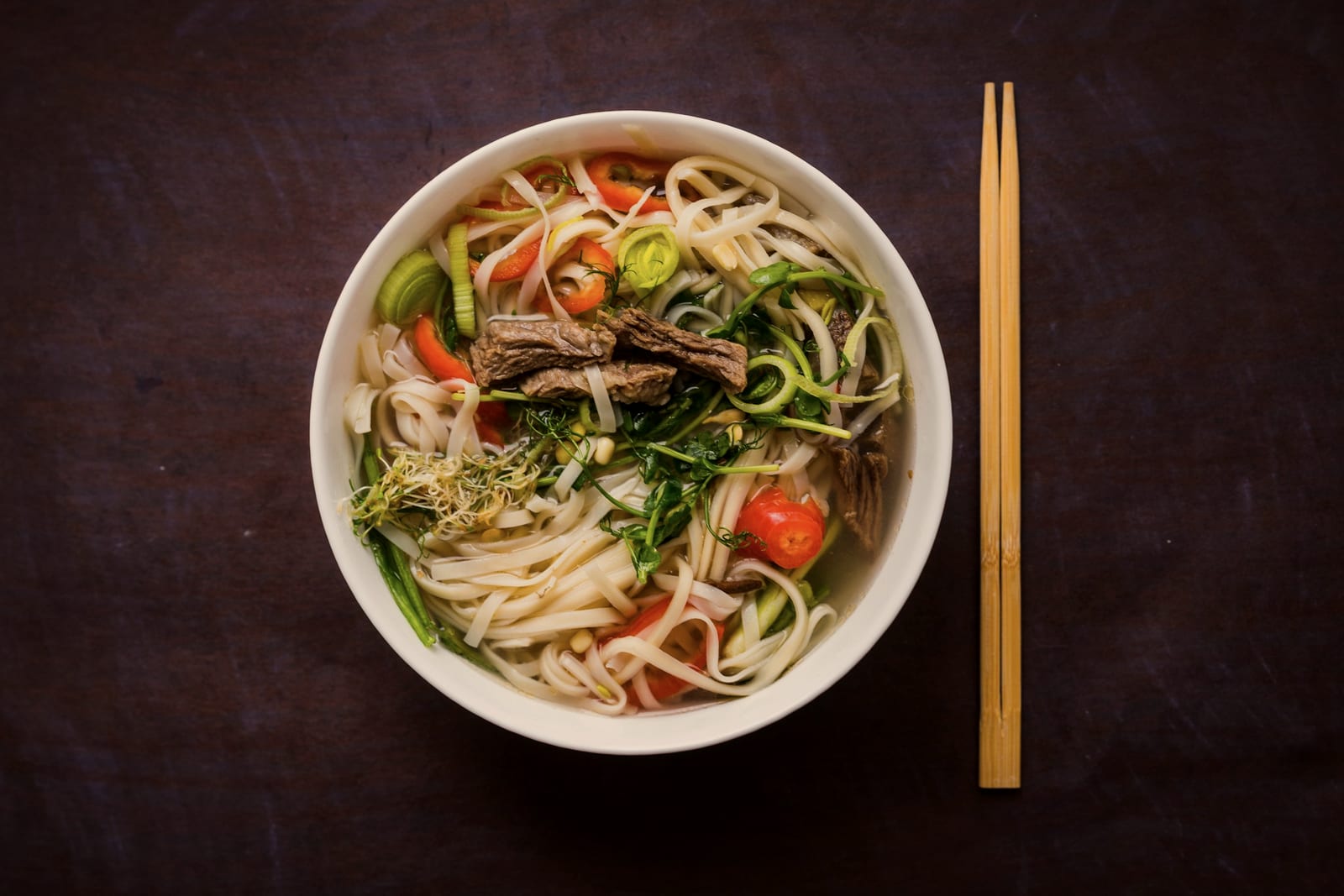
The broth is the dish
A bowl of phở has three parts: fresh flat rice noodles (bánh phở), beef, and a broth poured over them at a rolling boil. The broth is the dish. It is made by simmering beef bones for many hours with onion and ginger charred over a flame, and a small set of warm spices — star anise, cinnamon, black cardamom (thảo quả), sometimes clove and coriander seed — then seasoned with fish sauce and a little rock sugar. A good phở broth is clear, light amber and fragrant, with body from bone gelatin but no greasiness.
The beef is ordered by name. Tái is raw beef sliced thin and laid on the noodles so the boiling broth cooks it at the table; chín is cooked meat, usually brisket, simmered in the stock and sliced; nạm is flank with its membranes; gầu is the fatty point of the brisket; gân is tendon, cooked until soft and gelatinous; bắp is shank. A bowl that combines several is phở tái nạm, phở tái gầu or, with everything, phở đặc biệt.
Nam Định, early 1900s
Phở appeared in northern Vietnam at the beginning of the 20th century, in the province of Nam Định and in Hanoi, sold by street vendors who carried a stove and pot on a shoulder pole. Villages around Nam Định, such as Vân Cù, are known for families who took the trade to Hanoi. Beef was not a common meat in Vietnam before French rule; the slaughter of cattle for the colonial market, with bones and trimmings left over, is usually given as part of the background.
The origin of the name is debated. One theory links phở to the French pot-au-feu, the boiled beef dish of the colonial era, through the word feu. Another derives it from the Cantonese ngưu nhục phấn (beef with rice noodles), sold by Chinese cooks in Hanoi, with phấn becoming phở. Historians such as Vu Hong Lien describe the dish as a product of both influences on a Vietnamese base; neither theory is proven. After the partition of 1954, northerners who moved south took phở to Saigon, where it acquired a different style, and after 1975 Vietnamese emigrants carried it around the world.
Ingredients
| Ingredient | Amount | Note |
|---|---|---|
| Beef bones (knuckle, marrow) | 2.5 kg / 5.5 lb | blanched before simmering |
| Beef brisket or flank (nạm, gầu) | 600 g / 1.3 lb | whole piece, for chín slices |
| Beef tenderloin or eye of round | 300 g / 10½ oz | for tái; sliced paper-thin |
| Water | 6 L / 6.3 qt | |
| Onions | 2, about 300 g / 10½ oz | charred whole, peeled |
| Ginger | 100 g / 3½ oz | charred, scraped, sliced |
| Star anise | 5 whole | toasted |
| Cinnamon (cassia) stick | 1, about 8 cm / 3 in | toasted |
| Black cardamom (thảo quả) | 2 pods | toasted, cracked |
| Cloves, coriander seed | 4 cloves, 1 tbsp / 6 g | optional |
| Fish sauce | 60 ml / ¼ cup | to taste |
| Rock sugar | 30 g / 1 oz | or 2 tbsp sugar |
| Fresh flat rice noodles (bánh phở) | 1 kg / 2.2 lb | or 500 g / 1.1 lb dried |
| Scallions, white onion, coriander | 1 bunch, ½ onion, 1 bunch | sliced thin, for the bowls |
Method
- Cover the bones with cold water, bring to a boil for 5 minutes, drain and rinse bones and pot. This removes blood and impurities and keeps the broth clear.
- Char the onions and ginger directly over a flame or under a grill until blackened in spots, then peel off the burnt skin. Toast the star anise, cinnamon, cardamom, cloves and coriander in a dry pan until fragrant.
- Return the bones to the pot with 6 L / 6.3 qt of fresh water, the onions, ginger and a little salt. Bring to a boil, then lower to a bare simmer, about 90–95 °C / 194–203 °F, and skim the foam. Add the brisket or flank.
- Remove the brisket when tender, after about 1½–2 hours, plunge it into cold water for 10 minutes to keep it from darkening, and refrigerate. Continue simmering the bones for 6–8 hours in total.
- Add the spices in a muslin bag for the last 45–60 minutes only; longer makes the broth bitter and medicinal. Strain, skim off most of the fat, and season with fish sauce, rock sugar and salt.
- Freeze the tenderloin for 20–30 minutes and slice it against the grain as thinly as possible. Slice the cooked brisket. Blanch the noodles for a few seconds in boiling water and divide among warm bowls.
- Top with chín slices, raw tái slices, scallion, onion and coriander. Bring the broth back to a full boil and ladle it over immediately: only boiling broth cooks the tái.
Hanoi and Saigon
Hanoi (phở Bắc) is austere: a clear, savory broth, wide noodles, beef, scallions and onion. At the table there is lime, chilli, garlic vinegar and sometimes quẩy, fried dough sticks. Hanoi also has phở tái lăn, rare beef quickly stir-fried with garlic before going into the bowl, phở cuốn, beef and herbs rolled in uncut noodle sheets, and phở xào, stir-fried noodles.
Saigon (phở Nam) is sweeter and more generous: a plate of bean sprouts, Thai basil, sawtooth coriander (ngò gai), lime and chilli comes with the bowl, and hoisin and chilli sauce are on the table. Beef balls (bò viên) are common. Northern purists see the sauces as masking the broth; in the south they are part of the dish.
Breakfast, broth first
Phở is above all a breakfast, eaten very hot, though it is now sold at every hour. The broth is tasted first, before any seasoning; the herbs are torn in a little at a time so they stay fresh. The same warm spices, star anise and cinnamon above all, reappear in other Vietnamese beef dishes such as the stew bò kho.
Common mistakes: skipping the blanching of the bones, which clouds the broth; boiling hard instead of simmering, which emulsifies the fat; leaving the spices in for hours; slicing the tái thick, so the broth cannot cook it; and pouring broth that is not at a full boil. Rare beef in phở is only partly cooked; people at higher risk of foodborne illness may order it chín.
Frequently asked questions
What does tái mean in phở?
Tái is raw beef sliced very thin and placed on the noodles so the boiling broth cooks it in the bowl; it arrives pink and turns grey as it sits.
What is the difference between Hanoi and Saigon phở?
Hanoi phở has a clear, savory broth served with scallions and onion; Saigon phở is slightly sweeter and comes with bean sprouts, herbs, lime, hoisin and chilli sauce.
What spices are in phở broth?
Charred onion and ginger, star anise, cinnamon and black cardamom (thảo quả), sometimes clove and coriander seed, seasoned with fish sauce and rock sugar.
Where does the word phở come from?
It is disputed: one theory points to the French pot-au-feu, another to the Cantonese name for beef with rice noodles. Neither is proven.
Sources
5
- McGee, Harold. On Food and Cooking: The Science and Lore of the Kitchen, rev. ed. New York: Scribner, 2004.
- USDA Food Safety and Inspection Service. Safe Minimum Internal Temperature Chart. 2023. www.fsis.usda.gov/food-safety/safe-food-handling-and-preparation/food-safety-basics/safe-temperature-chart
- Nguyen, Andrea. The Pho Cookbook. Berkeley: Ten Speed Press, 2017.
- Vu Hong Lien. Rice and Baguette: A History of Food in Vietnam. London: Reaktion Books, 2016.
- Nguyen, Andrea. Into the Vietnamese Kitchen: Treasured Foodways, Modern Flavors. Berkeley: Ten Speed Press, 2006.
Related