Cooking · The 40-minute rule
Salting steak
A steak is best salted either at least 40 minutes before cooking, and up to two days ahead uncovered in the refrigerator (a dry brine), or immediately before it goes on the heat. Salted in between, it sits in a film of brine that must boil off before the surface can brown. About 1 % of the meat's weight in salt, 2.5 g for a 250 g steak, seasons it through.
At a glance
- Amount
- About 1 % of the meat's weight
- Salt early
- 40 min to 48 h ahead
- Or
- Right before cooking
- Avoid
- 3–40 min before: surface wet
- Measure
- By weight, not by spoon
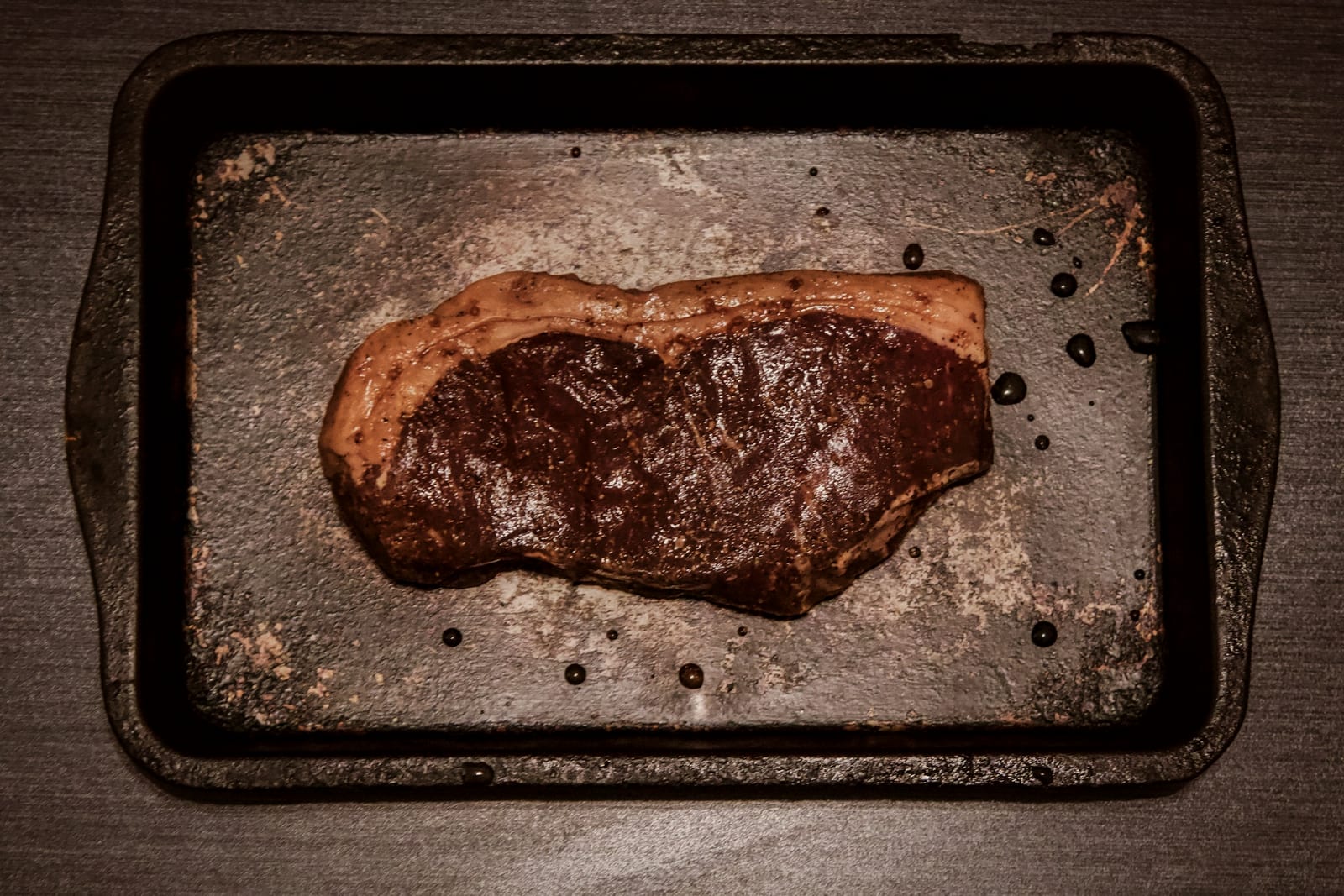
Timing matters as much as amount
Salt is the one seasoning almost every steak receives, and its timing changes the result as much as its amount. A dry brine is salting a steak well in advance, without water, and leaving it uncovered in the refrigerator for hours or days: the salt penetrates the meat and the surface dries. Salting at the last moment seasons only the outside but leaves the surface dry enough to sear. In Argentina and Uruguay, coarse salt (sal gruesa or sal parrillera) is scattered on the meat before or during grilling; in Japan and much of East Asia, finished steak is often served with salt on the side.
Out by osmosis, back by diffusion
Salt on the surface of raw meat draws water out by osmosis within minutes; the salt dissolves in it and forms a concentrated brine on the surface. Over the next half hour or so, that brine is drawn back in by diffusion: the dissolved salt partially loosens the muscle proteins, chiefly myosin, which increases their capacity to hold water. The meat ends up seasoned below the surface and, if salted long enough, holds slightly more of its juice during cooking.
Penetration is slow: salt moves through meat at only a few millimetres per hour at refrigerator temperature, so an overnight dry brine seasons a steak much more evenly than one of 40 minutes. Uncovered in the cold, dry air of a refrigerator, the surface meanwhile loses moisture and becomes tacky and darker, which helps the Maillard reaction later. Beyond two or three days the outer layer can take on a cured, ham-like texture.
When to salt
| When | Surface | Result |
|---|---|---|
| Just before cooking (0–3 min) | Dry | Good crust; seasoning stays on the outside |
| 3–40 min before | Wet with brine | Worst: brine must boil off; weaker crust |
| 40 min–2 h before | Brine reabsorbed, surface drying | Good crust; seasoning a few millimetres deep |
| Overnight to 48 h, uncovered on a rack | Dry, tacky | Best crust and most even seasoning |
| More than 3 days | Very dry | Outer layer turns cured and firm |
How much and which salt
About 1 % of the meat's weight seasons a steak fully: 2.5 g for a 250 g steak, or roughly ½ teaspoon of fine salt. Many cooks use 0.8–1.2 %. Salt should be measured by weight because grain size changes the volume dramatically: a teaspoon of fine table salt weighs about 6 g, of coarse kosher salt 3–5 g depending on the brand, of flaky sea salt less still.
| Salt | Grain | Best use |
|---|---|---|
| Fine table or sea salt | Small, dense | Dry brines (by weight); dissolves fast |
| Kosher salt | Light flakes or crystals | Even seasoning by hand before cooking |
| Coarse salt (sal gruesa, sal parrillera) | Large crystals | Grilling over embers; dissolves slowly, so it does not oversalt |
| Flaky salt (Maldon type, fleur de sel) | Thin, crunchy flakes | Finishing on the sliced steak, for texture |
Step by step: dry brine
- Weigh the steak and measure 1 % of its weight in salt.
- Pat it dry and scatter the salt evenly over all faces, including the edges, from about 20–30 cm / 8–12 in above so it falls evenly.
- Set it on a wire rack over a tray, uncovered, in the refrigerator, for at least 40 minutes and ideally 12–48 hours.
- Do not rinse it before cooking; pat away any surface moisture and cook it straight from the refrigerator.
- Add pepper just before or after cooking, because ground pepper scorches and turns bitter at searing temperatures.
- Taste a slice; finish with a few flakes of salt if wanted.
Salt does not dry or toughen a steak
That salting early "draws the juice out and dries the steak": it draws water out for a few minutes, but the brine goes back in, and a dry-brined steak is usually juicier, not drier. That salt toughens meat: at the amounts used for steak, salt makes muscle proteins hold water better and the texture slightly firmer, not tougher; very long cures are another matter. That coarse salt is "less salty": per gram it is the same salt; it is simply easier to distribute and slower to dissolve.
Ten to twenty minutes: the worst moment
Salting 10–20 minutes before cooking, the worst moment for the crust. Measuring salt by volume with a different salt from the recipe's. Salting only the top face. Covering a dry-brining steak with plastic, which keeps the surface wet. And salting so heavily at the table that the flavour of the meat disappears.
Frequently asked questions
When should you salt a steak?
Either at least 40 minutes before cooking, ideally overnight uncovered in the refrigerator, or immediately before cooking. Avoid salting 3–40 minutes ahead.
What is a dry brine?
Salting meat in advance without water and leaving it uncovered in the refrigerator for hours or days, so the salt penetrates and the surface dries.
How much salt should you put on a steak?
About 1 % of its weight: 2.5 g for a 250 g steak, roughly half a teaspoon of fine salt.
Is coarse salt better for steak?
It is easier to scatter evenly and dissolves slowly, which suits grilling over embers; gram for gram it is no more or less salty than fine salt.
Sources
4
- McGee, Harold. On Food and Cooking: The Science and Lore of the Kitchen, rev. ed. New York: Scribner, 2004.
- Toldrá, Fidel (ed.). Lawrie's Meat Science, 8th ed. Duxford: Woodhead, 2017.
- Myhrvold, Nathan; Young, Chris; Bilet, Maxime. Modernist Cuisine: The Art and Science of Cooking. Bellevue: The Cooking Lab, 2011.
- López-Alt, J. Kenji. The Food Lab: Better Home Cooking Through Science. New York: W. W. Norton, 2015.
Related