Cut · Diaphragm, open grain
Skirt steak
Skirt steak is the diaphragm of the steer: two thin muscles, the outside and the inside skirt, that work with every breath — hence the most open grain and one of the deepest flavours of any steak. Seared hot and fast, it is the Argentine entraña, the Mexican arrachera, the French hampe and the Japanese harami.
At a glance
- Primal
- Plate (outside skirt) and flank (inside skirt)
- Muscles
- Outside: costal part of the diaphragm · inside: transversus abdominis
- Weight
- Outside 600–900 g · inside 900–1,300 g, one of each per side
- Best cooked
- Very hot and fast, rare to medium-rare, sliced across the grain
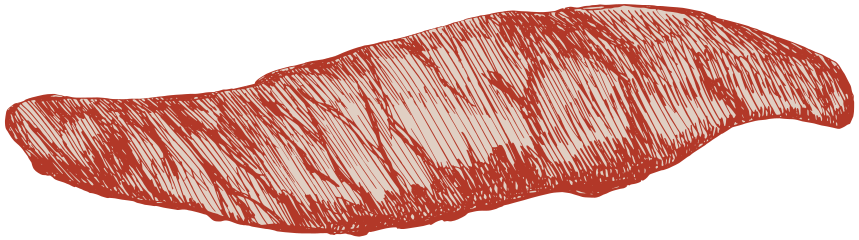 Skirt (machete)
A muscle that works with every breath
The skirt is the diaphragm, the sheet of muscle that separates the chest from the abdomen and contracts with every breath. Because it works constantly, it is rich in myoglobin and flavour; because it is a thin sheet, 1–2 cm thick, its fibres run in long, very visible bundles that give it the most open, coarse grain of any steak.
Butchers separate two muscles under the same name. The outside skirt is the costal part of the diaphragm itself, attached to the inside of the ribs and wrapped in a tough membrane; it is narrower, thicker and more marbled. The inside skirt is the transversus abdominis, a wider, thinner and leaner muscle on the abdominal wall. Most cooks and most national cuisines prefer the outside skirt, and it usually costs more.
Two other cuts are often confused with skirt. The hanger steak (French onglet) is the pillar of the diaphragm, a single thick muscle that hangs from the spine; the flank is a separate abdominal muscle, thicker, leaner and with a tighter grain.
Only two of each per steer
Inside the carcass, where the chest ends. The outside skirt lies against the inside of the sixth to twelfth ribs, on the plate; the inside skirt lies against the flank. Each side of the animal yields one outside skirt of about 600–900 g and one inside skirt of 900–1,300 g, so a whole steer gives only two of each.
For a long time the diaphragm was handled with the offal and sold cheaply. In the United States it became the meat of Tex-Mex fajitas; in Mexico it is marinated as arrachera for tacos; in Japan harami, once an inexpensive offal cut, is now one of the most ordered items at a yakiniku table. In Argentina and Uruguay the outside skirt is the entraña, a cut with its own place at the asado.
Skirt, hanger, arrachera, harami: which is which
Three different muscles from the middle of the steer share a handful of names, and the same word can mean another muscle one border away. “Thick skirt” in Australia is the hanger, not a skirt; 封門柳 on a Hong Kong menu is the hanger too; Brazil's fraldinha is the flank and flap, not the diaphragm. The table lists what each name usually means. Belly-wall names (bavette, flap, fraldinha) are sorted out in the vacío table.
| Name | Where | Which muscle |
|---|---|---|
| Outside skirt | United States (IMPS 121C) | Diaphragm, rib side: the skirt most cooks want |
| Inside skirt | United States (IMPS 121D) | Transversus abdominis, a belly-wall muscle |
| Skirt · thin skirt | UK · Australia, NZ | Outside skirt |
| Thick skirt | Australia, NZ | The hanger (hanging tender) |
| Entraña | Argentina, Uruguay, Spain | Outside skirt |
| Arrachera | Mexico | Skirt, outside or inside, usually marinated |
| Fajita meat | United States | Skirt; in supermarkets often inside skirt or flank strips |
| Hampe | France | Outside skirt |
| Onglet | France, UK | The hanger |
| Solomillo de pulmón · entraña gruesa | Spain | The hanger |
| ハラミ harami | Japan | Outside skirt (rib side of the diaphragm) |
| サガリ sagari | Japan | The hanger (spine side); in Hokkaido often the whole diaphragm |
| 안창살 anchangsal | South Korea | Outside skirt |
| 토시살 tosisal | South Korea | The hanger |
| 外裙肉 · 內裙肉 | Hong Kong, Taiwan, China | Outside skirt · inside skirt |
| 封門柳 · 肝連 | Hong Kong · Taiwan | The hanger |
| Fraldinha | Brazil | Not the skirt: the flank and flap |
| Flank steak | Everywhere | Not the skirt: the rectus abdominis |
Cooking it: hot and fast, then a rest
Hot and fast. A skirt steak goes onto the hottest part of the grill or a smoking pan for two to three minutes a side and comes off rare or medium-rare, around 52–55 °C / 126–131 °F at the core, before resting for a few minutes. Cooked much past medium, the thin fibres tighten and turn to leather.
Slicing matters as much as heat. The grain runs across the width of the strip, so the steak is first cut into pieces 10–15 cm long and each piece is then sliced thin across its fibres. Sliced along the grain, a skirt is chewy at any temperature.
Its open structure takes marinades in minutes rather than hours: citrus, garlic and chilli for arrachera and fajitas; soy, sugar and sesame in Korean and Japanese barbecue. In the Río de la Plata it is simply salted and grilled membrane-side first, so the membrane crisps; in Japan harami is cut into bite-sized pieces and grilled at the table over charcoal.
Ask for the outside skirt by name
Ask for outside skirt by name (IMPS 121C in the United States, thin skirt in Australia); without the word, the piece is often the inside skirt, which is wider, thinner and leaner. The outside skirt should be deep red, about 2 cm thick at its centre, with visible streaks of fat between the fibre bundles.
It is sold membrane on or peeled. The membrane protects the meat in the cold chain and crisps on a grill; peeled skirt is ready for a pan or a marinade. Because there are only two outside skirts per carcass and much of the supply is exported, the cut is often sold frozen and vacuum-packed; thawed slowly in the refrigerator, it cooks well. Avoid packs with grey edges or a lot of purge.
Names around the world
20
The same muscle, named by language and by trade system.
| English | Skirt |
| Tiếng Việt | Diềm thăn |
| Español | Entraña · arrachera |
| 한국어 | 안창살 |
| 日本語 | ハラミ |
| Français | Hampe |
| Italiano | Diaframma |
| Русский | Скёрт |
| 中文 | 外裙肉 |
All the cuts' names, country by country →
Trade and national systems
| System | Name | Reference |
|---|---|---|
| United States | Skirt steak · outside skirt (preferred) · inside skirt · fajita meat | IMPS 121C / 121D |
| United Kingdom | Skirt · thin skirt | AHDB |
| Australia / NZ | Thin skirt (outside) · inside skirt · thick skirt is the hanger, a different muscle | HAM |
| Argentina | Entraña (outside skirt, membrane on or off) | IPCVA |
| Brazil | Diafragma · entranha (fraldinha is the flank and flap, not the skirt) | Portaria 5/88 |
| France | Hampe (outside) · onglet is the hanging tender, not the skirt | Larousse |
| Japan | ハラミ (harami) · サガリ (sagari) is the hanger | JMGA |
| Mexico | Arrachera | |
| Spain | Entraña (entraña gruesa is the hanger) | |
| South Korea | 안창살 (anchangsal) · 토시살 (tosisal) is the hanger | |
| Hong Kong · Taiwan · China | 外裙肉 outside skirt · 內裙肉 inside skirt (封門柳 and 肝連 are the hanger) |
Field data
Numbers measured in a working kitchen, piece by piece, not taken from a table. Another kitchen, another trimming specification, another number. How field data is collected.
Field data
Skirt
Small sample: indicative only.
Steakpedia Field Kitchen28 Sept 2026 – 28 Sept 2026
Frequently asked questions
Is skirt steak the same as flank steak?
No. Skirt is the diaphragm, thin and coarse-grained; flank is an abdominal muscle further back, thicker, leaner and with a tighter grain. Both are cooked hot and sliced across the grain, but skirt has more fat and flavour.
What is the difference between outside and inside skirt?
The outside skirt is the diaphragm itself: narrower, thicker, more marbled and more expensive. The inside skirt is the transversus abdominis, wider and thinner, leaner and slightly tougher.
Is skirt steak the same as hanger steak?
No. Both come from the diaphragm area, but the hanger is the single thick pillar that hangs from the spine, with a central sinew; the skirt is the thin, wide sheet of the diaphragm.
Should skirt steak be marinated?
It does not need to be, but its open grain absorbs a marinade in 30 minutes to a few hours. Plain salt before grilling is the Argentine and Uruguayan way.
Is there another name for skirt steak?
Many. The outside skirt is entraña in Argentina, Uruguay and Spain, arrachera in Mexico, hampe in France, harami (ハラミ) in Japan and anchangsal (안창살) in Korea; in Australia it is thin skirt, and in the United States it is also sold as fajita meat. The table above shows which similar names belong to a different muscle.
Is skirt steak very chewy?
Only when it is overcooked or sliced along the grain. Cooked hot to medium-rare and cut thin across the fibres, outside skirt is tender; inside skirt is a little chewier and benefits from a marinade.
Which is more expensive, inside or outside skirt?
Outside skirt. There are only two per animal, much of it goes to restaurants and export, and it is thicker and more marbled. Inside skirt is more common and usually cheaper.
Is inside or outside skirt best for fajitas?
Outside skirt is the traditional fajita cut and stays juicier; inside skirt works well if it is marinated and sliced thin across the grain.
Is arrachera the same as skirt steak?
Yes. Arrachera is the Mexican name for skirt steak, usually marinated with citrus, garlic and spices and chopped for tacos; it can be outside or inside skirt.
What is better, flank or skirt?
For flavour and juiciness, skirt: it has more fat and a looser grain. Flank is leaner and thicker, easier to cook evenly and to slice into neat strips. Either can replace the other in fajitas or a stir-fry if cooked hot and cut across the grain.
Sources
6
- USDA Agricultural Marketing Service. Institutional Meat Purchase Specifications: Fresh Beef Series 100. Washington, DC, 2014. www.ams.usda.gov/sites/default/files/media/IMPS_100_Fresh_Beef%5B1%5D.pdf
- AUS-MEAT Limited. Handbook of Australian Meat, 7th ed. (International Red Meat Manual). Brisbane, 2005. www.ausmeat.com.au
- Instituto de Promoción de la Carne Vacuna Argentina (IPCVA). Cortes de carne vacuna argentina — nomenclatura y usos. Buenos Aires. www.ipcva.com.ar
- Larousse Gastronomique, rev. ed. London: Hamlyn, 2009.
- McGee, Harold. On Food and Cooking: The Science and Lore of the Kitchen, rev. ed. New York: Scribner, 2004.
- Steakpedia Field Kitchen. Butchery records, July–October 2026: 279 sheets, 1,604.6 kg of meat processed, weighed piece by piece on a calibrated scale and logged per cut. Open data, CC BY 4.0. steakpedia.com/field-data
Related