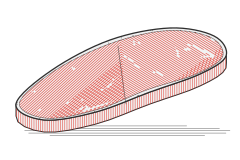
Cut · Rump triangle, two grains
Tri-tip
Tri-tip is the small triangular muscle at the base of the rump, the tensor fasciae latae, weighing 0.7–1.2 kg. Lean and fine-textured, it is cooked whole over red oak in the Santa Maria barbecue of California — the thin point cooks further —and grilled as colita de cuadril in Argentina and maminha in Brazil.
At a glance
- Primal
- Sirloin / rump (bottom sirloin)
- Muscles
- Tensor fasciae latae
- Weight
- 0.7–1.2 kg (1.5–2.6 lb)
- Grain
- Changes direction across the piece
- Best cooked
- Whole, over wood or charcoal, to medium-rare
A roast in the time of a steak
The tri-tip is a single muscle, the tensor fasciae latae, shaped like a long, flattened triangle about 4–5 cm thick at its thickest point. Whole and trimmed it weighs 0.7–1.2 kg (1.5–2.6 lb), which makes it one of the few cuts that can be cooked whole like a roast and served in the time of a steak. It is lean, with a thin fat cover on one side and fine to medium marbling.
Its defining feature is the grain. The fibres fan out from the point towards the wide end, so the direction changes across the piece; carved as if it were a single steak, half of it is cut along the grain and eats tough. Butchers and pitmasters therefore split the cooked piece where the grain turns and slice each part across its own fibres.
In the United States the cut belongs to California's Central Coast, where it is the centre of Santa Maria-style barbecue. In Argentina, as colita de cuadril, it is an everyday grill cut; in Brazil, as maminha, it appears in churrascarias next to the picanha.
The lower edge of the rump
The tri-tip lies at the lower edge of the rump, towards the belly, where the hip meets the flank. In American butchery it is part of the bottom sirloin, together with the ball tip and the flap, and is specified as IMPS 185C (boneless, with its fat) and 185D (defatted). Below and in front of it runs the abdominal wall that, in Argentina, is cut as vacío.
Because there is only one tri-tip per side, about two per animal, it was long ground or cut into stew meat in American plants. Its use as a whole roast is generally traced to butchers in Santa Maria in the 1950s, and it spread from California to the rest of the country only in the 1990s and 2000s. Outside the Americas many trade specifications leave it attached to the rump, where it becomes the narrow tail of a rump steak.
Cooking it: red oak, the Santa Maria way
The traditional Santa Maria method seasons the whole piece with salt, black pepper and garlic and cooks it over the coals of red oak on an adjustable iron grate, raising or lowering it to control the heat. It is turned often and taken off at 52–55 °C / 126–131 °F in the thickest part for medium-rare (still pink and juicy at the centre). Because the point is much thinner, the same piece offers several degrees of doneness. It is served sliced, with pinquito beans, salsa and grilled bread.
It also suits a reverse sear: smoked or roasted at 110–120 °C / 230–248 °F to about 50 °C / 122 °F inside, then seared over strong heat. In Argentina it is grilled whole over moderate embers with coarse salt; in Brazil the maminha is skewered whole. Lean as it is, it dries out past medium, around 60 °C / 140 °F.
Choosing one: thin fat, fine marbling
A good tri-tip is evenly shaped, with a thin, white fat cover and fine marbling visible on the cut face. Pieces sold as 185D are already defatted; 185C pieces keep their fat, which can be trimmed to 3–5 mm before cooking. The silver skin on the underside should be removed if the butcher has not done so.
Tri-tip steaks, cut from the whole piece, are also sold, but they inherit the grain problem: each steak should be cut across the fibres of its own part of the triangle. Where the cut is unknown, it can be ordered from a butcher as the tail of the rump or bottom sirloin, or under its regional names, colita de cuadril, maminha or aiguillette baronne.
Names around the world
17
The same muscle, named by language and by trade system.
| English | Tri-tip |
| Tiếng Việt | Tri-tip |
| Español | Colita de cuadril (Argentina) |
| 한국어 | 트라이팁 |
| 日本語 | トモサンカク (tomosankaku) |
| Français | Aiguillette baronne |
| Italiano | Tri-tip |
| Русский | Три-тип |
| 中文 | 三角尖 |
| Português | Maminha |
All the cuts' names, country by country →
Trade and national systems
| System | Name | Reference |
|---|---|---|
| United States | Tri-tip · bottom sirloin tri-tip · Santa Maria roast (whole) · tri-tip steak | IMPS 185C / 185D |
| United Kingdom | Usually left in the rump; sold as tri-tip where separated | AHDB |
| Australia / NZ | Tri-tip (separated from the rump) | HAM |
| Argentina | Colita de cuadril | IPCVA |
| Brazil | Maminha (da alcatra) | Portaria 5/88 |
| France | Aiguillette baronne | Larousse |
| Japan | トモサンカク (tomosankaku) | JMGA |
Frequently asked questions
What is tri-tip?
A triangular muscle (tensor fasciae latae) from the bottom of the beef sirloin, weighing about 0.7–1.2 kg, cooked whole and sliced. It is the cut of Santa Maria barbecue in California.
Picanha vs tri-tip: which is which?
Both are triangular cuts of the rump. Picanha is the top cap with a thick fat layer; tri-tip is the lean muscle at the base, with a grain that changes direction.
How do you slice tri-tip?
Find where the grain turns, usually near the middle, cut the piece in two there, and slice each half thinly across its own fibres.
What is tri-tip called in Argentina and Brazil?
Colita de cuadril in Argentina and maminha in Brazil. In France it is the aiguillette baronne.
Sources
6
- USDA Agricultural Marketing Service. Institutional Meat Purchase Specifications: Fresh Beef Series 100. Washington, DC, 2014. www.ams.usda.gov/sites/default/files/media/IMPS_100_Fresh_Beef%5B1%5D.pdf
- North American Meat Institute. The Meat Buyer's Guide, 8th ed. Washington, DC, 2014.
- Instituto de Promoción de la Carne Vacuna Argentina (IPCVA). Cortes de carne vacuna argentina — nomenclatura y usos. Buenos Aires. www.ipcva.com.ar
- Brasil, Ministério da Agricultura, SIPA. Portaria nº 5, de 8 de novembro de 1988 — Padronização de cortes de carne bovina.
- Larousse Gastronomique, rev. ed. London: Hamlyn, 2009.
- McGee, Harold. On Food and Cooking: The Science and Lore of the Kitchen, rev. ed. New York: Scribner, 2004.
Related