Stew · Burgundy, Pinot Noir
Boeuf bourguignon
Boeuf bourguignon is a French braise of shoulder or cheek beef, browned and cooked slowly in red Burgundy, served with lardons, button mushrooms and small onions. A low oven turns the collagen to gelatin; the sauce reduces until it coats a spoon.
At a glance
- Origin
- Burgundy, France
- Cut
- Chuck (paleron), cheek or shin
- Liquid
- Red Burgundy (Pinot Noir) and stock
- Oven
- 160 °C / 320 °F, 2½–3 h
- Serves
- 6
- Time
- 1 h active, about 4 h total
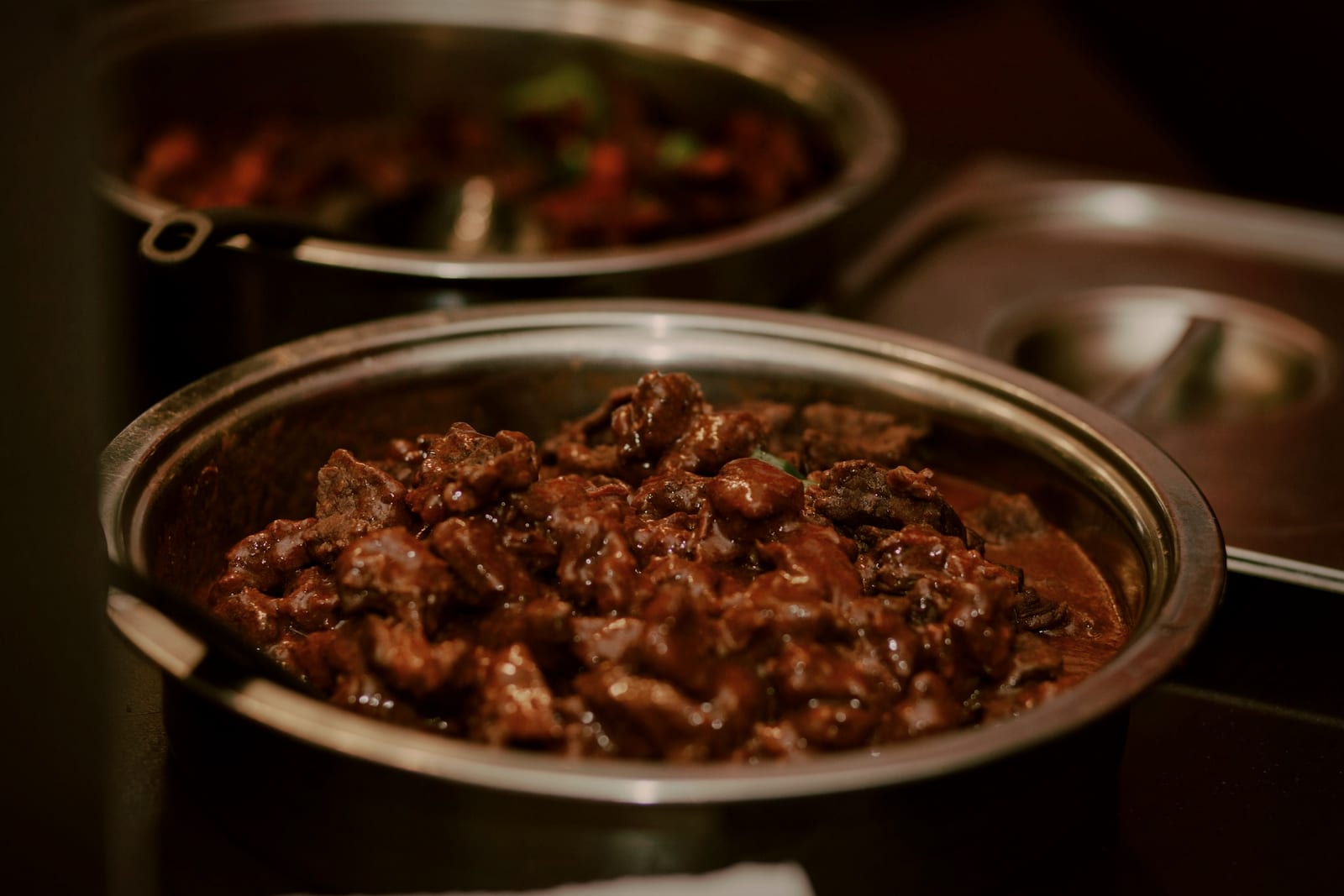
Pinot Noir and the bourguignonne garnish
The dish takes tough, well-exercised cuts and turns them tender through a long, gentle braise in wine. Cubes of beef of about 5 cm / 2 in are browned, dusted with flour, covered with red wine and stock with aromatics, and cooked in a low oven until the collagen in the connective tissue has turned to gelatin. The sauce is then reduced until it coats a spoon.
What makes it bourguignon is the wine — traditionally a red Burgundy made from Pinot Noir — and the garnish à la bourguignonne: lardons of salt pork or bacon, button mushrooms and small onions, each cooked separately and added at the end. French butchers sell paleron (the oyster blade of the shoulder), macreuse, joue (cheek) and gîte (shin) for it; chuck and boneless short ribs are common substitutes elsewhere.
Burgundy farms, Escoffier, Julia Child
Beef stewed in wine is an old farmhouse practice in Burgundy, a region of both Charolais cattle and Pinot Noir vineyards, but the dish has no documented inventor or date. It entered the professional repertoire in the 19th and early 20th centuries: Auguste Escoffier's Le Guide culinaire (1903) describes beef braised à la bourguignonne, with red wine and the garnish of mushrooms, small onions and lardons, which fixed its classic form.
Its international fame is largely due to Julia Child, Louisette Bertholle and Simone Beck, whose Mastering the Art of French Cooking (1961) gave a detailed recipe for English-speaking home cooks. Child cooked it in the first episode of her television series The French Chef in 1963, and the dish became a byword for French home cooking in the United States.
Ingredients
| Ingredient | Amount | Note |
|---|---|---|
| Beef chuck, cheek or shin | 1.5 kg / 3.3 lb | in 5 cm / 2 in cubes, dried well |
| Lardons or slab bacon | 170 g / 6 oz | in batons; blanched if very smoky |
| Red Burgundy or other dry Pinot Noir | 750 ml / 3 cups | one bottle |
| Beef stock | 500 ml / 2 cups | unsalted or lightly salted |
| Carrot and onion | 1 of each, about 120 g / 4 oz each | sliced |
| Plain flour | 30 g / ¼ cup | |
| Tomato paste | 1 tbsp / 15 g | |
| Garlic | 2 cloves | crushed |
| Bouquet garni | 1 | thyme, bay leaf, parsley stalks |
| Pearl onions | 250 g / 9 oz | peeled |
| Button mushrooms | 450 g / 1 lb | quartered |
| Butter | 45 g / 1½ oz | for the garnish |
| Neutral oil, salt, pepper | as needed |
Method
- Heat the oven to 160 °C / 320 °F. Brown the lardons in a heavy casserole with a little oil and remove them, leaving the fat.
- Pat the beef dry and brown it in batches over medium-high heat until each face is deep brown; crowding the pan steams the meat instead. Set aside. Soften the sliced carrot and onion in the same fat.
- Return the beef and lardons, season with salt and pepper, sprinkle with the flour and toss; put the uncovered casserole in the oven for 5 minutes, toss, and 5 more, to toast the flour.
- Add the wine and enough stock to barely cover the meat, the tomato paste, garlic and bouquet garni. Bring to a simmer on the stove, cover and return to the oven.
- Braise for 2½–3 hours, keeping the liquid at a bare simmer, until a fork slides into the meat with no resistance.
- Meanwhile, brown the pearl onions in butter, add a splash of stock and simmer covered until tender, about 25 minutes. Sauté the mushrooms in butter over high heat until golden.
- Drain the meat through a sieve into a pan, discard the bouquet garni and skim the fat. Reduce the sauce until it lightly coats a spoon, adjust the seasoning, and pour it back over the beef with the onions and mushrooms. Simmer together for a few minutes.
Marinated overnight, or whole cheeks
Escoffier's version braises a larger piece of beef rather than cubes; Child's cubes became the home standard. Many Burgundian cooks marinate the beef overnight in the wine with the vegetables, which seasons it more deeply but slightly firms its texture. Others use a full-bodied red from outside Burgundy; Child herself suggested Chianti, Beaujolais or a Côtes du Rhône as alternatives. A modern restaurant approach braises whole cheeks and finishes the sauce with a little dark chocolate or a beurre manié instead of flour at the start. The same method applied to chicken gives coq au vin.
Better after a night in the fridge
Boeuf bourguignon is served in deep plates with boiled or steamed potatoes, buttered noodles or crusty bread, often sprinkled with chopped parsley. Like most braises it improves after a night in the refrigerator, when the fat can be lifted off cold. Common mistakes: browning wet meat or too many pieces at once, so it boils grey; letting the braise boil rather than simmer, which dries the fibers even though the meat is surrounded by liquid; using lean cuts such as round, which turn stringy; and adding the mushrooms and onions at the start, where they collapse into the sauce.
Frequently asked questions
What cut of beef is best for boeuf bourguignon?
Cuts with plenty of connective tissue: chuck (paleron), cheek or shin. Lean cuts such as round or tenderloin become dry and stringy.
Which wine is used in boeuf bourguignon?
Traditionally a red Burgundy made from Pinot Noir. Any dry, not too tannic red that is good enough to drink works.
How long does boeuf bourguignon take to cook?
About 2½–3 hours of braising at 160 °C / 320 °F, plus an hour of preparation.
Is boeuf bourguignon better the next day?
Usually yes: the flavors settle, the sauce thickens and the cold fat is easy to remove.
Sources
4
- Larousse Gastronomique, rev. ed. London: Hamlyn, 2009.
- McGee, Harold. On Food and Cooking: The Science and Lore of the Kitchen, rev. ed. New York: Scribner, 2004.
- Escoffier, Auguste. Le Guide culinaire. Paris, 1903.
- Child, Julia; Bertholle, Louisette; Beck, Simone. Mastering the Art of French Cooking, vol. 1. New York: Knopf, 1961.
Related