Cut · Whole flank, slow fire
Vacío
Vacío is neither flap nor flank but both: it is the whole flank wall of the animal, which other countries split into the flap (bavette, fraldinha, kainomi) and the flank steak. Butchers in Argentina and Uruguay take it in one piece, from the last ribs to the hip, with its fat and membrane. It weighs 2–4 kg and is grilled whole over low embers for one to two hours, while its fat and membrane crisp and shield the meat.
At a glance
- Primal
- Flank / abdominal wall, between the ribs and the hip
- Muscles
- Obliquus internus abdominis (the flap), other abdominal-wall muscles, part of the rectus abdominis (the flank)
- Weight
- 2–4 kg (4.4–8.8 lb), whole
- Best cooked
- Whole, over low embers, 1–2 hours
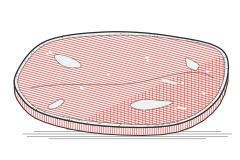
One flat piece, fat on one side
Vacío (in Spanish, the hollow of the flank between the last ribs and the hip) is a large, flat piece of the abdominal wall, cut in Argentina and Uruguay as a single unit. A whole vacío weighs 2–4 kg (4.4–8.8 lb) and is 3–5 cm thick at its thickest. One side carries a layer of fat and a tough, shiny membrane, the tela; the other is open meat with a long, loose grain.
It is not one muscle but several. The largest is the internal oblique (obliquus internus abdominis), which American butchers sell on its own as flap meat or bavette; with it come other abdominal-wall muscles and, in the full Argentine cut, part of the rectus abdominis, which elsewhere is the flank steak. That mix of muscles, fat and connective tissue is why it is cooked in a way no steak is.
It is one of the cuts that defines the Argentine asado, alongside the asado de tira, the matambre and the entraña, valued for meat that is soft, fatty and full of flavour.
Between the last ribs and the hip
Vacío sits on the side of the belly, between the last ribs (the asado, or short plate) and the hip (the cuadril). Above it is the loin; below it, the belly closes towards the midline. The tri-tip and the rump lie behind and above its rear edge, and the picanha sits higher still, on top of the hip.
Other butchery traditions divide this region instead of keeping it whole. In the United States the internal oblique becomes the bottom sirloin flap (IMPS 185A) and the rectus abdominis becomes flank steak (IMPS 193), both trimmed of membrane and fat; there is no American item for the whole vacío. Brazil cuts the area as fraldinha, France as the two bavettes, and Britain sells it as thin flank, mostly for mince and braising.
Cooking it: low embers, one to two hours
The Argentine method is slow and indirect: the whole vacío goes onto the grill over a low bed of embers, often with the grill high, and cooks for one to two hours, depending on size and heat. Practice varies on which side goes first. Many cooks start with the membrane and fat towards the fire to crisp them and protect the meat, then turn it to finish on the open side; others do the reverse. Coarse salt goes on at the start or during cooking.
The goal is not a rare steak but meat that is cooked through to about 65–70 °C / 149–158 °F at the thickest point, with the fat rendered, the membrane crisp and the connective tissue softened. Done this way it is juicy and tender, and is carved across the grain into thick strips. Thinner pieces can be rolled, stuffed and cooked as vacío relleno, or baked in the oven covered for part of the time. When the flank is lifted out as bife de vacío, it is cooked like flank steak: hot, fast, rare to medium-rare.
Buying it outside Argentina and Uruguay
Outside Argentina and Uruguay the cut rarely exists as such, so it must be described to the butcher: the whole abdominal wall behind the plate, with the flap and flank attached, fat and membrane left on. Imported Argentine and Uruguayan beef is sometimes sold as vacío or as "flank (Argentine cut)" in vacuum packs; American flap meat is the nearest single-muscle substitute.
A good vacío has an even layer of white fat, a membrane without tears, and a thickness that does not drop away too sharply at the edges, which dry out first. Pieces from heavier animals are thicker and need longer over the fire; the smaller ones, below 2 kg, cook faster and are more forgiving for a first attempt.
Flap, flank or bavette: why the names get mixed up
The same few belly-wall muscles are cut and named differently in every butchery tradition, and one word can mean different muscles in two countries: in a London butcher's shop “bavette” is usually the flank, in Paris and on American menus it is the flap. The table lists what each name usually means and whether it is part of a whole vacío.
| Name | Where | What it usually is | Part of vacío? |
|---|---|---|---|
| Vacío | Argentina, Uruguay | The whole abdominal wall: flap, flank, thin belly muscles, fat and membrane | All of it |
| Flap meat · bottom sirloin flap | United States, Australia | The internal oblique, alone (IMPS 185A) | Its main muscle |
| Sirloin tips | New England (US) | Flap meat cut into cubes or strips | Yes, as pieces |
| Flank steak | United States, Canada, Australia | The rectus abdominis, alone (IMPS 193) | Part, in the full cut |
| Inside skirt | United States | The transversus abdominis, a thin belly-wall muscle | Often included |
| Bavette | United Kingdom | Usually the flank; some butchers sell the flap | Part |
| Bavette d'aloyau · bavette de flanchet | France | The flap · the flank | Both are parts |
| Fraldinha | Brazil | The flap and nearby belly wall, trimmed | Most of it |
| カイノミ kainomi | Japan | The flap, cut for yakiniku | Its main muscle |
| Outside skirt · entraña | Everywhere | The diaphragm | No: a different cut |
Names around the world
17
The same muscle, named by language and by trade system.
| English | Flap and flank, whole · flank (Argentine cut) · bavette (approx.) |
| Tiếng Việt | Thăn bụng |
| Español | Vacío |
| 한국어 | 플랩 |
| 日本語 | カイノミ kainomi (the flap only) |
| Français | Bavette d'aloyau (approx.) |
| Italiano | Bavetta |
| Русский | Флэп |
| 中文 | 腹肉 |
| Português | Fraldinha (approx.) |
All the cuts' names, country by country →
Trade and national systems
| System | Name | Reference |
|---|---|---|
| Argentina | Vacío (whole abdominal wall, with fat and membrane) · bife de vacío (the flank steak inside it) | IPCVA |
| United States | No single equivalent: bottom sirloin flap (flap meat) and flank steak, sold separately | IMPS 185A / 193 |
| United Kingdom | Thin flank (whole) · bavette (sold as flank or as flap, depending on the butcher) | AHDB |
| Brazil | Fraldinha (approx.) | Portaria 5/88 |
| France | Bavette d'aloyau · bavette de flanchet (approx.) | Larousse |
| Australia | Flap (the internal oblique) · flank steak, sold separately | |
| Japan | カイノミ kainomi (the flap, a yakiniku cut) |
Frequently asked questions
Is vacío the same as brisket?
No. Brisket is the breast, at the front of the animal, under the chuck. Vacío is the belly wall behind the ribs. Both are cooked slowly, but they share no muscle.
Bavette vs flank: are they the same?
It depends on the country. In the UK “bavette” is usually the flank steak; in France and on American menus it is the flap. Ask which muscle you are getting: the flank is a single, flat, lean muscle, the flap is thicker, looser and fattier.
Flap meat vs skirt steak: what is the difference?
Flap meat is the internal oblique, part of the belly wall and of vacío. Skirt is the diaphragm (outside skirt, entraña in Spanish), a different cut. Both have a loose, open grain and are cooked hot and fast when cut as steaks.
Can vacío be cooked like a steak?
Yes, once it is split into its parts. The flap and the flank steak inside it are cooked hot and fast to medium-rare and sliced across the grain. The whole piece, with fat and membrane, needs the slow cook instead.
What is vacío called in Japan?
There is no Japanese cut for the whole piece. Its main muscle, the flap, is sold as カイノミ (kainomi), a prized yakiniku cut.
Vacío vs flank: are they the same?
No. Flank steak is one muscle, the rectus abdominis, cooked fast. Vacío is the whole Argentine abdominal-wall cut, mainly the flap, with part of the flank, fat and membrane, cooked slowly.
How do you cook vacío?
Whole, over low embers, for one to two hours, with coarse salt, until the fat is rendered and the membrane crisp; then carve across the grain.
What is vacío called in English?
There is no exact English name. It is closest to the flap (bottom sirloin flap) and flank together; importers often label it "flank (Argentine cut)".
Is vacío the same as fraldinha?
Approximately. Brazilian fraldinha covers the same belly-wall area, but it is usually cut smaller and trimmed, and the name is also used for the flap alone.
Sources
5
- Instituto de Promoción de la Carne Vacuna Argentina (IPCVA). Cortes de carne vacuna argentina — nomenclatura y usos. Buenos Aires. www.ipcva.com.ar
- USDA Agricultural Marketing Service. Institutional Meat Purchase Specifications: Fresh Beef Series 100. Washington, DC, 2014. www.ams.usda.gov/sites/default/files/media/IMPS_100_Fresh_Beef%5B1%5D.pdf
- Brasil, Ministério da Agricultura, SIPA. Portaria nº 5, de 8 de novembro de 1988 — Padronização de cortes de carne bovina.
- Larousse Gastronomique, rev. ed. London: Hamlyn, 2009.
- Mallmann, Francis; Kaminsky, Peter. Seven Fires: Grilling the Argentine Way. New York: Artisan, 2009.
Related