
Main course · Marinated, broiled, sliced thin
London broil
London broil is a method, not a cut: a thick, lean steak, today almost always top round, marinated, cooked under a very hot broiler or over direct fire to medium-rare and carved in thin slices across the grain. For a top round steak 3–5 cm / 1¼–2 in thick, marinate it 4–12 hours in the refrigerator, broil it 8–10 cm / 3–4 in below the element, turning once, take it off at 52–54 °C / 126–129 °F and rest it 10 minutes; it finishes at 54–57 °C / 129–135 °F. Past 60 °C / 140 °F this lean cut turns dry and tough, and no marinade fixes it.
At a glance
- Cut
- Top round (inside round); originally flank
- Size
- 3–5 cm / 1¼–2 in thick; about 1 kg / 2.2 lb serves 4–5
- Marinade
- 4–12 hours, in the refrigerator
- Broiler
- 8–10 cm / 3–4 in below; 4–6 min per side at 2.5 cm / 1 in
- Medium-rare
- Off at 52–54 °C / 126–129 °F; 54–57 °C / 129–135 °F after resting
- Slicing
- 3–5 mm / ⅛–¼ in, across the grain, at 45°
A method, not a cut
"Broil" is the American word for cooking with intense, direct heat, from the overhead element of an oven (the broiler) or over a grill. The dish began with flank steak; in US supermarkets today a package labeled London broil is usually a thick top round steak, sometimes top sirloin or shoulder. Top round (IMPS 168/169) is the large inside muscle group of the hind leg, sold as topside in Britain and Australia and as nalga in Argentina. How the two original cuts differ is in London broil vs flank steak.
This recipe is for top round. It is one of the leanest pieces of the carcass, with long, even fibers and very little marbling: affordable and neat to slice, but with a narrow window between juicy and dry. Three things make it tender: cooking it no further than medium-rare, resting it, and slicing it very thin across the grain. The marinade adds flavor, mostly to the surface.
Ingredients
| Ingredient | Amount | Note |
|---|---|---|
| Top round steak (London broil) | 1 steak, 3–5 cm / 1¼–2 in thick (about 1 kg / 2.2 lb) | serves 4–5 |
| Neutral oil or olive oil | 60 ml / 2 fl oz | for the marinade |
| Soy sauce | 60 ml / 2 fl oz | supplies the salt: no more is added |
| Red-wine or balsamic vinegar | 30 ml / 1 fl oz | 2 tbsp |
| Worcestershire sauce | 15 ml / ½ fl oz | 1 tbsp |
| Garlic | 4 cloves | grated or crushed |
| Brown sugar or honey | 15 g / ½ oz | 1 tbsp, optional |
| Black pepper | 2 g / 1 tsp | coarsely ground |
| Dried thyme or rosemary | 1 tsp | optional |
Method
- Whisk the oil, soy sauce, vinegar, Worcestershire sauce, garlic, sugar, pepper and herbs together. If you want some as a sauce, set it aside now, before it touches raw meat.
- Put the steak in a zip-top bag or a glass or stainless-steel dish, pour the marinade over it, turn it to coat and refrigerate for 4–12 hours, turning it once. Never marinate on the counter. How long each kind of marinade can stay on is in steak marinade.
- Take the steak out of the refrigerator 30 minutes before cooking. Discard the used marinade and pat the meat very dry with paper towels: a wet surface steams instead of browning, and sugar left on it burns.
- Set an oven rack so the top of the steak will sit 8–10 cm / 3–4 in below the broiler, and heat the broiler fully. On a grill, build a hot direct zone and a cooler one.
- Put the steak on a rack over a tray, or on the grill grate, and cook it, turning once. A steak 2.5 cm / 1 in thick takes about 4–6 minutes per side under the broiler; thicker pieces are in the table below. In an electric oven, leave the door ajar so the thermostat does not switch the element off.
- Check early with an instant-read thermometer in the thickest part. Take it off at 52–54 °C / 126–129 °F for medium-rare; a piece 4 cm / 1½ in thick at 50–51 °C / 122–124 °F and 5 cm / 2 in at 49–50 °C / 120–122 °F, because it carries more heat inward while it rests.
- Rest it 10 minutes on a board. It rises to about 54–57 °C / 129–135 °F.
- Slice it 3–5 mm / ⅛–¼ in thick, across the grain, with the knife tilted at 45° to the board. Thin, angled slices cut the long fibers short, which is what makes top round feel tender. Pour the board juices over the slices.
Times by thickness
Guide times for medium-rare. Home broilers and fires vary widely, so the thermometer decides. Under a broiler, pieces 4 cm / 1½ in and thicker tend to brown outside before the center is done: cook them with the reverse sear below, or on a two-zone grill.
| Thickness | Broiler, 8–10 cm / 3–4 in below | Grill (total) | Take off at |
|---|---|---|---|
| 2.5 cm / 1 in | 4–6 min per side | 6–10 min, direct heat | 52–54 °C / 129 °F 126–129 °F |
| 4 cm / 1½ in | reverse sear: 30–40 min at 120 °C / 248 °F 250 °F, then brown | 10–14 min, finished indirect | grill: 50–51 °C / 122–124 °F · reverse sear: out of the oven at 43–46 °C / 110–115 °F |
| 5 cm / 2 in | reverse sear: 40–55 min at 120 °C / 248 °F 250 °F, then brown | 14–18 min, finished indirect | grill: 49–50 °C / 120–122 °F · reverse sear: out of the oven at 43–46 °C / 110–115 °F |
Temperatures
| Doneness | Take off the heat | After resting |
|---|---|---|
| Rare | 47–48 °C / 118 °F 117–118 °F | 50–52 °C / 126 °F 122–126 °F |
| Medium-rare (recommended) | 52–54 °C / 129 °F 126–129 °F | 54–57 °C / 135 °F 129–135 °F |
| Medium (the limit for top round) | 56–57 °C / 135 °F 133–135 °F | 59–61 °C / 142 °F 138–142 °F |
| USDA safe minimum (whole cuts) | — | 63 °C / 145 °F 145 °F with a 3-minute rest |
Thick London broil: the reverse sear
For a piece 4–5 cm / 1½–2 in thick, pat it very dry after the marinade and bake it on a rack at 120 °C / 250 °F until the center reads 43–46 °C / 110–115 °F: about 30–40 minutes for 4 cm / 1½ in and 40–55 minutes for 5 cm / 2 in. Then brown it in a smoking-hot pan, 45–90 seconds per side, or under the hottest broiler, to a final 53–56 °C / 127–133 °F. Cooked this way it is pink from edge to edge and needs only 1–2 minutes of rest. The method is explained in reverse sear.
On the grill
Over charcoal, wood or gas, cook London broil over high direct heat, about 230–290 °C / 450–550 °F at the grate, with a cooler zone beside it. A steak 2.5 cm / 1 in thick stays over direct heat the whole time, 6–10 minutes in total. From 4 cm / 1½ in, brown both faces over the fire and finish on the cool side with the lid closed. Soy and sugar in the marinade brown fast: if the surface darkens before the center is ready, move the steak to the cooler side sooner. Times for every doneness are in how long to grill steak; zones and fuels in grilling over fire.
Common mistakes
Cooking it past medium. Above 60 °C / 140 °F the fibers squeeze out their water and top round turns firm and grainy; the marinade does not rescue it. Slicing with the grain leaves long strands to chew: note the direction of the fibers before cooking, since they are harder to see under the crust. A wet surface steams instead of browning. Too much acid for too long: a marinade heavy in citrus or vinegar left more than 8 hours turns the surface pale and mealy. Reusing the marinade as a sauce without boiling it first. Why lean steaks get tough: tough steak.
Serving and leftovers
Fan the slices on a warm plate and pour the resting juices over them. In the USDA's cooking-yield study, broiled or grilled top round kept about 72 % of its raw weight, so a London broil (1 kg / 2.2 lb) gives about 720 g / 1.6 lb of sliced meat: four or five servings. It goes well with chimichurri, potatoes and a green salad. Cold, thin-sliced leftovers make good sandwiches, like deli roast beef, which is often the same muscle roasted whole; to warm slices without overcooking them, see reheating steak.
Keep reading
 Cut · Round, a name for a methodLondon broil (top round)A method that became a label: top round marinated, broiled hot and sliced thin across the grain.
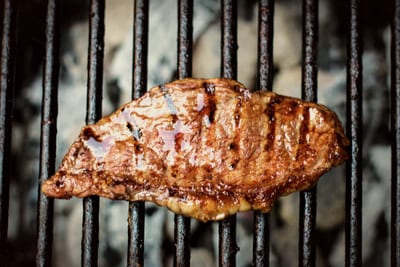
 Buying guide · A method vs a muscleLondon broil vs flank steakA cooking method that became a label, against a belly muscle: what is in the package and how each is cooked.
 Sauce · Marinade for grill and panSteak marinadeOil, soy, lime, garlic and sugar: the basic marinade, how long each kind needs, and why it only reaches the surface.
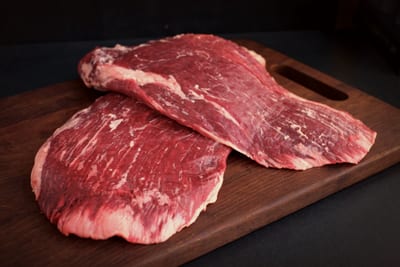 Cut · Flank, long-grainedFlank steakThe flat belly muscle of fajitas, London broil and phở: never past medium-rare, always cut across the grain.
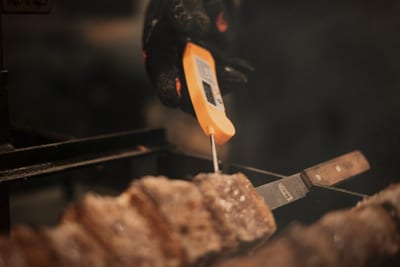 Cooking · Pull early, then restSteak temperature & doneness chartSix levels from blue to well done in °C and °F: when to pull, carryover by thickness, safety, and a printable chart.
 Main course · Lean roast, pink, sliced thinEye of round roastThe leanest roast of the leg, cooked low to 52–54 °C / 126–129 °F and sliced thin: why it dries out, times, temperatures and how to slice it.
Frequently asked questions
How long do you cook London broil in the oven?
Under a fully heated broiler, with the top of the meat 8–10 cm / 3–4 in from the element: about 4–6 minutes per side for a steak 2.5 cm / 1 in thick. Thicker pieces, 4–5 cm / 1½–2 in, cook more evenly with a reverse sear: 30–55 minutes at 120 °C / 250 °F, then a hot sear. Take it off at 52–54 °C / 126–129 °F.
What temperature should London broil be cooked to?
Medium-rare: off the heat at 52–54 °C / 126–129 °F, about 54–57 °C / 129–135 °F after a 10-minute rest. Past 60 °C / 140 °F top round gets dry and tough. The USDA minimum for whole cuts is 63 °C / 145 °F with a 3-minute rest.
How long should you marinate London broil?
4–12 hours in the refrigerator, in a marinade of oil, soy sauce and a little vinegar. Marinades heavy in citrus or vinegar should stay on no more than 8 hours, or the surface turns pale and mealy. The marinade flavors only the outer millimeters.
What cut of meat is London broil?
Today usually top round, the lean inside muscle group of the hind leg (topside in the UK and Australia). The name first meant broiled flank steak, and shops sometimes use it for top sirloin or shoulder steaks.
How do you make London broil tender?
Cook it no further than medium-rare, rest it 10 minutes and slice it 3–5 mm / ⅛–¼ in thin across the grain at a 45° angle. The slicing does more for tenderness than the marinade.
Sources
3
- USDA Agricultural Marketing Service. Institutional Meat Purchase Specifications: Fresh Beef Series 100. Washington, DC, 2014. www.ams.usda.gov/sites/default/files/media/IMPS_100_Fresh_Beef%5B1%5D.pdf
- USDA Food Safety and Inspection Service. Safe Minimum Internal Temperature Chart. 2023. www.fsis.usda.gov/food-safety/safe-food-handling-and-preparation/food-safety-basics/safe-temperature-chart
- McGee, Harold. On Food and Cooking: The Science and Lore of the Kitchen, rev. ed. New York: Scribner, 2004.