Cut · Round, a name for a method
London broil (top round)
London broil is a way of cooking beef, not a cut: a thick, lean steak marinated, broiled or grilled over high heat to rare or medium-rare and carved in thin slices across the grain. It began with flank steak; in American shops today the label almost always means top round, the large inside muscle of the hind leg that Britain and Australia call topside. The name is American: there is no London dish of that name.
At a glance
- Primal
- Round (hind leg), inside
- Muscles
- Semimembranosus, adductor
- Best cooked
- Marinated, broiled or grilled hot to 54 °C, sliced thin
- Cooking yield
- About 72 % of raw weight, grilled (USDA)
- Per 100 g raw
- 23 g protein · 3–5 g fat (lean, USDA)
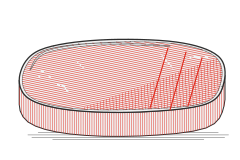
A preparation that became a label
The phrase describes the cooking: "broil" is the American word for cooking under or over direct, intense heat, and the dish is a broiled steak sliced thin. The first meat used for it was flank steak. The American cookery writer James Beard noted in 1974 that, until a few years earlier, London broil had meant only grilled flank, and that supermarkets were by then selling top round, sirloin and other cuts under the same name. In British English the term is rarely used.
Today a package labelled London broil in a US supermarket is usually a top round steak 4–5 cm (1½–2 in) thick, sometimes a piece of top sirloin, shoulder or bottom round. The USDA's descriptions of retail cuts list London broil among the common names of the top round steak, together with round steak and minute steak.
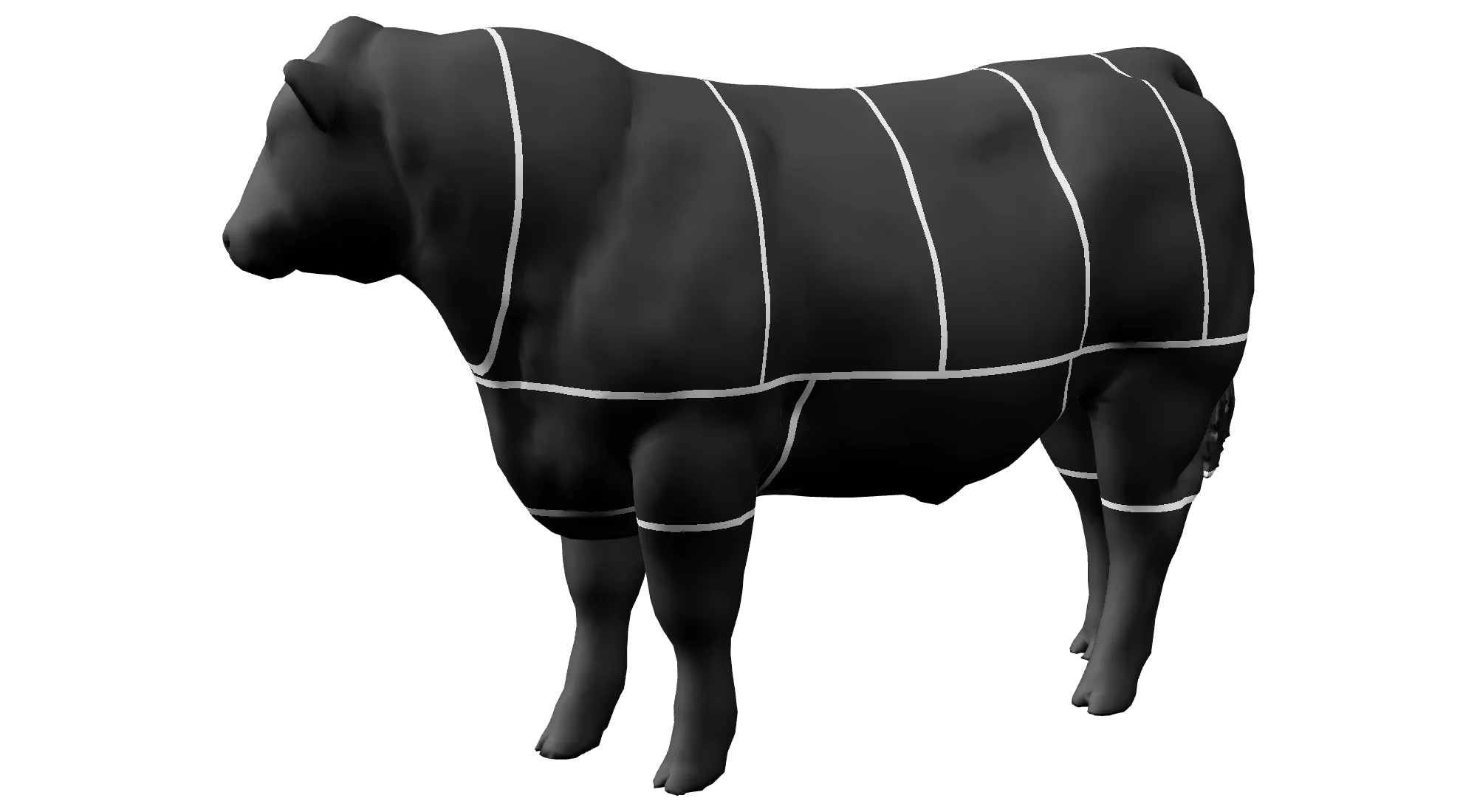
On the animal
 Loading
02 Rib
03 Loin
05 Topside
London broil (top round) · this cutCube steak
06 Brisket
08 Silverside & knuckle
09 Shin
Tap a part to see its cutsDrag to turn · tap a partThe whole cow in 3D →
Top round: the inside of the leg
The round is the hind leg, and the top round (IMPS 168, inside round) is its largest single muscle group, on the inner side of the thigh: the semimembranosus with the adductor alongside it, sold with or without its thin cap (IMPS 169, cap off). It is one of the leanest pieces of the carcass, with long, even fibres and very little intramuscular fat. That makes it easy to slice neatly and affordable, and it also means it dries out and toughens quickly if cooked past medium.
In other countries the same piece is the British and Australian topside, the Argentine nalga (or nalga de adentro), the Mexican cara or pulpa negra, the Spanish tapa, the Chilean posta negra, the Brazilian coxão mole and the French tende de tranche. Next to it in the round sit the bottom round, the eye of round and the knuckle.
How to cook London broil
- Choose a top round steak 3–5 cm (1¼–2 in) thick, so the outside can brown while the centre stays pink.
- Marinate it for 4–12 hours in oil, salt and an acid (vinegar, wine, citrus) with garlic or soy. Salt seasons and helps the surface hold moisture; the acid only acts on the outer millimetres.
- Dry the surface well and bring the meat out of the fridge 30 minutes before cooking.
- Broil it 8–10 cm (3–4 in) below a very hot oven grill, or over direct heat on a barbecue, turning once, until the centre reads 52–54 °C / 126–129 °F for medium-rare.
- Rest it for 10 minutes; it will rise to about 54–57 °C / 129–135 °F.
- Carve it in slices 3–5 mm thick, across the grain and at a 45° angle to the board. Thin, angled slices cut the long fibres short, which is what makes a lean cut feel tender.
Why it can be tough
Top round has almost no marbling to keep it moist, so the window between juicy and dry is narrow: above 60 °C / 140 °F the fibres squeeze out their water and the meat turns firm and grainy. A marinade does not rescue an overcooked London broil, and slicing with the grain leaves long strands to chew. A thermometer and a sharp knife do most of the work. Very thick pieces cook more evenly with the reverse sear: low heat until about 10 °C / 18 °F below the target, then a short, very hot sear. The same piece roasted whole and sliced paper-thin is the classic deli roast beef.
What a kilo gives
In the USDA's cooking-yield study, top round steaks trimmed to 3 mm (⅛ in) of fat kept on average 72 % of their raw weight when broiled or grilled (20 samples, 62–83 %). A kilo of raw London broil therefore gives about 720 g of sliced meat. The lean carries about 23 g of protein and 3–5 g of fat per 100 g raw, which puts top round under the US definition of "extra lean" (less than 5 g of fat per 100 g).
| Per kilo of raw top round steak | Amount | Source |
|---|---|---|
| Cooked weight, broiled or grilled | ≈ 720 g (620–830 g) | USDA cooking yields, 2012 |
| Protein (lean, raw) | ≈ 227–231 g | USDA FoodData Central, SR 23617 · 23636 |
| Fat (lean, raw) | ≈ 34–48 g | USDA FoodData Central, SR 23617 · 23636 |
| Energy (lean, raw) | ≈ 1,290–1,400 kcal | USDA FoodData Central, SR 23617 · 23636 |
Names around the world
24
The same muscle, named by language and by trade system.
| English | London broil · top round · inside round · topside |
| Español | Nalga · nalga de adentro · pulpa negra · tapa · posta negra |
| Tiếng Việt | Nạc mông bò (top round) |
| Português | Coxão mole · chã de dentro |
| Français | Tende de tranche |
| Italiano | Fesa |
| Deutsch | Oberschale |
| 日本語 | 内もも (uchimomo) |
| 한국어 | 우둔살 (udunsal) |
All the cuts' names, country by country →
Trade and national systems
| System | Name | Reference |
|---|---|---|
| United States | Top round · inside round · London broil (thick top round steak) · top round roast | IMPS 168 / 169 · 1168 |
| United Kingdom | Topside | USMEF 2013 · AHDB |
| Australia / NZ | Topside · inside | USMEF 2013 · HAM |
| Argentina | Nalga de adentro · nalga | USMEF 2013 |
| Mexico | Cara · pulpa negra | USMEF 2013 |
| Spain | Tapa | USMEF 2013 |
| Colombia · Peru | Centro de pierna (Colombia) · tapa (Peru) | USMEF 2013 |
| Chile | Posta negra | USMEF 2013 |
| Brazil | Coxão mole · coxão de dentro | USMEF 2013 |
| France | Tende de tranche | USMEF 2013 |
| Italy | Fesa interna | USMEF 2013 |
| Germany | Oberschale | USMEF 2013 |
| Japan | 内もも (uchimomo) · トップラウンド (US import) | JMGA · USMEF 2013 |
| Korea | 우둔살 (udunsal) | USMEF 2013 |
| Vietnam | Nạc mông · đùi trong (approx.) |
Frequently asked questions
What cut of meat is London broil?
Usually top round today, the large inside muscle of the hind leg. It was originally flank steak, and shops sometimes use the name for top sirloin or shoulder steaks.
Is London broil the same as flank steak?
Not any more. London broil first meant broiled flank steak; now the name is mostly given to thick top round steaks.
Why is it called London broil?
The name is American and describes the method, broiling; there is no traditional London dish of that name, and the term is rare in British English.
How do you cook London broil in the oven?
Marinate it, dry it, then broil it 8–10 cm under a very hot grill, turning once, until 52–54 °C / 126–129 °F inside. Rest 10 minutes and slice thin across the grain.
What temperature should London broil be cooked to?
Medium-rare: take it off at 52–54 °C / 126–129 °F and let it rest to 54–57 °C. Past 60 °C / 140 °F this lean cut gets dry and tough.
How do you slice London broil?
Thinly, 3–5 mm, across the grain and at a 45° angle. Cutting the long fibres short is what makes it tender.
What is London broil called in Spanish?
The top round is nalga in Argentina, cara or pulpa negra in Mexico, tapa in Spain and Peru and posta negra in Chile.
Sources
12
- USDA Agricultural Marketing Service. Institutional Meat Purchase Specifications: Fresh Beef Series 100. Washington, DC, 2014. www.ams.usda.gov/sites/default/files/media/IMPS_100_Fresh_Beef%5B1%5D.pdf
- North American Meat Institute. The Meat Buyer's Guide, 8th ed. Washington, DC, 2014.
- AUS-MEAT Limited. Handbook of Australian Meat, 7th ed. (International Red Meat Manual). Brisbane, 2005. www.ausmeat.com.au
- Agriculture and Horticulture Development Board (UK). Beef Meat Purchasing Guide. Kenilworth, 2016. ahdb.org.uk
- Japan Meat Grading Association. Beef Carcass Grading Standard. Tokyo, 1988 (rev. 2014). www.jmga.or.jp
- McGee, Harold. On Food and Cooking: The Science and Lore of the Kitchen, rev. ed. New York: Scribner, 2004.
- Beard, James. Beard on Food. New York: Alfred A. Knopf, 1974.
- USDA Agricultural Research Service, Nutrient Data Laboratory. Beef retail cuts: descriptions and common names (Retail Beef Cuts). Beltsville, MD.
- Huerta-Leidenz, Nelson. International Nomenclature Guide of Beef Cuts for the U.S.A. and Other Countries Targeted by the U.S. Meat Export Federation. Denver: U.S. Meat Export Federation, 2013. www.usa-beef.org/wp-content/uploads/2020/07/1064.GUIDE_beef-cuts_ingl%C3%A9s_09oct13.pdf
- Showell, B. A.; Williams, J. R.; Duvall, M.; Howe, J. C.; Patterson, K. Y.; Roseland, J. M.; Holden, J. M. USDA Table of Cooking Yields for Meat and Poultry. Beltsville, MD: USDA Agricultural Research Service, Nutrient Data Laboratory, 2012. www.ars.usda.gov/ARSUserFiles/80400525/Data/retn/USDA_CookingYields_MeatPoultry.pdf
- USDA Agricultural Research Service. FoodData Central, SR Legacy (National Nutrient Database for Standard Reference). Beltsville, MD, 2019. fdc.nal.usda.gov
- U.S. Food and Drug Administration. 21 CFR 101.62(e), nutrient content claims: "lean" and "extra lean" for meat. www.ecfr.gov/current/title-21/chapter-I/subchapter-B/part-101/subpart-D/section-101.62
Related