Cut · Sirloin, the American meaning
Top sirloin
Top sirloin is the American name for the boneless steak cut from the top of the sirloin, the section between the short loin and the round. Its centre is the gluteus medius, the same muscle that Britain and Australia sell as rump steak: lean, beefy and best cooked fast to medium-rare. It is not the British sirloin, which is the striploin.
At a glance
- Primal
- Sirloin (US) · rump (UK, Australia)
- Muscle
- Gluteus medius (+ the cap, biceps femoris)
- Best cooked
- Grilled or pan-seared, 2.5–4 cm thick, to 54–57 °C
- Cooking yield
- About 80 % of raw weight, grilled (USDA)
- Per 100 g raw
- 22 g protein · 4 g fat (lean, USDA)
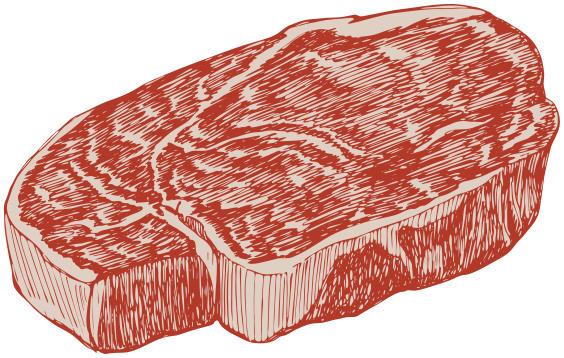 Sirloin steak
Two sirloins: the American and the British
The word sirloin names two different cuts depending on the country. In the United States the sirloin is the section of the hindquarter behind the short loin and in front of the round, over the hip bone. In Britain, Australia, New Zealand and South Africa, sirloin means the boneless loin muscle behind the ribs, the cut Americans call the striploin or New York strip. A British "sirloin steak" and an American "sirloin steak" are therefore different muscles, with a different grain, fat and price.
What the United States sells as top sirloin, Britain and Australia sell as rump. The word comes from the Old French surlonge, "above the loin"; the story of an English king knighting a loin of beef "Sir Loin" is a later joke, recorded from the seventeenth century, that at most changed the spelling.
On the animal
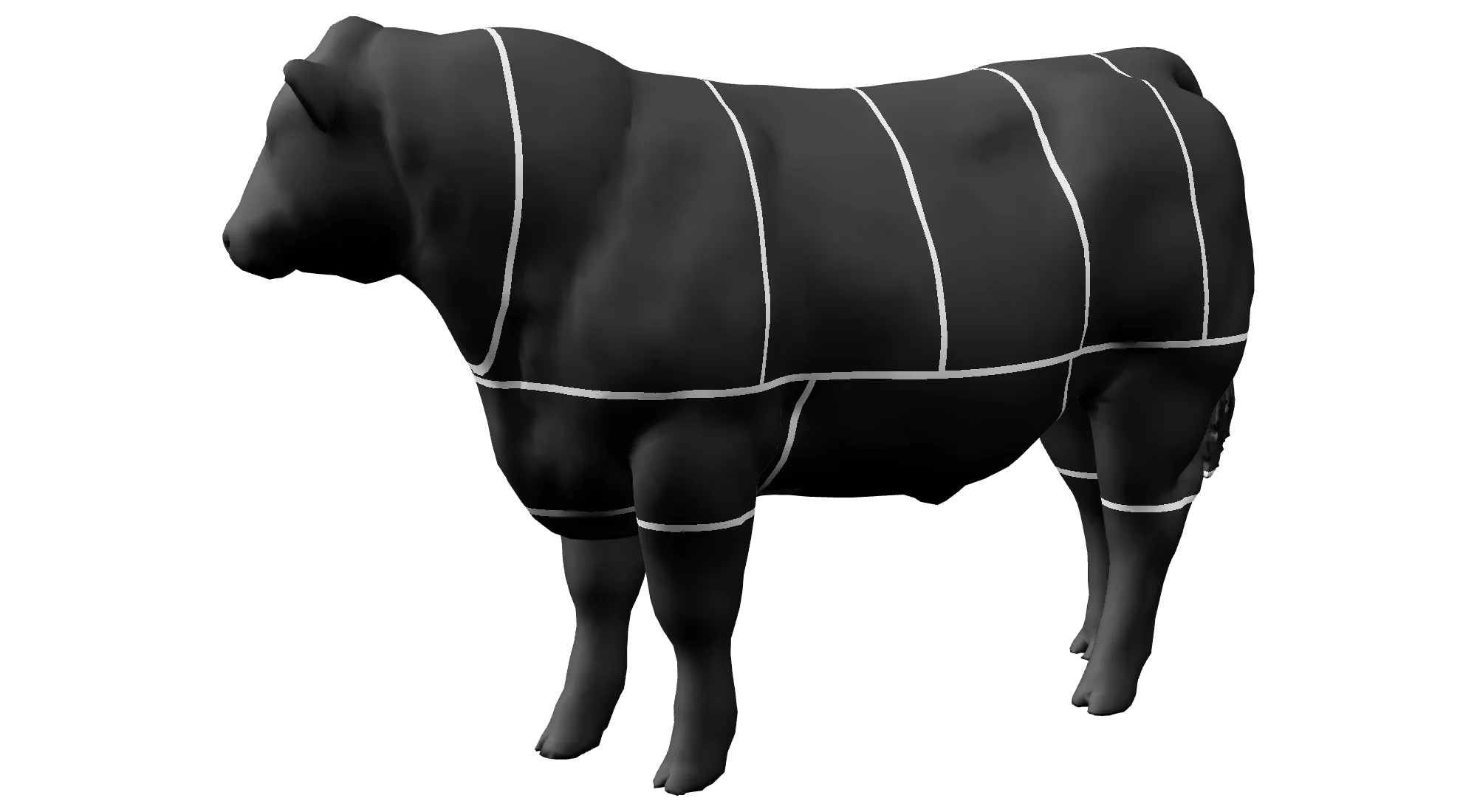 Loading
02 Rib
03 Loin
05 Topside
06 Brisket
08 Silverside & knuckle
09 Shin
Tap a part to see its cutsDrag to turn · tap a partThe whole cow in 3D →
Top sirloin and bottom sirloin
American fabrication splits the sirloin into two pieces. The top sirloin butt (IMPS 184) is the upper, larger muscle group: the gluteus medius at its centre, with the small gluteus accessorius and gluteus profundus beneath and the top sirloin cap (biceps femoris, IMPS 184D) over it. With the cap removed it is sold as centre-cut top sirloin (184B), and steaks cut across it are listed as 1184. Because the gluteus medius makes up most of the piece, a top sirloin steak eats as one even, fine-grained muscle.
The bottom sirloin butt (IMPS 185) is the thinner lower part, divided into three cuts sold under their own names: the flap (185A, the bavette), the ball tip (185B) and the tri-tip (185C). A steak labelled only "sirloin steak" can come from either part; the word "top" on the label is what promises the tender upper muscle.
| Part of the US sirloin | IMPS | Main muscle | Sold elsewhere as |
|---|---|---|---|
| Top sirloin butt (centre) | 184 / 184B | Gluteus medius | Rump (UK, AU) · cuadril (AR) · alcatra (BR) |
| Top sirloin cap | 184D | Biceps femoris | Picanha · rump cap · tapa de cuadril |
| Tri-tip | 185C | Tensor fasciae latae | Colita de cuadril (AR) · maminha (BR) |
| Ball tip | 185B | Front end of the knuckle muscles | Part of the knuckle (thick flank) |
| Flap | 185A | Obliquus internus abdominis | Bavette · part of the vacío (AR) |
Cooking it: hot and fast, to 54–57 °C
Top sirloin is lean, so it rewards high heat and short cooking. A steak 2.5–4 cm (1–1½ in) thick, seasoned with salt ahead of time, is seared over a hot grill or in a heavy pan until a dark crust forms, then taken off at about 52–54 °C / 126–129 °F in the centre for medium-rare; resting brings it up to 54–57 °C / 129–135 °F. Past medium (60 °C / 140 °F) there is little intramuscular fat to keep it moist, and the meat firms up quickly.
Thicker pieces, and the whole centre-cut top sirloin roasted as a joint, do best with the reverse sear: low heat until about 10 °C / 18 °F below the target, then a short, very hot sear. Slicing across the grain matters more than with the striploin, because the gluteus medius has a coarser fibre. A marinade adds flavour to the surface but does not tenderise the inside.
The US food-safety agency sets 63 °C / 145 °F with a three-minute rest as the minimum for whole cuts of beef; cooks who serve it rarer rely on the fact that, in an intact steak, bacteria sit on the surface that the sear reaches.
What a kilo gives
In the USDA's cooking-yield study, top sirloin steaks trimmed to 3 mm (⅛ in) of fat kept on average 80 % of their raw weight when grilled (20 samples, from 69 % to 87 %). A kilo of raw steak therefore gives about 800 g on the plate; the 200 g lost is mostly water and some fat. The lean meat carries about 22 g of protein and 4 g of fat per 100 g raw, which places top sirloin under the US definition of "extra lean" (less than 5 g of fat and 2 g of saturated fat per 100 g).
| Per kilo of raw top sirloin steak | Amount | Source |
|---|---|---|
| Cooked weight after grilling | ≈ 800 g (690–870 g) | USDA cooking yields, 2012 |
| Protein (lean, raw) | ≈ 221 g | USDA FoodData Central, SR 23611 |
| Fat (lean, raw) | ≈ 41 g | USDA FoodData Central, SR 23611 |
| Energy (lean, raw) | ≈ 1,310 kcal | USDA FoodData Central, SR 23611 |
Choosing one at the counter
Look for the word top: "top sirloin steak" or "centre-cut top sirloin" means the gluteus medius, while plain "sirloin steak" may include muscles from the bottom sirloin. An even thickness of at least 2.5 cm, fine flecks of marbling and a clean, cherry-red surface are the signs of a good steak; higher grades (USDA Choice and Prime) carry more marbling and stay juicier.
Two labels cause confusion. A sirloin cap or coulotte steak is the cap muscle, the picanha, cut into steaks. A sirloin tip is not sirloin at all: it is the knuckle, a lean muscle group of the round, better roasted or braised than grilled.
Names around the world
22
The same muscle, named by language and by trade system.
| English | Top sirloin · sirloin steak (US) · top sirloin butt |
| Español | Corazón de cuadril · aguayón superior · corazón de cadera |
| Tiếng Việt | Lõi thăn mông (top sirloin) |
| Português | Alcatra · miolo da alcatra |
| Français | Cœur de rumsteck |
| Italiano | Cuore dello scamone |
| Deutsch | Hüfte · Hüftsteak |
| 日本語 | トップサーロイン · ランプ (ranpu) |
All the cuts' names, country by country →
Trade and national systems
| System | Name | Reference |
|---|---|---|
| United States | Top sirloin steak · top sirloin butt (whole) · centre-cut sirloin · sirloin steak | IMPS 184 / 1184 |
| United Kingdom | Rump · rump steak (not "sirloin", which is the striploin) | USMEF 2013 · AHDB |
| Australia / NZ | Rump · rump steak | USMEF 2013 · HAM |
| Argentina | Cuadril | USMEF 2013 |
| Mexico | Aguayón superior · gallina | USMEF 2013 |
| Spain | Corazón de cadera | USMEF 2013 |
| Colombia · Peru | Cadera (Colombia) · asado de cadera (Peru) | USMEF 2013 |
| Chile | Asiento de picaña | USMEF 2013 |
| Brazil | Alcatra · miolo da alcatra | USMEF 2013 |
| France | Cœur de rumsteck | USMEF 2013 |
| Italy | Cuore dello scamone | USMEF 2013 |
| Germany | Hüfte · Herz der Hüfte | USMEF 2013 |
| Japan | トップサーロイン (US import name) · ランプ (ranpu, Japanese rump) | USMEF 2013 · JMGA |
| Vietnam | Thăn mông (approx.) |
Frequently asked questions
What is top sirloin steak?
A boneless steak from the top of the US sirloin, cut mainly from the gluteus medius over the hip. It is lean, beefy and best cooked fast to medium-rare.
Is top sirloin the same as sirloin?
In the US, top sirloin is the upper and more tender part of the sirloin; plain "sirloin steak" can also come from the bottom sirloin. In the UK and Australia, sirloin means the striploin, a different cut.
Is top sirloin the same as rump steak?
Yes, largely. The British and Australian rump steak is cut from the same muscle, the gluteus medius, though a British or Australian rump steak is often cut across the whole rump, cap included.
Top sirloin vs New York strip: which is better?
The New York strip (striploin) is more tender and more marbled; top sirloin is leaner, has more beef flavour per bite and costs less.
What temperature should top sirloin be cooked to?
Take it off the heat at about 52–54 °C / 126–129 °F for medium-rare; it finishes at 54–57 °C / 129–135 °F after resting. USDA's minimum for whole beef cuts is 63 °C / 145 °F.
Is top sirloin a good steak?
It is one of the leanest tender steaks: less marbled than ribeye or strip, but tender when cooked no further than medium and sliced across the grain.
What is top sirloin called in Spanish?
Cuadril in Argentina and Uruguay, aguayón superior in Mexico, corazón de cadera in Spain and cadera in Colombia.
Sources
10
- USDA Agricultural Marketing Service. Institutional Meat Purchase Specifications: Fresh Beef Series 100. Washington, DC, 2014. www.ams.usda.gov/sites/default/files/media/IMPS_100_Fresh_Beef%5B1%5D.pdf
- North American Meat Institute. The Meat Buyer's Guide, 8th ed. Washington, DC, 2014.
- AUS-MEAT Limited. Handbook of Australian Meat, 7th ed. (International Red Meat Manual). Brisbane, 2005. www.ausmeat.com.au
- Agriculture and Horticulture Development Board (UK). Beef Meat Purchasing Guide. Kenilworth, 2016. ahdb.org.uk
- USDA Food Safety and Inspection Service. Safe Minimum Internal Temperature Chart. 2023. www.fsis.usda.gov/food-safety/safe-food-handling-and-preparation/food-safety-basics/safe-temperature-chart
- McGee, Harold. On Food and Cooking: The Science and Lore of the Kitchen, rev. ed. New York: Scribner, 2004.
- Huerta-Leidenz, Nelson. International Nomenclature Guide of Beef Cuts for the U.S.A. and Other Countries Targeted by the U.S. Meat Export Federation. Denver: U.S. Meat Export Federation, 2013. www.usa-beef.org/wp-content/uploads/2020/07/1064.GUIDE_beef-cuts_ingl%C3%A9s_09oct13.pdf
- Showell, B. A.; Williams, J. R.; Duvall, M.; Howe, J. C.; Patterson, K. Y.; Roseland, J. M.; Holden, J. M. USDA Table of Cooking Yields for Meat and Poultry. Beltsville, MD: USDA Agricultural Research Service, Nutrient Data Laboratory, 2012. www.ars.usda.gov/ARSUserFiles/80400525/Data/retn/USDA_CookingYields_MeatPoultry.pdf
- USDA Agricultural Research Service. FoodData Central, SR Legacy (National Nutrient Database for Standard Reference). Beltsville, MD, 2019. fdc.nal.usda.gov
- U.S. Food and Drug Administration. 21 CFR 101.62(e), nutrient content claims: "lean" and "extra lean" for meat. www.ecfr.gov/current/title-21/chapter-I/subchapter-B/part-101/subpart-D/section-101.62
Related