
Main course · Lean roast, pink, sliced thin
Eye of round roast
Eye of round is the leanest roast of the hind leg, with almost no fat to protect it, so it dries out fast. Roast a whole eye of 1.5 kg / 3.3 lb at 110–120 °C / 230–250 °F for about 1½–2 hours, take it out at 52–54 °C / 126–129 °F, rest it 15 minutes and slice it as thin as you can across the grain. It finishes at 54–57 °C / 129–135 °F, evenly pink from edge to edge, and a kilo of raw meat gives about 810 g / 29 oz of roast.
At a glance
- Cut
- Eye of round, 1.5 kg / 3.3 lb, even thickness
- Oven
- 110–120 °C / 230–250 °F, about 1½–2 h
- Medium-rare
- Out at 52–54 °C / 126–129 °F; final 54–57 °C / 129–135 °F after 15 min
- Slice
- 3 mm / ⅛ in or thinner, across the grain
- Yield
- About 81 % of raw weight (USDA); serves 6–7
A lean roast with no margin for error
The eye of round is the semitendinosus, a long, even cylinder of 1.5–2.5 kg / 3.3–5.5 lb from the back of the hind leg. It carries about 23 g of protein and only 2.5–3.5 g of fat per 100 g / 3.5 oz raw, with no marbling to keep it moist once its fibers tighten. Past 60 °C / 140 °F it turns dry and grainy, so the distance between pink and dry is a matter of a few degrees.
Three habits keep it juicy. Roast it at low heat, 110–120 °C / 230–250 °F, so the whole cylinder warms through together. Take it out by thermometer at 52–54 °C / 126–129 °F, not by the clock. And slice it as thin as possible across the grain. This is a roast for thin slices, hot on a plate or cold in a sandwich. For a fattier, thicker-carved Sunday roast see roast beef; for a lean roast carved in thick medallions, beef tenderloin roast; for the neighboring top round cooked hot and fast, London broil.
Ingredients
| Ingredient | Amount | Note |
|---|---|---|
| Eye of round | 1 piece, 1.5 kg / 3.3 lb | even thickness from end to end; serves 6–7 |
| Coarse salt | about 1 % of the weight (15 g) | 12–24 hours ahead |
| Black pepper | to taste | coarsely ground |
| Neutral oil | 1 tbsp | for the sear |
| Kitchen string | a few lengths | to tie the tapered end |
| Mustard or horseradish, bread | to serve | for sandwiches |
Salt a day ahead, roast low, rest 15 minutes
- Trim the silverskin: slide a thin knife under the shiny layer along one side and peel it off in strips. It does not soften in the oven. If one end tapers, fold the last few centimeters back under and tie the roast in two or three places so it has the same thickness along its length, or cut the tapered end off and keep it for a stew.
- Salt the roast on all sides with about 1 % of its weight (15 g for 1.5 kg / 3.3 lb) 12–24 hours ahead and leave it uncovered on a rack in the refrigerator. See salting steak.
- Take the roast out of the refrigerator 1 hour before it goes in the oven. Heat the oven to 110–120 °C / 230–250 °F. Pat the roast dry, rub it with pepper and the oil, and sear it in a heavy pan over high heat, turning it until it is browned on all sides.
- Put the roast on a rack over a tray. Insert a probe thermometer so the tip sits in the center of the thickest part.
- Roast for about 1½–2 hours for a 1.5 kg / 3.3 lb eye that has sat out of the refrigerator for 1 hour after its 12–24 hours of salting. Start probing after 1 hour, and take it out when the center reads 52–54 °C / 126–129 °F.
- Rest it on a board, uncovered or loosely tented with foil, for 15 minutes. The center rises to 54–57 °C / 129–135 °F, medium-rare. See resting steak.
- Remove the string and slice across the grain, 3 mm / ⅛ in thick or thinner (see below). Pour the juices from the board over the slices.
Temperatures
| Doneness | Take out of the oven | Final, after the 15-minute rest |
|---|---|---|
| Rare | 45–48 °C / 118 °F 113–118 °F | 48–52 °C / 126 °F 118–126 °F |
| Medium-rare (recommended) | 52–54 °C / 129 °F 126–129 °F | 54–57 °C / 135 °F 129–135 °F |
| Above 60 °C / 140 °F | — | dry and grainy: no marbling to compensate |
| USDA safe minimum (whole cuts) | — | 63 °C / 145 °F 145 °F with a 3-minute rest |
Timeline for a 1.5 kg / 3.3 lb eye
A heavier eye (the cut runs up to 2.5 kg / 5.5 lb) takes longer, and the time grows faster than the weight because the heat has farther to travel to the center. Go by the probe, not by the clock; the steak temperature chart has the full scale.
| Step | Time | Note |
|---|---|---|
| Salt | 12–24 h ahead | uncovered, on a rack, in the refrigerator; out 1 h before roasting |
| Sear | a few minutes | browned on all sides, before the oven |
| Oven at 110–120 °C / 230–250 °F | 1½–2 h | until the center reads 52–54 °C / 129 °F 126–129 °F |
| Rest | 15 min | rises to 54–57 °C / 135 °F 129–135 °F |
| Slice | a few minutes | 3 mm / ⅛ in or thinner |
Slicing: where the tenderness comes from
The fibers of the eye run along its length, so the knife goes across the roast: each slice is a round and each fiber is cut into pieces a few millimeters long. Slice 3 mm / ⅛ in thick or thinner with a long, sharp knife; at that thickness the meat cuts more cleanly once it is cold or well rested. Thin slices across the grain are what make a lean muscle feel tender; thick slices or slices cut lengthwise are the usual reason a lean roast is called tough (see why steak is tough).
For deli-style slices, chill the cooked roast for several hours: cold meat is firmer and slices evenly thin. Serve it warm with the board juices, or cold in sandwiches with mustard or horseradish.
Roast it, braise it or poach it
This recipe is the roast. The other tradition cooks the eye whole until it can be cut with a spoon, in liquid. Two versions add fat: the Mexican cuete mechado, studded with bacon, and the Brazilian lagarto recheado, stuffed. In Argentina and Uruguay the peceto is poached whole and sliced for vitel toné (see the cut page). Braising suits collagen-rich cuts; a lean eye braised plain can go dry and stringy. Steaks cut from the eye are small and lean: marinate them and cook them fast, or pound them thin for milanesa.
What a kilo gives, and leftovers
In the USDA's cooking-yield study, eye of round roasts trimmed to 3 mm (⅛ in) of fat kept on average 81 % of their raw weight when roasted, so a 1.5 kg / 3.3 lb eye gives about 1.2 kg / 2.7 lb of cooked meat. Plan 200–250 g / 7–9 oz raw per adult, the same allowance as for a tenderloin roast: one eye of 1.5 kg / 3.3 lb serves six or seven.
Put leftovers in the refrigerator within 2 hours; they keep 3–4 days (see reheating steak), and are best eaten cold, thinly sliced. On safety: the USDA minimum for whole cuts is 63 °C / 145 °F with a 3-minute rest, and a medium-rare roast is below it by choice. In an intact whole muscle the bacteria are on the surface, which the sear reaches; beef that has been mechanically (needle) tenderized, which the label should say, should be cooked to 63 °C / 145 °F.
What dries an eye of round
Roasting at a high temperature: the outside overcooks before the center is warm. Cooking by the clock: 1½–2 hours is a range, and ovens and roasts vary. Pulling the roast at 60 °C / 140 °F or more, which leaves it dry. Skipping the rest, or resting it under tight foil. Leaving the silverskin on, so it stays tough in the slices. Slicing it thick or along the fibers. And a tapered end left untied, which overcooks long before the center of the roast is ready.
Keep reading
 Cut · Round, the leanest roastEye of roundA lean cylinder from the back of the leg: roast beef sliced thin, or the peceto, cuete and lagarto braised whole.
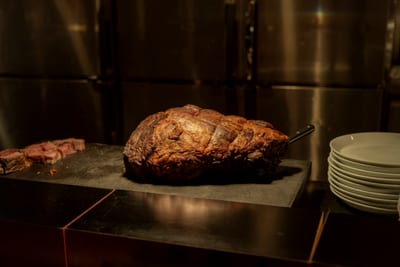 Main course · The English SundayRoast beefEngland's Sunday roast: fore rib or sirloin browned, roasted gently and rested, with Yorkshire pudding and horseradish.
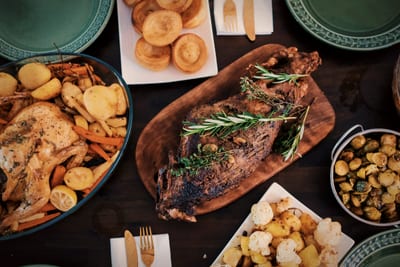 Main course · Tied, roasted pinkBeef tenderloin roastThe whole tenderloin, tied and pulled at 50–52 °C / 122–126 °F for a pink center: trimming, the chain and the tail, a pan sauce.
 Main course · Marinated, broiled, sliced thinLondon broilTop round marinated 4–12 hours, broiled or grilled hot to medium-rare and sliced thin across the grain: the marinade, times by thickness and temperatures.
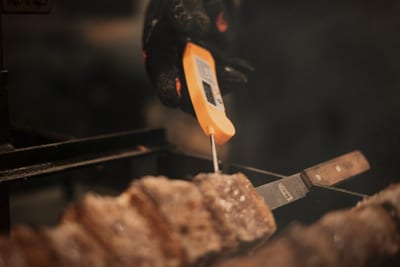 Cooking · Pull early, then restSteak temperature & doneness chartSix levels from blue to well done in °C and °F: when to pull, carryover by thickness, safety, and a printable chart.
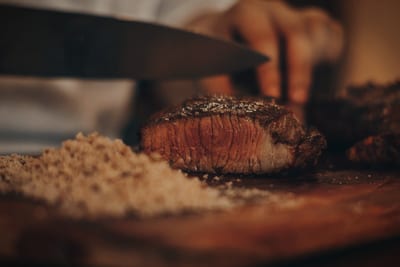 Cooking · Five to ten minutesResting steakThe core climbs 1–8 °C / 2–14 °F and less juice reaches the board: how long to rest, what tests show, when to skip it.
Frequently asked questions
How long do you cook an eye of round roast?
About 1½–2 hours for a 1.5 kg / 3.3 lb eye at 110–120 °C / 230–250 °F, until the center reads 52–54 °C / 126–129 °F, then a 15-minute rest. Go by the thermometer, not by the time.
What temperature should an eye of round roast be?
Take it out at 52–54 °C / 126–129 °F; after the rest it finishes at 54–57 °C / 129–135 °F, medium-rare. Past 60 °C / 140 °F it turns dry and grainy.
Why is my eye of round roast dry or tough?
It has almost no fat, so a few degrees too many dry it out, and its long fibers feel tough when it is sliced thick or along the grain. Roast it low to 52–54 °C / 126–129 °F, rest it and slice it 3 mm / ⅛ in thin across the grain.
How much eye of round per person?
About 200–250 g / 7–9 oz raw per adult. A 1.5 kg / 3.3 lb eye serves six or seven and gives about 1.2 kg / 2.7 lb of cooked meat (81 % of the raw weight).
Can you slice an eye of round roast for deli-style sandwiches?
Yes. Chill the cooked roast for several hours, then slice it 3 mm / ⅛ in thick or thinner across the grain. It keeps 3–4 days in the refrigerator.
Sources
3
- USDA Food Safety and Inspection Service. Safe Minimum Internal Temperature Chart. 2023. www.fsis.usda.gov/food-safety/safe-food-handling-and-preparation/food-safety-basics/safe-temperature-chart
- McGee, Harold. On Food and Cooking: The Science and Lore of the Kitchen, rev. ed. New York: Scribner, 2004.
- USDA Agricultural Marketing Service. Institutional Meat Purchase Specifications: Fresh Beef Series 100. Washington, DC, 2014. www.ams.usda.gov/sites/default/files/media/IMPS_100_Fresh_Beef%5B1%5D.pdf