
Main course · Rump cap, fat side first
Picanha
Picanha is the rump cap, a triangle of lean muscle under a layer of fat 1–2 cm / ½–¾ in thick, and the recipe is built around that fat: it goes toward the heat first, renders and seasons the meat. A whole piece (1–1.5 kg / 2.2–3.3 lb) serves three or four. The simplest way to cook it is to cut it with the grain into three or four steaks 3–4 cm / 1¼–1½ in thick, salt them with coarse salt, render the fat edge over the fire and grill them to 51–52 °C / 124–126 °F at the center for medium-rare. Whole, it does well in a 120 °C / 250 °F oven followed by a hard sear. Either way it is sliced thin, across the grain.
At a glance
- Cut
- Rump cap (top sirloin cap, coulotte), fat on
- Size
- 1–1.5 kg / 2.2–3.3 lb; serves 3–4
- Steaks
- 3–4 cm / 1¼–1½ in, cut with the grain
- Medium-rare
- Off the grill at 51–52 °C / 124–126 °F
- Key
- Fat toward the heat first; slice across the grain
Steaks, whole or on the skewer
The picanha is the cap of the rump (biceps femoris), sold in the United States as top sirloin cap or coulotte, in Britain and Australia as rump cap and in Argentina as tapa de cuadril. It can be cooked three ways. Cut into thick steaks, it grills in about the time of any thick steak. Whole, it is a small roast that suits a low oven or a slow fire. Folded into a C on long skewers, fat outside, it is the centerpiece of the Brazilian churrasco, carved in layers as it browns.
This recipe covers the first two, the ways a single picanha is usually cooked at home; the skewer method, the rodízio service and the sides of a full churrasco are in the churrasco recipe. Under its fat the picanha is a lean muscle, so whatever the method it is best between medium-rare and medium; past about 60 °C / 140 °F it dries out.
Read the piece before you cut it
Check the size first. A trimmed picanha weighs 1–1.5 kg / 2.2–3.3 lb; a heavier piece usually includes part of the tougher muscle beneath it. The fat should be white to cream, 1–2 cm / ½–¾ in thick and continuous. Leave it on: it protects the lean meat and bastes it as it renders, and each diner can set it aside on the plate. If it is much thicker than 2 cm / ¾ in, trim it down to that. Some cooks score it in a shallow crosshatch, without cutting into the meat, so the salt reaches further and the fat renders more evenly.
Then look at the grain on the raw meat side, where the fibers are easiest to see. For steaks, cut the piece with the grain, parallel to the fibers, into three or four pieces 3–4 cm / 1¼–1½ in thick, each with its strip of fat. Cut that way, the cooked steaks are then sliced across the fibers on the board, which is what makes them tender to eat; cut the other way, every slice at the table runs along the grain. It is the same cut used for the skewers of a churrasco.
Ingredients
| Ingredient | Amount | Note |
|---|---|---|
| Picanha (rump cap), fat on | 1 whole piece (1–1.5 kg / 2.2–3.3 lb) | serves 3–4 |
| Coarse salt (sal grosso, sal gruesa) | about 1 % of the weight (10–15 g) | just before cooking, or the day before |
| Black pepper | to taste | optional, after cooking |
| Lump charcoal or hardwood | enough for a two-zone fire | or a gas grill |
| Flaky salt | to finish | after slicing |
| Chimichurri or Brazilian vinaigrette (vinagrete) | to serve | optional |
Method: picanha steaks on the grill
- Light the charcoal or wood about 40 minutes ahead and let it burn down to glowing embers, with no flame. Spread them into a hot zone, a medium zone and an area with no fire below; see grilling over fire.
- Pat the picanha dry, check the fat and cut the piece with the grain into three or four steaks 3–4 cm / 1¼–1½ in thick, as described above.
- Salt the steaks on all sides with coarse salt just before they go on the grill and shake off the excess. For a dry brine instead, salt them with about 1 % of their weight the day before, or at least 40 minutes ahead, and leave them uncovered on a rack in the refrigerator; see salting steak.
- Start with the fat. Stand the steaks on their fat edge over the medium zone, or lay them fat side down, until the fat is golden and has rendered. Dripping fat causes flare-ups: move the steaks over the area with no fire until the flames die down.
- Sear the two cut faces over the hot zone for 2–3 minutes each, then move the steaks to the medium zone, closing the lid on a kettle grill, until the center reads 51–52 °C / 124–126 °F for medium-rare. In all, a 4 cm / 1½ in steak takes about 10–14 minutes; a 3 cm / 1¼ in steak a little less.
- Rest the steaks for about 5 minutes. Finished over the medium zone, they rise a further 3–4 °C / 5–7 °F, into the final medium-rare range.
- Slice thin, across the grain, so that each slice keeps a little of the fat. Finish with flaky salt, and pepper if you like.
Whole picanha in the oven
A whole picanha is thick enough for the reverse sear. Salt it, set it fat side up on a rack over a tray in a 120 °C / 250 °F oven with a probe in the thickest part, and take it out at 43–46 °C / 110–115 °F for medium-rare. The time depends on thickness, not weight: about 30–40 minutes where the piece is 4 cm / 1½ in thick and 40–55 minutes where it is 5 cm / 2 in. Then sear it in a smoking-hot cast-iron pan or over the hottest part of the grill, fat side down first until the fat is crisp and brown, then 45–90 seconds on each of the other faces. It should finish at 53–56 °C / 127–133 °F. Rest it 1–2 minutes, then cut it into steaks with the grain and slice each one thinly across it.
Whole over the embers
On an Argentine-style grill the whole piece is cooked slowly, fat side down first, over low embers 20–30 cm / 8–12 in below the grate, for 1–2 hours, and turned to brown the meat side. On a kettle grill, render and brown the fat over the hot zone, then finish the piece over the cool side with the lid closed. Either way, take it off at 51–52 °C / 124–126 °F in the thickest part for medium-rare and rest it 8–10 minutes: a thick piece keeps rising after it leaves the fire (see carryover in the steak temperature chart).
Temperatures
| Doneness | Oven (reverse sear): out → final | Grill: off the heat → after resting |
|---|---|---|
| Rare | 40–43 °C / 104–109 °F → 49–52 °C / 120–126 °F | 47–48 °C / 117–118 °F → 50–52 °C / 122–126 °F |
| Medium-rare | 43–46 °C / 110–115 °F → 53–56 °C / 127–133 °F | 51–52 °C / 124–126 °F → 54–56 °C / 129–133 °F |
| Medium | 49–52 °C / 120–126 °F → 58–61 °C / 136–142 °F | 56–57 °C / 133–135 °F → 59–61 °C / 138–142 °F |
| USDA safe minimum (whole cuts) | 63 °C / 145 °F 145 °F with a 3-minute rest | 63 °C / 145 °F 145 °F with a 3-minute rest |
How far to cook it
Medium-rare is the usual target. Because of its fat, many cooks take picanha to the top of that range or just past it, a final 55–58 °C / 131–136 °F, where the fat softens (see temperatures by cut in the steak temperature chart). Past about 60 °C / 140 °F the lean muscle under the cap dries out. The USDA safe minimum for whole cuts, 63 °C / 145 °F with a 3-minute rest, is the right one for people who are pregnant, elderly, very young or immunocompromised.
Times
| Method | Size | Time to medium-rare |
|---|---|---|
| Steaks on the grill: sear, then medium zone | 4 cm / 1½ in thick | 10–14 min in total |
| Whole, oven at 120 °C / 250 °F, then sear | 4 cm / 1½ in at the thickest | 30–40 min, plus the sear |
| Whole, oven at 120 °C / 250 °F, then sear | 5 cm / 2 in at the thickest | 40–55 min, plus the sear |
| Whole over low embers, Argentine style | 1 piece (1–1.5 kg / 2.2–3.3 lb) | 1–2 h |
| Folded on skewers (churrasco) | steaks 3–4 cm / 1¼–1½ in | first slices after 15–20 min |
Common mistakes
Five habits spoil most picanhas. Trimming off the fat before cooking, which leaves an ordinary lean steak. Cutting the steaks across the grain, so that every slice on the plate runs along it. Cooking over flame instead of embers, so the dripping fat flares up and blackens the meat. Salting 3–40 minutes before cooking, when the salt has drawn out a film of brine that must boil off before the surface can brown (see salting steak). And cooking it past medium: under the cap the muscle is lean and dries out quickly.
Buying and serving
Ask for picanha, top sirloin cap, coulotte, rump cap or tapa de cuadril, whole and with its fat; steaks sold as coulotte steak are sometimes trimmed bare. Plan one whole piece for three or four people as a main course; as part of a mixed grill it goes further. Serve it with chimichurri, or the Brazilian way with farofa, vinagrete and white rice (see churrasco). For the difference from its neighbor on the rump, see picanha vs tri-tip; for its other Brazilian names, Brazilian beef cuts.
Keep reading
 Cut · Rump cap, fat onPicanhaThe rump cap with its fat on: churrasco, tapa de cuadril, coulotte, and how to buy and slice it.
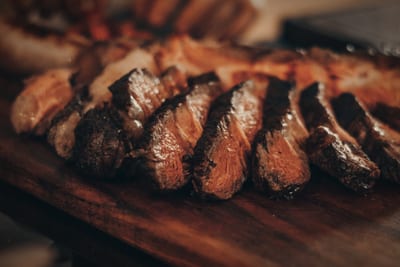 Main course · Brazil, on the skewerChurrascoBrazil's beef on skewers over embers: sal grosso, picanha folded fat-side out, carved in layers at the table.
 Buying guide · Cap vs trianglePicanha vs tri-tipThe rump cap under 1–2 cm / ½–¾ in of fat against the lean rump triangle: muscle, grain, names by country, cooking and yield.
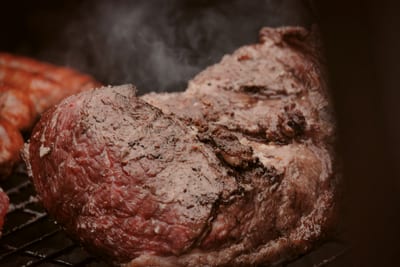 Cooking · Low oven, sear lastReverse searLow oven first, sear last: one even pink edge to edge, a crust in under a minute, and when it is not worth it.
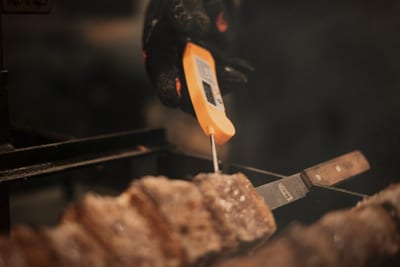 Cooking · Pull early, then restSteak temperature & doneness chartSix levels from blue to well done in °C and °F: when to pull, carryover by thickness, safety, and a printable chart.
 Sauce · Asado, hand-choppedChimichurriThe green sauce of the asado: parsley, garlic, oregano, chili, vinegar and oil, chopped by hand and rested for hours.
Frequently asked questions
How long does it take to cook picanha?
As steaks 4 cm / 1½ in thick, about 10–14 minutes on the grill for medium-rare. Whole, about 30–55 minutes in a 120 °C / 250 °F oven depending on thickness, then a short sear; over low embers, Argentine style, 1–2 hours. The thermometer decides, not the clock.
What temperature should picanha be cooked to?
For medium-rare, take it off the grill at 51–52 °C / 124–126 °F at the center, or out of a low oven at 43–46 °C / 110–115 °F before the sear; it finishes at about 53–56 °C / 127–133 °F. Many cooks take picanha a little further, to 55–58 °C / 131–136 °F, but not past about 60 °C / 140 °F.
Do you cook picanha fat side up or down?
Fat toward the heat first: fat side down, or the steaks standing on their fat edge, until the fat is golden and rendered, then the meat sides. In the oven it goes fat side up, and the fat is crisped in the final sear.
Do you cut picanha with or against the grain?
Both, at different moments: cut the raw piece into steaks with the grain, then slice the cooked steaks thinly across it. That way every slice on the plate is cut across the fibers.
Should you remove the fat from picanha?
Not before cooking. The 1–2 cm / ½–¾ in cap protects the lean meat and bastes it as it renders; trim it only where it is much thicker than that, and leave the rest to each diner.
Sources
6
- USDA Agricultural Marketing Service. Institutional Meat Purchase Specifications: Fresh Beef Series 100. Washington, DC, 2014. www.ams.usda.gov/sites/default/files/media/IMPS_100_Fresh_Beef%5B1%5D.pdf
- Brasil, Ministério da Agricultura, SIPA. Portaria nº 5, de 8 de novembro de 1988 — Padronização de cortes de carne bovina.
- Instituto de Promoción de la Carne Vacuna Argentina (IPCVA). Cortes de carne vacuna argentina — nomenclatura y usos. Buenos Aires. www.ipcva.com.ar
- USDA Food Safety and Inspection Service. Safe Minimum Internal Temperature Chart. 2023. www.fsis.usda.gov/food-safety/safe-food-handling-and-preparation/food-safety-basics/safe-temperature-chart
- McGee, Harold. On Food and Cooking: The Science and Lore of the Kitchen, rev. ed. New York: Scribner, 2004.
- Mallmann, Francis; Kaminsky, Peter. Seven Fires: Grilling the Argentine Way. New York: Artisan, 2009.