Cut · Round, the leanest roast
Eye of round
Eye of round is a long, cylindrical muscle from the back of the hind leg, the semitendinosus, sold whole as a roast or sliced into small round steaks. With about 3 g of fat per 100 g it is one of the leanest cuts of beef: roasted slowly to medium-rare and carved paper-thin it makes neat roast beef, and braised whole it is the Argentine peceto of vitel toné, the Mexican cuete and the Brazilian lagarto.
At a glance
- Primal
- Round (hind leg), outside
- Muscle
- Semitendinosus
- Best cooked
- Roasted low to 54–57 °C and sliced thin, or braised
- Cooking yield
- About 81 % of raw weight, roasted (USDA)
- Per 100 g raw
- 23 g protein · 2.5–3.5 g fat (USDA)
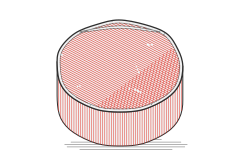
A cylinder of muscle in the back of the leg
The semitendinosus runs down the back of the thigh, from the pelvis towards the knee. Seen whole it is a long, even cylinder of 1.5–2.5 kg with a thin sheath of silverskin and almost no fat between its fibres, which run along its length. Its shape is the reason for its names in many languages: the round "eye" in English, redondo in Spain, girello in Italy, pièce ronde in France.
In American fabrication the eye is separated from the bottom (outside) round (IMPS 171C). British butchers sell it as part of the silverside or on its own as the silverside eye; Australian specifications call it eye round. Because it is so lean and so even, it slices into very regular rounds, but it has little to keep it moist once its fibres tighten past medium.
On the animal
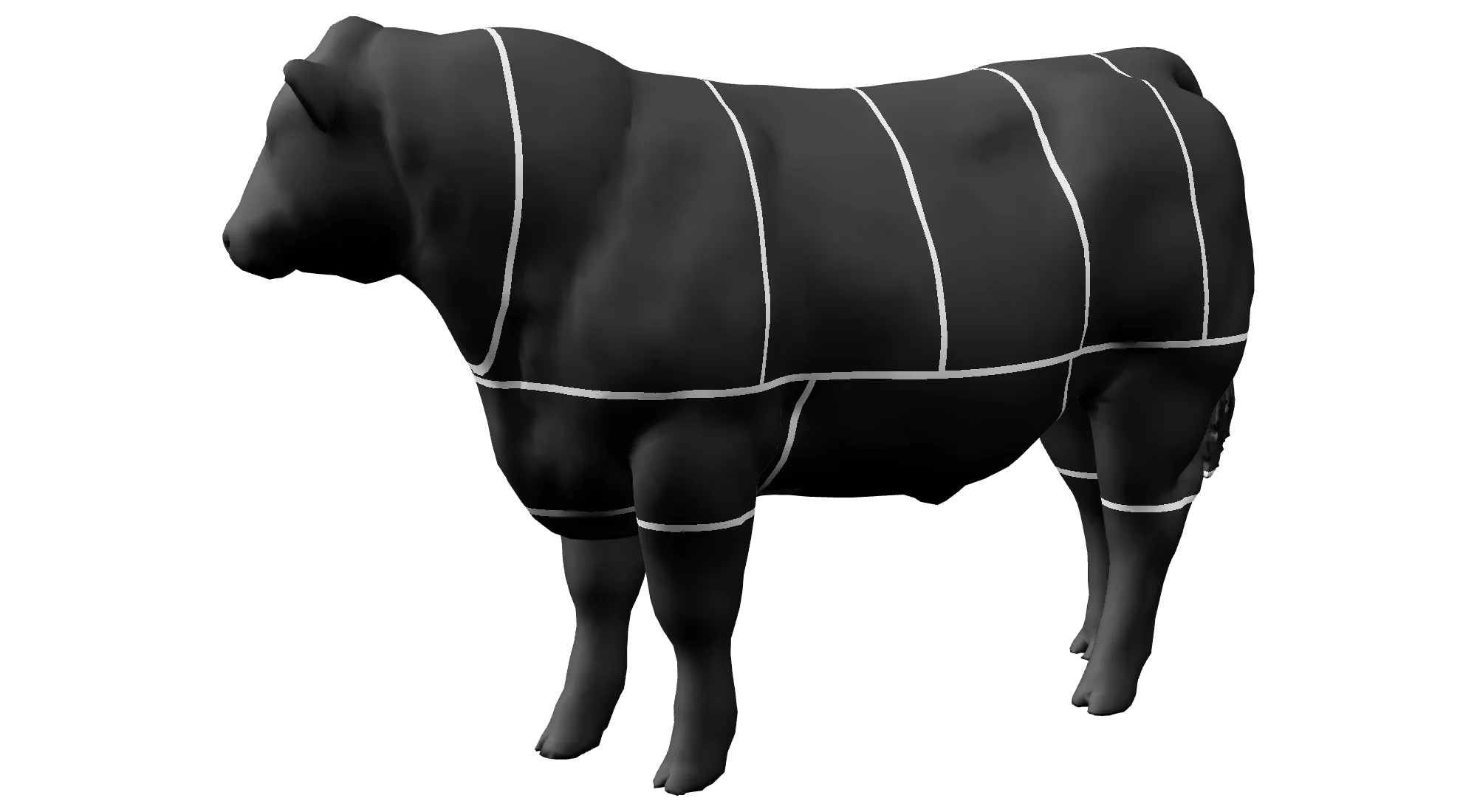 Loading
02 Rib
03 Loin
05 Topside
06 Brisket
08 Silverside & knuckle
Eye of round · this cut
09 Shin
Tap a part to see its cutsDrag to turn · tap a partThe whole cow in 3D →
The round, piece by piece
The round is the whole hind leg behind the sirloin, more than a fifth of the carcass and its leanest primal. American butchers divide it into four main pieces, each sold under several names around the world.
| Part of the round | Main muscle | IMPS | Elsewhere | Best for |
|---|---|---|---|---|
| Top round (inside) | Semimembranosus | 168 / 169 | Topside · nalga · pulpa negra | London broil, roast beef |
| Bottom round (outside flat) | Biceps femoris | 171B | Silverside · cuadrada · contra | Braising, roasting, biltong |
| Eye of round | Semitendinosus | 171C | Peceto · cuete · lagarto | Thin roast beef, braising |
| Knuckle (sirloin tip) | Rectus femoris, vastus | 167 | Thick flank · bola de lomo · babilla | Roasts, kebabs, stir-fry |
Cooking it: low and slow, or braised whole
Cooked as a roast, eye of round needs low heat and a thermometer. A whole eye of 1.5 kg seared all over and roasted at 110–120 °C / 230–250 °F takes roughly 1½–2 hours to reach 52–54 °C / 126–129 °F in the centre; after a 15-minute rest it finishes at medium-rare, evenly pink from edge to edge. Sliced as thinly as possible across the grain, it is the classic cold roast beef for sandwiches. Past 60 °C / 140 °F it turns dry and grainy, because there is no marbling to compensate.
The other tradition braises it whole until it can be cut with a spoon, often larded or stuffed to add fat: the Argentine and Uruguayan peceto poached for vitel toné, the Mexican cuete mechado studded with bacon, the Brazilian lagarto recheado, the Croatian pašticada and the Korean jangjorim, simmered in soy sauce and shredded. Its lean, even fibres also make it a standard cut for jerky, biltong and the Argentine milanesa.
Steaks cut from the eye are small and lean; they are best marinated and cooked quickly to rare or medium-rare, or pounded thin.
What a kilo gives
In the USDA's cooking-yield study, eye of round roasts trimmed to 3 mm (⅛ in) of fat kept on average 81 % of their raw weight when roasted (20 samples, 75–83 %), more than grilled top sirloin (80 %) or top round steak (72 %). A kilo of raw eye of round gives about 810 g of roast. The lean meat has about 23 g of protein and only 2.5–3.5 g of fat per 100 g raw, comfortably within the US definition of "extra lean" (less than 5 g of fat and 2 g of saturated fat per 100 g).
| Per kilo of raw eye of round | Amount | Source |
|---|---|---|
| Cooked weight, roasted | ≈ 810 g (750–830 g) | USDA cooking yields, 2012 |
| Protein (lean, raw) | ≈ 234 g | USDA FoodData Central, SR 23361 · 23362 |
| Fat (lean, raw) | ≈ 25–34 g | USDA FoodData Central, SR 23361 · 23362 |
| Energy (lean, raw) | ≈ 1,160–1,240 kcal | USDA FoodData Central, SR 23361 · 23362 |
Choosing one at the counter
A whole eye should be evenly thick from end to end; the tapered end overcooks first and is better cut off for stews or tied back. The silverskin along one side is tough and does not soften in a roast: it is trimmed off with a thin knife before cooking. Because the meat itself has so little fat, grade matters less than with steaks, while technique matters more.
At the counter the names change by country: ask for peceto in Argentina and Uruguay, cuete in Mexico, redondo in Spain, muchacho in Colombia and Venezuela, pollo ganso in Chile, lagarto in Brazil and girello in Italy.
Names around the world
30
The same muscle, named by language and by trade system.
| English | Eye of round · eye round · silverside eye |
| Tiếng Việt | Bắp lõi đùi bò (eye of round) |
| Español | Peceto · cuete · redondo · muchacho · pollo ganso · boliche |
| 한국어 | 홍두깨살 (hongdukkaesal) |
| 日本語 | 外もも |
| Français | Rond de gîte |
| Italiano | Girello · magatello |
| Русский | Аутсайд |
| 中文 | 牛霖外侧 |
| Português | Lagarto |
| Deutsch | Semerrolle |
All the cuts' names, country by country →
Trade and national systems
| System | Name | Reference |
|---|---|---|
| United States | Eye of round · eye round roast · eye of round steak | IMPS 171C |
| United Kingdom | Eye of round · silverside eye (part of the silverside) | USMEF 2013 · AHDB |
| Australia / NZ | Eye round | USMEF 2013 · HAM |
| Argentina | Peceto | USMEF 2013 |
| Mexico | Cuete | USMEF 2013 |
| Spain | Redondo | USMEF 2013 |
| Colombia · Venezuela | Muchacho · muchacho redondo | USMEF 2013 |
| Chile | Pollo ganso | USMEF 2013 |
| Peru | Asado pejerrey | USMEF 2013 |
| Uruguay · Paraguay | Peceto · redondo | USMEF 2013 |
| Cuba · Dominican Republic | Boliche | USMEF 2013 |
| Central America | Mano de piedra (Costa Rica, Honduras, Nicaragua) · salón (El Salvador) | USMEF 2013 |
| Brazil | Lagarto · lagarto paulista | USMEF 2013 |
| France | Rond de gîte · pièce ronde | USMEF 2013 |
| Italy | Magatello · girello | USMEF 2013 |
| Germany | Runder Mocken · Semerrolle | USMEF 2013 |
| Japan | アイ・オブ・ラウンド (US import name) | USMEF 2013 |
| Korea | 홍두깨살 (hongdukkaesal) | USMEF 2013 |
| Vietnam | Bắp lõi đùi (approx.) |
Frequently asked questions
What is eye of round?
A long, cylindrical muscle from the back of the hind leg, the semitendinosus. It is one of the leanest cuts of beef and is roasted and sliced thin or braised whole.
Is eye of round a good roast?
Yes, if it is roasted at low heat to medium-rare and sliced very thin; cooked past medium it becomes dry because it has almost no marbling.
Eye of round vs top round: what is the difference?
Both come from the round. Top round is the larger inside muscle, sold as London broil; eye of round is the smaller, more regular cylinder at the back, even leaner.
How long does it take to cook an eye of round roast?
About 1½–2 hours for 1.5 kg at 110–120 °C / 230–250 °F, until 52–54 °C / 126–129 °F inside, then a 15-minute rest. Go by temperature, not time.
What is eye of round called in Spanish?
Peceto in Argentina and Uruguay, cuete in Mexico, redondo in Spain, muchacho in Colombia and Venezuela, pollo ganso in Chile and boliche in Cuba.
Is eye of round the same as silverside?
Not exactly. The British silverside is the outside of the leg, which includes the eye; the eye of round can be sold on its own as silverside eye.
Sources
10
- USDA Agricultural Marketing Service. Institutional Meat Purchase Specifications: Fresh Beef Series 100. Washington, DC, 2014. www.ams.usda.gov/sites/default/files/media/IMPS_100_Fresh_Beef%5B1%5D.pdf
- North American Meat Institute. The Meat Buyer's Guide, 8th ed. Washington, DC, 2014.
- AUS-MEAT Limited. Handbook of Australian Meat, 7th ed. (International Red Meat Manual). Brisbane, 2005. www.ausmeat.com.au
- Agriculture and Horticulture Development Board (UK). Beef Meat Purchasing Guide. Kenilworth, 2016. ahdb.org.uk
- McGee, Harold. On Food and Cooking: The Science and Lore of the Kitchen, rev. ed. New York: Scribner, 2004.
- Huerta-Leidenz, Nelson. International Nomenclature Guide of Beef Cuts for the U.S.A. and Other Countries Targeted by the U.S. Meat Export Federation. Denver: U.S. Meat Export Federation, 2013. www.usa-beef.org/wp-content/uploads/2020/07/1064.GUIDE_beef-cuts_ingl%C3%A9s_09oct13.pdf
- Showell, B. A.; Williams, J. R.; Duvall, M.; Howe, J. C.; Patterson, K. Y.; Roseland, J. M.; Holden, J. M. USDA Table of Cooking Yields for Meat and Poultry. Beltsville, MD: USDA Agricultural Research Service, Nutrient Data Laboratory, 2012. www.ars.usda.gov/ARSUserFiles/80400525/Data/retn/USDA_CookingYields_MeatPoultry.pdf
- USDA Agricultural Research Service. FoodData Central, SR Legacy (National Nutrient Database for Standard Reference). Beltsville, MD, 2019. fdc.nal.usda.gov
- U.S. Food and Drug Administration. 21 CFR 101.62(e), nutrient content claims: "lean" and "extra lean" for meat. www.ecfr.gov/current/title-21/chapter-I/subchapter-B/part-101/subpart-D/section-101.62
- Von Seggern, D. D.; Calkins, C. R.; Johnson, D. D.; Brickler, J. E.; Gwartney, B. L. "Muscle profiling: characterizing the muscles of the beef chuck and round." Meat Science 71, no. 1 (2005): 39–51.
Related