Cut · Under the hide, rolled
Matambre
Matambre is the cutaneus trunci, the thin, wide sheet of muscle between the hide and the ribs that lets cattle twitch off flies. A cut of the Río de la Plata with no standard equivalent elsewhere, it is rolled around egg and vegetables, poached and sliced cold, topped like a pizza, or grilled slowly whole, fat side down.
At a glance
- Primal
- Under the hide, over the rib cage and the flank
- Muscles
- Cutaneus trunci (the skin muscle of the trunk)
- Weight
- About 1.5–2.5 kg per side
- Best cooked
- Rolled and poached, or slowly on the grill
- Region
- Argentina, Uruguay, Paraguay
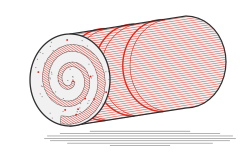
The muscle that shakes off flies
The matambre is the cutaneus trunci, the skin muscle that lets cattle twitch their hide to shake off flies. It is a broad, flat sheet, usually 1–2 cm thick, that covers the side of the animal over the ribs and the belly. One face is lean muscle; the other carries a layer of fat and connective tissue that faced the hide.
Despite its position it is not the flank (the rectus abdominis), nor part of the vacío: it lies on top of both and of the rib cage, and is lifted off them as a separate piece. Some cut maps place it in the flank area because that is where most of it sits.
The name is popularly explained as mata hambre, "kills hunger": a piece that was quick to cook and filled people up before the main cuts were ready. The story is widely repeated but not documented. There is also a pork matambre, the equivalent muscle of the pig, thinner and fattier, which has become one of the most popular cuts on the Argentine grill.
The first piece off after the hide
On a beef side the matambre is the first thing a butcher removes after the hide: it is peeled off in one sheet from the ribs and the belly, roughly from the shoulder to the flank. Each side gives one piece of about 1.5–2.5 kg, larger and thicker in heavy steers.
It is a cut of Argentine, Uruguayan and Paraguayan butchery, and of the southern Brazilian states that share their cooking. In the American, British and Australian systems the muscle has no standard name or specification and is usually left on the carcass, ending in trim or ground beef.
Cooking it: rolled, a la pizza or grilled
Matambre arrollado. The classic dish of the family table. The sheet is trimmed, sometimes tenderised, seasoned and covered with a filling (hard-boiled eggs, carrots, red pepper, spinach or chard, parsley, garlic), then rolled tightly with the grain running along the roll, tied or wrapped in cloth, and poached for two to three hours or baked. It is cooled under weight, sliced thin and served cold, a fixture of holiday tables and picnics.
Matambre a la pizza. The piece is first made tender, by long cooking on the grill fat side down, by braising, or by simmering in milk (matambre a la leche), and then finished with tomato sauce, mozzarella and oregano, under a lid or in the oven, until the cheese melts.
On the grill. At an asado the whole matambre is cooked slowly over low embers, fat side to the fire first, for about one to one and a half hours, until the fat renders and the meat softens; it is turned for a short final cook on the lean side. Cooked fast and hot, it is tough. Pork matambre, thinner, is grilled the same way in less time.
Even thickness, no holes in the sheet
Outside the Río de la Plata matambre usually has to be ordered from a butcher who knows the cut, since it is lifted from the carcass before the primals are broken down. In Argentina it is sold whole by the piece, often with the outer fat partly trimmed; for arrollado the butcher can also trim it to an even rectangle.
A good piece is evenly thick, with a pale, firm layer of fat on one side and no holes in the sheet, which would let the filling out of a roll. Pieces from young animals are thinner and more tender; from older ones they are thicker and need longer cooking.
Names around the world
12
The same muscle, named by language and by trade system.
| English | Flank |
| Tiếng Việt | Bắp bụng |
| Español | Matambre |
| 한국어 | 플랭크 |
| 日本語 | フランク |
| Français | Bavette de flanchet |
| Italiano | Fianco |
| Русский | Фланк |
| 中文 | 腹腩排 |
| Português | Matambre |
All the cuts' names, country by country →
Trade and national systems
| System | Name | Reference |
|---|---|---|
| Argentina | Matambre (beef) · matambre de cerdo (pork) | IPCVA |
| United States | No IMPS item; not a standard retail cut | IMPS |
Frequently asked questions
What is matambre in English?
There is no standard English name. It is the cutaneus trunci, the thin skin muscle over the ribs and belly of the steer. Outside South America butchers rarely separate it, and it is sold almost only there.
Is matambre the same as flank steak?
No. The flank steak is the rectus abdominis, a thicker abdominal muscle. The matambre is the thin skin muscle that lies on top of the flank and the ribs.
What is matambre arrollado?
A matambre rolled around a filling of egg, vegetables and herbs, tied, poached or baked, cooled under weight and served cold in thin slices.
How long does matambre take on the grill?
About one to one and a half hours over low embers, fat side down first, then a short cook on the lean side. Pork matambre takes less time.
Sources
2
- Instituto de Promoción de la Carne Vacuna Argentina (IPCVA). Cortes de carne vacuna argentina — nomenclatura y usos. Buenos Aires. www.ipcva.com.ar
- Mallmann, Francis; Kaminsky, Peter. Seven Fires: Grilling the Argentine Way. New York: Artisan, 2009.
Related