Cooking · Wood smoke, low heat
Smoking
Smoking is the flavouring, and often the slow cooking, of meat in the smoke of smouldering wood. Cold smoking keeps the chamber below about 30 °C / 86 °F and leaves the meat raw; barbecue smoking cooks it at 107–135 °C / 225–275 °F for hours, until a tough cut such as brisket turns tender and the phenols of the wood give it smoky, spicy, clove-like notes.
At a glance
- Cold smoking
- Chamber below 30 °C / 86 °F; meat stays raw
- Barbecue
- Pit at 107–135 °C / 225–275 °F
- The stall
- Around 65–75 °C / 150–170 °F inside
- Brisket done
- Probe-tender, about 93–96 °C / 200–205 °F
- Woods
- Oak, hickory, mesquite, pecan, fruit woods
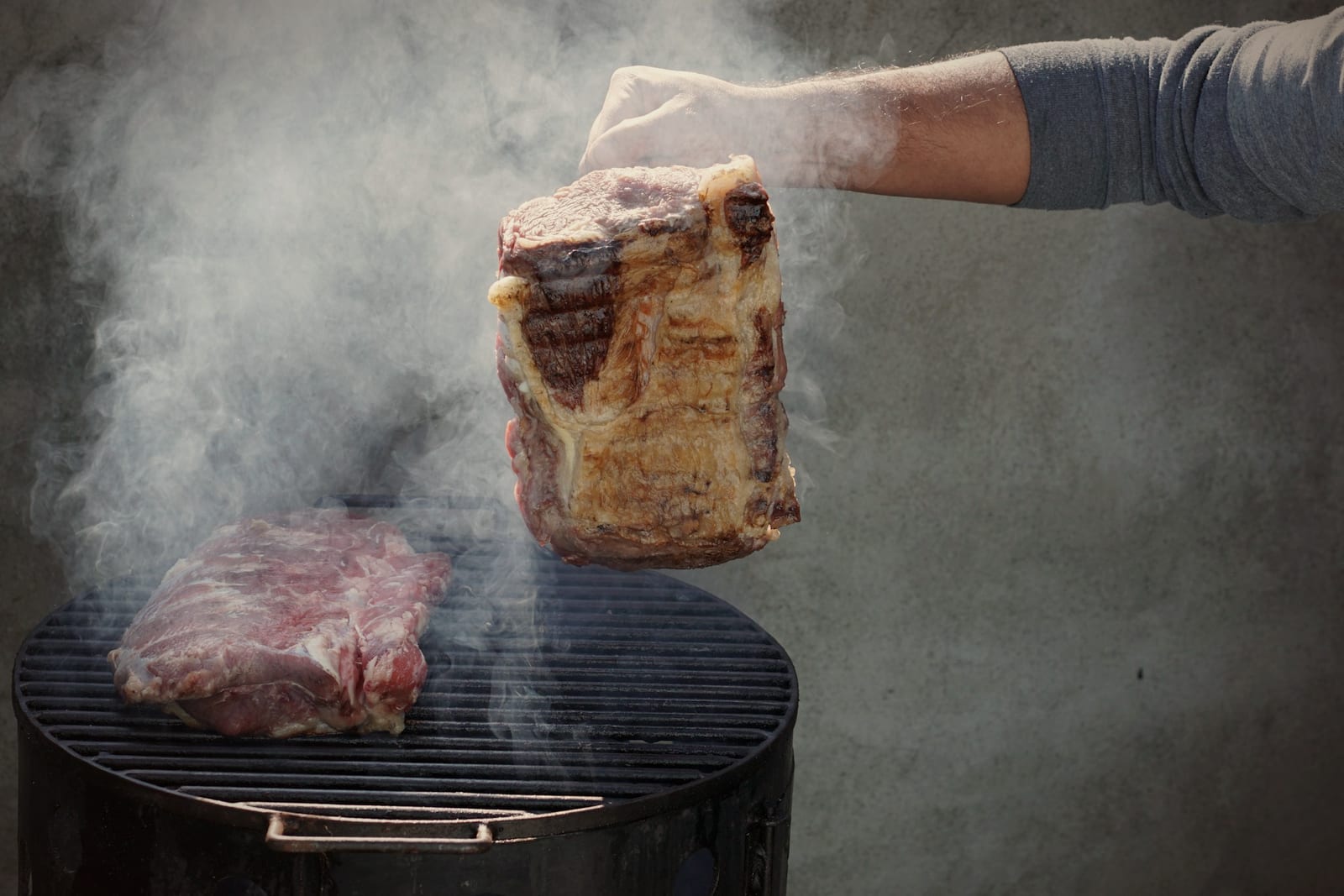
Cold smoke and hot smoke
Smoking began as a way to preserve meat: smoke dries the surface and deposits compounds that slow bacterial growth and the oxidation of fat. Today it is used mostly for flavour, and it comes in two broad forms. Cold smoking exposes meat to smoke at low temperature, usually 15–30 °C / 59–86 °F, for hours or days without cooking it; it is applied only to products that are cured or will be cooked later. Hot smoking flavours and cooks at once. For beef, the most important hot method is barbecue-style smoke-cooking, in which large, tough cuts are cooked with indirect heat in a closed pit at 107–135 °C / 225–275 °F.
The model for beef smoking is Central Texas barbecue: brisket seasoned only with coarse salt and black pepper, smoked over post oak in an offset smoker, where the fire burns in a separate firebox at one end and the heat and smoke cross the cooking chamber to a chimney at the other. The full recipe is in Texas brisket. Cured and smoked beef, such as pastrami, combines smoking with curing.
What smouldering wood gives off
Wood is mostly cellulose, hemicellulose and lignin. When it smoulders, as Harold McGee describes, these break down into hundreds of compounds: lignin yields phenols such as guaiacol and syringol, which give smoky, spicy and clove-like aromas, while the carbohydrates yield sweet, caramel-like furans and the carbonyl compounds that help brown the surface. The cleanest flavour comes from small, hot, well-ventilated fires; starved, smouldering fires produce thick white smoke loaded with soot and bitter, acrid compounds. Hardwoods burn cleanly; resinous softwoods such as pine and spruce give a sooty, turpentine taste. Oak is balanced, hickory is stronger, mesquite is intense and burns hot, and fruit woods such as apple and cherry are milder.
Smoke sticks best to a cool, moist surface, so meat absorbs most of its smoke flavour in the first hours. The pink smoke ring under the crust forms in the same window: nitrogen dioxide and carbon monoxide from combustion dissolve in the moist surface and bind to myoglobin, the meat's pigment, forming heat-stable pink compounds, essentially the same chemistry that colours cured meat. The ring stops growing once the surface dries and heats up. It shows contact with combustion gases, not doneness or quality, and wood fires make a deeper ring than gas or electric smokers.
Several hours in, the internal temperature of a large cut often stops rising for hours at around 65–75 °C / 150–170 °F. This stall is evaporative cooling: moisture reaching the surface evaporates as fast as the pit supplies heat. Wrapping the meat, in foil (the 'Texas crutch') or in unwaxed butcher paper, blocks evaporation and ends it; foil is faster but softens the crust, paper keeps it firmer. Meanwhile collagen dissolves into gelatin, slowly at first and faster above about 70 °C / 160 °F, which is why brisket is cooked far past the temperatures used for steak.
Incomplete combustion and fat dripping onto embers also produce polycyclic aromatic hydrocarbons (PAHs), some of them carcinogenic. The European Union limits benzo[a]pyrene in smoked meat to 2.0 µg/kg, and the International Agency for Research on Cancer classifies processed meat, a category that includes smoked meat, as carcinogenic to humans. Clean, well-ventilated fires and indirect heat keep PAH formation lower.
Step by step
- Use seasoned, dry hardwood or a mix of charcoal and wood chunks; never painted, treated or resinous wood.
- Light the fire and bring the empty pit to its target temperature, typically 107–121 °C / 225–250 °F, with the vents open. Wait until the smoke is thin and pale blue rather than thick and white.
- Season the meat, for brisket simply equal parts coarse salt and coarse black pepper, and put it into the pit cold, fat side toward the heat source in an offset.
- Keep the fire small and hot: add a split or a few chunks every 30–60 minutes and keep the lid closed. Control temperature with the fire size and the air intake, not by choking the chimney.
- Track both the pit and the meat with thermometers. When the crust is set and the internal temperature stalls, wrap the meat tightly in butcher paper or foil and return it to the pit.
- Cook to tenderness rather than to a number: brisket is ready when a probe slides in with almost no resistance, usually at 93–96 °C / 200–205 °F.
- Rest the meat wrapped for 1–4 hours in an insulated box or a low oven, keeping it above 60 °C / 140 °F, then slice.
Temperatures
| Stage | Temperature | Note |
|---|---|---|
| Cold smoking (chamber) | 15–30 °C 59–86 °F | flavour only; for cured products or meat cooked later |
| Hot smoking (chamber) | 52–80 °C 125–175 °F | sausages, hams, cured beef |
| Barbecue, low and slow (pit) | 107–121 °C 225–250 °F | the classic range for brisket and beef ribs |
| Barbecue, hot and fast (pit) | 135–163 °C 275–325 °F | shorter cook, firmer crust |
| Smoke ring forms | early, while the surface is cool and moist | stops once the surface dries and heats |
| The stall (internal) | 65–75 °C 150–170 °F | evaporative cooling; ended by wrapping |
| Collagen melts quickly (internal) | above 70 °C 160 °F | needs hours, not minutes |
| Brisket and beef ribs done (internal) | 93–96 °C 200–205 °F | probe-tender is the real test |
| Holding while resting | above 60 °C 140 °F | food-safety holding temperature |
Better smoke, not more smoke
Choking the fire to slow it down, which produces white, acrid smoke and a bitter, sooty crust. Adding wet or green wood, with the same result. Opening the lid constantly, which lengthens the cook and destabilises the pit. Treating the smoke ring as proof of doneness, or its absence as a fault. Pulling a brisket at a target temperature without checking that it is tender. Panicking in the stall and raising the heat until the outside burns. Skipping the rest, so that juices run onto the board. And using more smoke instead of better smoke: after the first hours the meat takes up little more, and heavy smoke only adds bitterness.
Frequently asked questions
What is the difference between hot and cold smoking?
Cold smoking flavours meat at 15–30 °C / 59–86 °F without cooking it and is used for cured products; hot smoking flavours and cooks at the same time.
Does the smoke ring mean the meat is cooked?
No. It is a pink layer formed when combustion gases react with myoglobin near the surface; it says nothing about the internal temperature.
Why does brisket stall?
Evaporation from the surface cools the meat as fast as the pit heats it, usually around 65–75 °C / 150–170 °F. Wrapping in paper or foil shortens the stall.
What is the best wood for smoking beef?
There is no single best: oak is the Central Texas standard, hickory is stronger, mesquite is intense, and fruit woods are mild. Dry, seasoned hardwood matters more than species.
Sources
6
- McGee, Harold. On Food and Cooking: The Science and Lore of the Kitchen, rev. ed. New York: Scribner, 2004.
- Myhrvold, Nathan; Young, Chris; Bilet, Maxime. Modernist Cuisine: The Art and Science of Cooking. Bellevue: The Cooking Lab, 2011.
- Franklin, Aaron; Mackay, Jordan. Franklin Barbecue: A Meat-Smoking Manifesto. Berkeley: Ten Speed Press, 2015.
- Goldwyn, Meathead; Blonder, Greg. Meathead: The Science of Great Barbecue and Grilling. Boston: Houghton Mifflin Harcourt, 2016.
- European Commission. Commission Regulation (EU) 2023/915 of 25 April 2023 on maximum levels for certain contaminants in food (polycyclic aromatic hydrocarbons in smoked meat and smoked meat products). Official Journal of the European Union L 119, 2023.
- International Agency for Research on Cancer. Red Meat and Processed Meat. IARC Monographs on the Evaluation of Carcinogenic Risks to Humans, vol. 114. Lyon: IARC, 2018.
Related