
Cut · Rib, the cap of the ribeye
Ribeye Cap
The ribeye cap is the spinalis dorsi, the thin, curved muscle that wraps the top of the ribeye. It is cut from the rib primal, carries more marbling than the eye of the same steak, and is sold either attached to the ribeye or lifted off and cooked on its own as a ribeye cap steak.
At a glance
- Primal
- Rib (ribs 6–12), on top of the ribeye
- Muscles
- Spinalis dorsi (the cap), lying over the longissimus dorsi
- Size
- Whole cap about 40 cm / 16 in long and 2–3 cm / ¾–1¼ in thick
- Best cooked
- Medium-rare, 54–57 °C / 129–135 °F after resting
 Ribeye
What the ribeye cap is
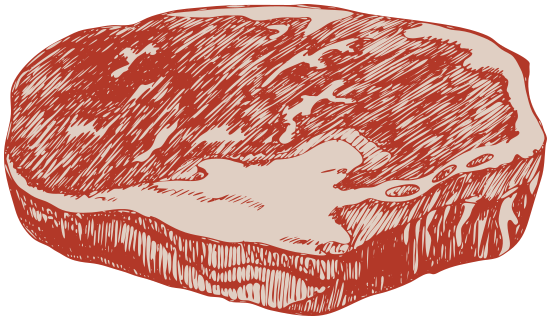
A ribeye is not one muscle. The large round center is the longissimus dorsi, the long back muscle that runs from the shoulder to the hip. Lying over its upper edge is the spinalis dorsi, a thinner, curved muscle that follows the spine. Butchers call it the cap. Between the two runs a seam of fat, and the cap itself is threaded with fine marbling, which is why it eats richer and softer than the eye beneath it.
Lifted off whole from a ribeye roll, the cap is roughly 40 cm / 16 in long, 20 cm / 8 in wide and 2–3 cm / ¾–1¼ in thick, a flat, flank-like sheet. It is widest toward the chuck end of the rib and tapers toward the loin, so a steak from the chuck end of the ribeye carries a bigger cap. The ribeye page covers the whole steak; this page covers the cap.
Where it comes from
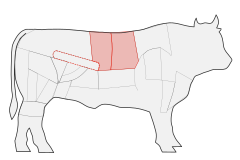
The cap belongs to the rib primal, ribs six to twelve, the section between the chuck and the short loin. It sits on top of the longissimus, on the side of the animal's back, a region that does little work. Past the thirteenth rib the cap thins out and disappears, which is why a striploin has no cap of its own.
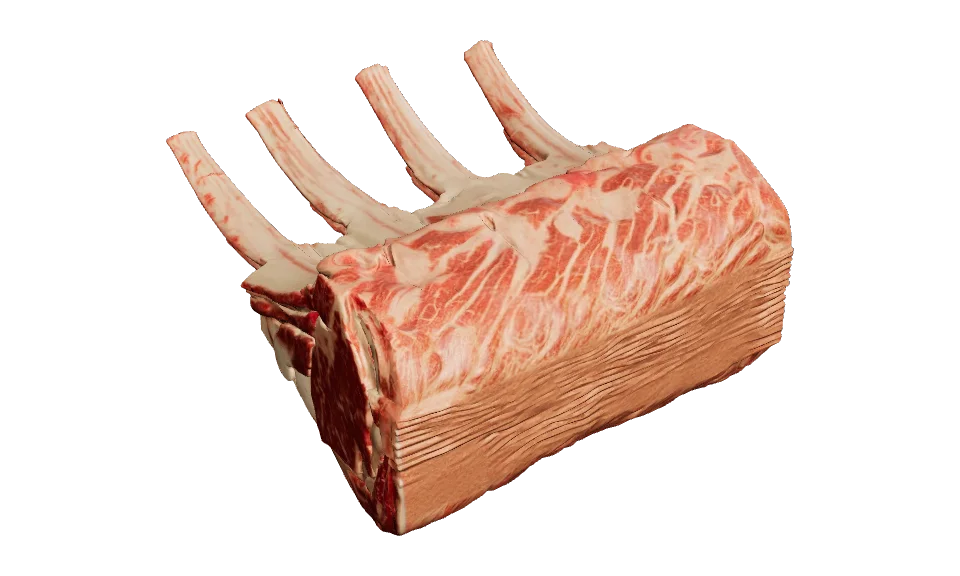
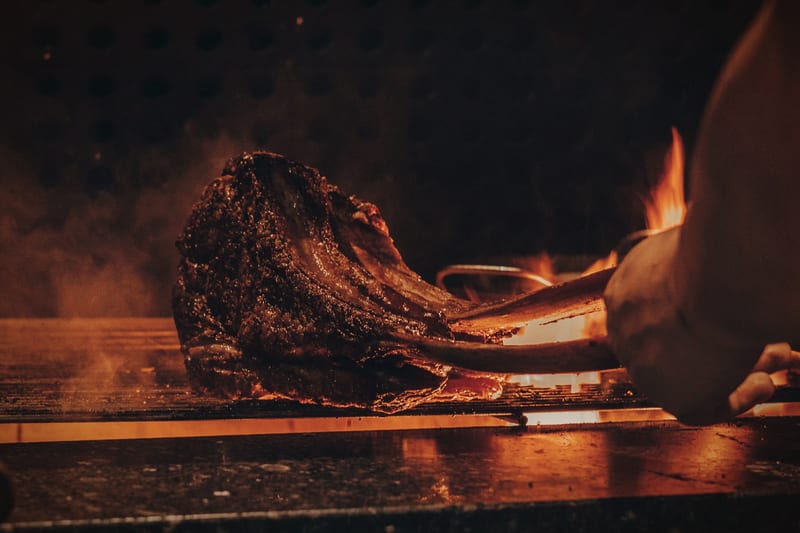
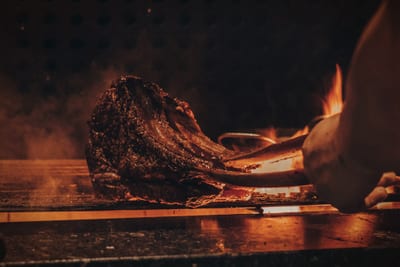
The same muscle is in every bone-in rib roast. A prime rib keeps it on the outside of the roast, where it browns and renders; in some rib-roast and restaurant usage the cap is also called the deckle, although in brisket butchery “deckle” means something else entirely. A cowboy steak and a tomahawk are bone-in ribeyes and keep the cap as well.
How it is sold and named
There are three ways to meet it. It can be left on the ribeye, as in an ordinary steak. It can be lifted off and sold as a ribeye cap roll or sliced into ribeye cap steaks, usually tied or rolled into a round. Or it can be left behind: the eye that remains is sold as a cap-off ribeye. US supplier charts list the cap roll as IMPS 112D; confirm the current IMPS 100 series before ordering by code.
Names vary by market. In the United States it is the ribeye cap, rib cap, cap of ribeye or spinalis. In Argentina it is the tapa de ojo de bife. In Japan it is かぶり (kaburi) or リブキャップ. In Australia and New Zealand it is the cap of the cube roll, usually sold on the roll. Korea names its beef cuts differently, so there the nearest match is 새우살 (also 등심덧살), and the correspondence is approximate; 살치살 is usually matched to the chuck flap tail.
Cooking it: high heat, short time, a short rest
The cap is thin and fatty, so it cooks fast and rewards high heat. For a cap steak about 2.5 cm / 1 in thick, sear it in a very hot pan or over hot coals for 2–3 minutes per side, then rest it for 5 minutes. The target is a core temperature of 54–57 °C / 129–135 °F after the rest, medium-rare, so take it off the heat at 52–54 °C / 126–130 °F. Intramuscular fat begins to soften around 50–55 °C / 122–131 °F, and a cap pulled much below that stays waxy.
A thicker piece (3 cm / 1¼ in and up) does better with a reverse sear: roast it at about 120 °C / 250 °F until the center reads 43–46 °C / 110–115 °F, then sear 1–2 minutes per side. A rolled cap cooked whole behaves like a small roast; slice it across the roll after resting. Because the cap is mostly fat and thin muscle, it flares easily over coals, so keep a cooler zone ready.
Cooked past medium it loses what makes it distinct, since the marbling that melts at medium-rare is largely spent by well done. The steak temperatures guide lists the full scale, and the ribeye steak recipe applies the same method to the whole steak.
Ribeye cap vs picanha and coulotte
Two confusions are common. The first is the picanha, the “rump cap” of Brazilian butchery. It is a different muscle, the biceps femoris cap at the top of the rump, from the rear of the animal. It is also sold with a thick fat cap along one edge and carved against the grain; the ribeye cap sits at the front, on the rib, and its fat is a curled mixture of marbling and seams.
The second is the coulotte. In the United States, “coulotte” or “coulotte steak” normally means the top sirloin cap, the picanha, not the ribeye cap. When a menu says coulotte, expect the sirloin muscle; when it says ribeye cap, spinalis or rib cap, expect the rib. Both are fatty and both love hot grills, but they are not interchangeable in a recipe.
Choosing and buying it
Look for a cap that is wide and even, with fine white marbling rather than a single thick strip of fat, and meat that looks dry and firm, not sitting in purge. Grades such as Prime and the higher Australian marbling scores are read on the eye, not on the cap, but a well-marbled ribeye usually carries a richer cap; judge the cap by eye, not by the grade.
Because it is a small share of each ribeye, a separate cap costs more per kilo than the ribeye it came from, in general terms, and supply is limited. The alternative is to buy a chuck-end ribeye and cook the cap together with the eye, then slice it off if you wish. If ordering by the case, state whether you want the cap rolled, tied or sliced into steaks, and whether it is cut from lip-on ribeyes.
Keep reading
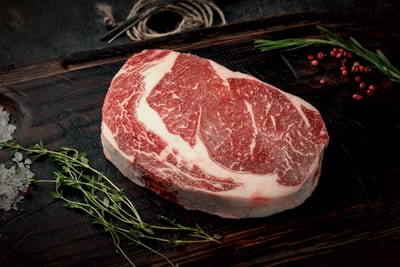 Cut · Rib, the marbled steakRibeyeEye, cap and fat seam from the rib — the marbled steak used to grade the carcass.
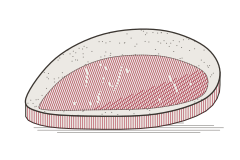 Cut · Rump cap, fat onPicanhaThe rump cap with its fat on: churrasco, tapa de cuadril, coulotte, and how to buy and slice it.
 Main course · Standing rib, bone-inPrime ribThe standing rib roast, pink edge to center: why “prime” is not a grade, low oven or reverse sear, jus and horseradish.
 Cut · Rib, on the boneCowboy steakA thick bone-in ribeye with a short frenched bone: the tomahawk's shorter sibling; the name varies.
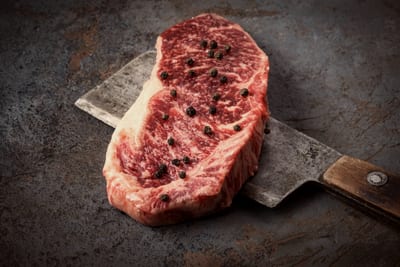 Cut · Short loin, one muscleStriploinOne muscle, one grain, one strip of fat — the New York strip, UK sirloin and bife de chorizo.
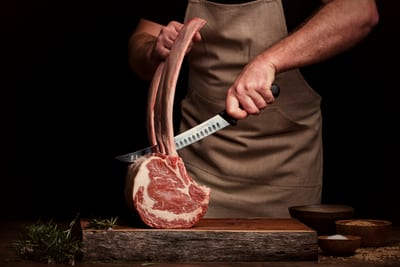 Cut · Rib, the long boneTomahawkA thick bone-in ribeye with the long rib bone left on and cleaned — same meat, more bone.
Names around the world
11
The same muscle, named by language and by trade system.
| English | Ribeye cap · rib cap · cap of ribeye · spinalis · spinalis dorsi · ribeye cap steak |
| Español | Tapa del ojo de bife · tapa del ribeye · spinalis · ribeye cap |
| Tiếng Việt | Nắp ribeye · spinalis · ribeye cap · rib cap |
| Português | Capa do ribeye · spinalis · ribeye cap · rib cap |
| 日本語 | リブロースのかぶり · リブキャップ · スピナリス |
| 한국어 | 꽃등심 새우살 · 등심덧살 · 립아이 캡 |
Every cut's name, country by country →
Trade and national systems
| System | Name | Reference |
|---|---|---|
| United States | Ribeye cap · rib cap · cap of ribeye · spinalis · ribeye cap steak (cap sold on its own); “deckle” in some rib-roast trade usage | IMPS 112D (supplier charts) |
| Australia / NZ | Cap of the cube roll (scotch fillet) · rib cap · spinalis dorsi; sold on the roll, and also on its own (often sliced and frozen) in specialty retail | |
| Argentina | Tapa de ojo de bife · tapa del bife ancho | IPCVA |
| Japan | かぶり (kaburi) · リブキャップ | JMGA |
| South Korea | 새우살 saeu-sal (the name most often matched to the ribeye cap) · 등심덧살 (also cap-type); 살치살 is usually matched to the chuck flap tail; the Korean cutting differs, so the match is approximate |
Frequently asked questions
What is ribeye cap?
The ribeye cap is the spinalis dorsi, the thin, curved, heavily marbled muscle that wraps the top of the ribeye. It is sometimes sold attached to the steak and sometimes lifted off and sold on its own as a ribeye cap steak or roll.
What part of the cow is ribeye cap?
The rib primal, ribs six to twelve, on top of the longissimus muscle that forms the ribeye eye. It is widest toward the chuck end of the rib and thins out toward the loin, where it disappears.
How do you cook ribeye cap?
Hot and fast. A cap steak about 2.5 cm / 1 in thick is seared 2–3 minutes per side, rested 5 minutes and served medium-rare. Thicker pieces do better with a reverse sear: roast at about 120 °C / 250 °F to 43–46 °C / 110–115 °F inside, then sear 1–2 minutes per side.
What internal temperature should ribeye cap reach?
For medium-rare, 54–57 °C / 129–135 °F after resting, so take it off the heat at 52–54 °C / 126–130 °F. The marbling melts at about 50–55 °C / 122–131 °F, and a cap pulled well below that stays waxy.
Is ribeye cap the same as picanha or coulotte?
No. The ribeye cap is the spinalis, from the rib. Picanha is the rump cap, and in the United States “coulotte” normally means that same sirloin cap. They are different muscles from opposite ends of the animal.
Is the ribeye cap the same as the ribeye?
It is part of the ribeye. A standard ribeye steak is the eye plus the cap; the cap can also be lifted off and sold alone, leaving a cap-off ribeye.
Another question about Ribeye Cap? Ask the butcher: write to us. Answers that help others are published here, with sources. hello@steakpedia.com or use the form: Contact →
Sources
9
- USDA Agricultural Marketing Service. Institutional Meat Purchase Specifications: Fresh Beef Series 100. Washington, DC, 2014. www.ams.usda.gov/sites/default/files/media/IMPS_100_Fresh_Beef%5B1%5D.pdf
- North American Meat Institute. The Meat Buyer's Guide, 8th ed. Washington, DC, 2014.
- Toldrá, Fidel (ed.). Lawrie's Meat Science, 8th ed. Duxford: Woodhead, 2017.
- USDA Agricultural Marketing Service. United States Standards for Grades of Carcass Beef. 2017. www.ams.usda.gov/grades-standards/carcass-beef-grades-and-standards
- McGee, Harold. On Food and Cooking: The Science and Lore of the Kitchen, rev. ed. New York: Scribner, 2004.
- Instituto de Promoción de la Carne Vacuna Argentina (IPCVA). Cortes de carne vacuna argentina — nomenclatura y usos. Buenos Aires. www.ipcva.com.ar
- Japan Meat Grading Association. Beef Carcass Grading Standard. Tokyo, 1988 (rev. 2014). www.jmga.or.jp
- Korea Institute for Animal Products Quality Evaluation (KAPE). Beef cuts and grading. www.ekape.or.kr
- “Rib eye steak.” Wikipedia, The Free Encyclopedia. en.wikipedia.org/wiki/Rib_eye_steak