
Cut · Short loin, hip end
Porterhouse
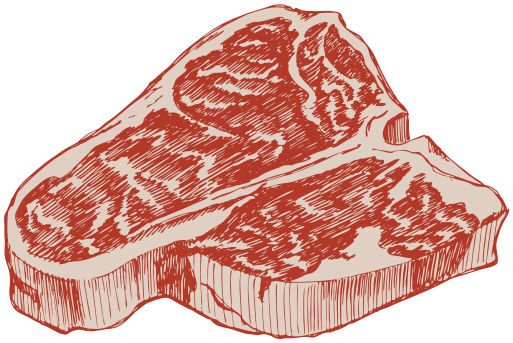
A porterhouse is a bone-in steak cut across the hip end of the short loin, with the striploin on one side of the T-shaped bone and a large piece of tenderloin on the other. Under the USDA purchase specifications the tenderloin must be at least 32 mm / 1¼ in wide; with less, the steak is a T-bone. It is usually cut 4–5 cm / 1½–2 in thick and weighs 0.9–1.4 kg / 2–3 lb.
At a glance
- Primal
- Short loin, hip end, bone-in
- Muscles
- Longissimus lumborum (strip side) and a large psoas major (tenderloin side)
- Weight
- 0.9–1.4 kg / 2–3 lb, usually cut 4–5 cm / 1½–2 in thick
- USDA rule
- Tenderloin at least 32 mm / 1¼ in wide (IMPS 1173)
- Best cooked
- Pulled at 50–54 °C / 122–129 °F in the strip side
 Porterhouse
What a porterhouse steak is
A porterhouse is two steaks on one bone: a strip (the longissimus lumborum muscle, as in a New York strip) and a piece of tenderloin (the psoas major, as in filet mignon), separated by the T-shaped lumbar vertebra. The strip is the larger, firmer, more flavorful side; the tenderloin is smaller, leaner and softer.
The name is not a separate animal part but a size category of the T-bone. The USDA Institutional Meat Purchase Specifications (IMPS) assign the porterhouse the number 1173 and the T-bone 1174, and the line between them is a measurement: a tenderloin at least 32 mm / 1.25 in wide at its widest point makes a porterhouse, at least 13 mm / 0.5 in a T-bone. The full comparison, with the measurement shown, is in T-bone vs porterhouse.
What part of the cow it comes from
The porterhouse comes from the short loin, the section of the back between the last rib and the hip, and from its hip end in particular. The tenderloin runs under the lumbar vertebrae and tapers toward the ribs, so it is thickest at the rear of the short loin: the last few steaks cut there carry enough of it to qualify. Cut toward the ribs, the tenderloin shrinks and the steaks become T-bones and then bone-in strip steaks.
Because only a handful of steaks from each short loin qualify, the porterhouse is normally cut thick and sold as a steak for two. Cut across the loin and boned out, the same piece gives a striploin and the center of a tenderloin; the porterhouse is the bone-in version of both together. The recipe for it is on its own page: how to cook a porterhouse steak.
Porterhouse around the world
The word is a trap across borders. In the United States and Canada it is the steak described above. In Australia and New Zealand it means a boneless striploin steak, and the bone-in steak is called a T-bone. In Britain it usually means a bone-in sirloin steak without the fillet, though usage varies; the steak with both sides is more often sold as a T-bone or fillet on the bone. The Tuscan bistecca alla fiorentina is the same cut, cut very thick from Chianina cattle and served rare.
| Name | Where | What it is |
|---|---|---|
| Porterhouse | United States, Canada | Bone-in short loin, hip end; tenderloin at least 32 mm wide |
| Porterhouse | UK, Ireland | Bone-in sirloin steak, usually without the fillet (usage varies) |
| Porterhouse | Australia, NZ | Not this cut: a boneless striploin steak |
| T-bone · bife con lomo | Argentina | Bone-in short loin |
| Bistecca alla fiorentina | Italy (Tuscany) | T-bone or porterhouse, 4–5 cm / 1½–2 in thick, 1–1.5 kg / 2.2–3.3 lb |
| Chuletón | Spain | Not a porterhouse: a thick bone-in rib steak |
| ポーターハウス · Tボーン | Japan | Both names are used for the bone-in loin steak |
| 포터하우스 · 티본 | South Korea | Both names are used for the bone-in loin steak |
Cooking it: thick, in two stages
The tenderloin is lean and cooks faster than the strip, and the bone slows the meat next to it. The usual answer is to start a thick porterhouse gently and finish it hot: in an oven at 120 °C / 250 °F for about 30–40 minutes (40–55 minutes at 5 cm / 2 in) until the strip reads 43–46 °C / 110–115 °F, then 45–90 seconds per side in a smoking pan or over embers. On a two-zone grill the same steak takes about 10–14 minutes in total. The steps are in the porterhouse recipe.
Position the tenderloin away from the hottest part of the fire and measure in the thickest part of the strip, about 2 cm / ¾ in from the bone. Pulled off a grill or pan at 50–54 °C / 122–129 °F and rested 5 minutes, it finishes medium-rare to medium; the USDA minimum for whole cuts is 63 °C / 145 °F followed by a 3-minute rest. A porterhouse under 2.5 cm / 1 in is too thin to protect the tenderloin and cooks in a hot pan in a few minutes. Doneness for every temperature is in the steak temperature chart.
To serve, each muscle is cut away from the bone in one piece, sliced across the grain and laid back against the bone so both sides can be shared.
Why a porterhouse costs more
The price per kilo is usually among the highest on a bone-in steak counter, for three reasons: the tenderloin is the most expensive muscle of the animal and a porterhouse carries the most of it; only the few steaks from the hip end of each short loin qualify; and it is cut thick, so each steak is a large piece. The bone, which is a sizeable share of the weight, is sold with it.
No price is given here because it varies by country, grade, aging and shop. A reliable comparison is price per kilo of boneless meat: with the bone weighed in, a 1 kg / 2.2 lb porterhouse yields noticeably less meat than 1 kg / 2.2 lb of boneless steak.
Where to buy it and what to look for
Porterhouse is sold by butchers and steakhouses, in many supermarkets in the United States, and cut to order from the aged short loin in shops that dry-age. Ask for 4–5 cm / 1½–2 in thick. The tenderloin side should be large and round, the sign it was cut near the hip; the strip should carry a fat cap of 5–10 mm and the cut faces should be clean, without bone dust from the saw.
Check the steak is the same thickness on both sides. For a comparison with another large steak, see porterhouse vs ribeye; for the cuts it combines, the striploin and tenderloin pages.
Keep reading
 Main course · Steak for two, bone-inPorterhouse steakThe steak for two with the strip on one side and the tenderloin on the other: how to cook both muscles right, times by thickness, pull temperatures and carving.
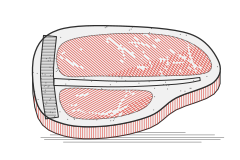 Cut · Short loin, two musclesT-boneStriploin and tenderloin on one bone — the porterhouse and the fiorentina.
 Buying guide · One bone, two widthsT-bone vs porterhouseSame bone, same two muscles: the 32 mm tenderloin rule, where each is cut, names by country and cooking.
- Buying guide · Two muscles on a bone vs onePorterhouse vs ribeyeThe widest-tenderloin T-bone against the marbled ribeye: cut, fat, size, cooking, names abroad.
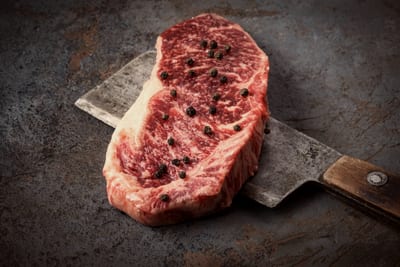 Cut · Short loin, one muscleStriploinOne muscle, one grain, one strip of fat — the New York strip, UK sirloin and bife de chorizo.
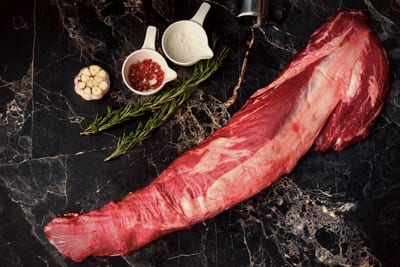 Cut · Loin, the psoasTenderloinThe psoas: the most tender, leanest premium cut — filet mignon, chateaubriand, lomo.
Names around the world
15
The same muscle, named by language and by trade system.
| English | Porterhouse · porterhouse steak |
| Tiếng Việt | Porterhouse (thăn nội + thăn ngoại) |
| Español | Porterhouse · bife con lomo |
| 한국어 | 포터하우스 스테이크 |
| 日本語 | ポーターハウスステーキ |
| Português | Porterhouse |
| Italiano | Bistecca alla fiorentina (the same cut) |
Every cut's name, country by country →
Trade and national systems
| System | Name | Reference |
|---|---|---|
| United States | Porterhouse (hip end of the short loin, tenderloin at least 32 mm wide) | IMPS 1173 |
| United Kingdom | Porterhouse (bone-in sirloin steak, usually without the fillet; usage varies, and some butchers sell the US-style steak under the name) | AHDB |
| Australia / NZ | Not this cut: "porterhouse" is a boneless striploin steak; the bone-in steak is sold as T-bone | HAM 1552 |
| Argentina | T-bone · bife con lomo | IPCVA |
| Italy | Bistecca alla fiorentina (the same cut, 4–5 cm / 1½–2 in thick, Chianina) | Accademia della Fiorentina |
| Spain | T-bone (a chuletón is a bone-in rib steak, not a porterhouse) | |
| Japan | ポーターハウス · Tボーン | JMGA |
| South Korea | 포터하우스 · 티본 |
Frequently asked questions
What is a porterhouse steak?
A bone-in steak cut across the hip end of the short loin, with a strip on one side of the T-shaped bone and a large piece of tenderloin on the other. Under the USDA rule the tenderloin is at least 32 mm / 1¼ in wide, which separates it from the T-bone.
What part of the cow is a porterhouse steak?
The hip end of the short loin, the section of the back between the last rib and the hip. There the tenderloin is thickest, so the steak holds a large piece of it beside the strip.
How do you cook a porterhouse steak?
Thick (4–5 cm / 1½–2 in), in two stages: about 30–40 minutes in a 120 °C / 250 °F oven, then 45–90 seconds per side in a hot pan, or 10–14 minutes on a two-zone grill. Keep the tenderloin away from the strongest heat. Full steps: porterhouse recipe.
What temperature should a porterhouse be cooked to?
Measured in the strip, about 2 cm / ¾ in from the bone: pull at 50–54 °C / 122–129 °F off a grill or pan for medium-rare to medium, and rest it 5 minutes. The USDA minimum for whole cuts is 63 °C / 145 °F with a 3-minute rest.
Why is a porterhouse so expensive, and where do you buy it?
It carries the most tenderloin, the costliest muscle, only a few steaks per loin qualify, it is cut thick and the bone is sold with it. Butchers, steakhouses and many US supermarkets sell it; ask for 4–5 cm / 1½–2 in thick.
What is a porterhouse called in other countries, and is it a T-bone?
It is the same cut as a T-bone with a wider tenderloin: see T-bone vs porterhouse. In Australia and New Zealand “porterhouse” is a boneless striploin steak; in Italy the same cut, cut very thick, is the bistecca alla fiorentina.
Another question about Porterhouse? Ask the butcher: write to us. Answers that help others are published here, with sources. hello@steakpedia.com or use the form: Contact →
Sources
7
- USDA Agricultural Marketing Service. Institutional Meat Purchase Specifications: Fresh Beef Series 100. Washington, DC, 2014. www.ams.usda.gov/sites/default/files/media/IMPS_100_Fresh_Beef%5B1%5D.pdf
- North American Meat Institute. The Meat Buyer's Guide, 8th ed. Washington, DC, 2014.
- AUS-MEAT Limited. Handbook of Australian Meat, 7th ed. (International Red Meat Manual). Brisbane, 2005. www.ausmeat.com.au
- Agriculture and Horticulture Development Board (UK). Beef Meat Purchasing Guide. Kenilworth, 2016. ahdb.org.uk
- USDA Food Safety and Inspection Service. Safe Minimum Internal Temperature Chart. 2023. www.fsis.usda.gov/food-safety/safe-food-handling-and-preparation/food-safety-basics/safe-temperature-chart
- McGee, Harold. On Food and Cooking: The Science and Lore of the Kitchen, rev. ed. New York: Scribner, 2004.
- Accademia della Fiorentina. Disciplinare della Bistecca alla Fiorentina. Florence.