
Main course · Steak for two, bone-in
Porterhouse steak
A porterhouse is a T-bone cut from the hip end of the short loin, with the strip on one side of the bone and a large piece of tenderloin on the other. It is usually cut 4–5 cm / 1½–2 in thick, weighs 0.9–1.4 kg / 2–3 lb and serves two or three. The surest way to cook it is the reverse sear: salt it ahead, bake it at 120 °C / 250 °F until the strip side reads 43–46 °C / 110–115 °F, then sear it hard for a crust. For medium-rare it should finish at 53–56 °C / 127–133 °F. Keep the tenderloin side away from the strongest heat: it is leaner and cooks faster.
At a glance
- Cut
- Short loin, bone-in, from the hip end
- Size
- 4–5 cm / 1½–2 in, 0.9–1.4 kg / 2–3 lb; serves 2–3
- Oven
- 120 °C / 250 °F, then a hard sear
- Medium-rare
- Out of the oven at 43–46 °C / 110–115 °F; final 53–56 °C / 127–133 °F
- Key
- Tenderloin side away from the heat; measure in the strip
Two steaks on one bone
The porterhouse is cut across the short loin with the vertebra left in. On one side of the T-shaped bone is the strip (longissimus lumborum), the muscle of the striploin; on the other is the tenderloin (psoas major). The tenderloin is widest toward the hip, and under the USDA purchase specifications a steak only counts as a porterhouse when its tenderloin is at least 32 mm / 1¼ in wide; narrower ones are T-bones. See T-bone vs porterhouse.
Because only the last few steaks of each short loin qualify, the porterhouse is usually sold thick, as a steak for two. In Australia and New Zealand the word means something else: a boneless striploin steak, cooked like any strip steak. This recipe is for the bone-in American porterhouse; in Australia and New Zealand this bone-in steak is sold as a T-bone.
The problem: two muscles that cook differently
The strip is the larger, fattier muscle and gives the steak its flavor; the tenderloin is smaller and very lean, so it heats through faster. The bone works against both: meat touching it stays cooler, so the strip near the bone lags behind the edges. Cooked carelessly, a porterhouse comes out with a gray tenderloin and an underdone strip at the bone.
Three habits solve most of it. Place the steak so the tenderloin points away from the hottest part of the pan, grill or broiler. Measure the temperature in the thickest part of the strip, about 2 cm / ¾ in from the bone. And cook a thick porterhouse gently first and fast at the end, so the whole steak arrives at the target together; this is the reverse sear.
Ingredients
| Ingredient | Amount | Note |
|---|---|---|
| Porterhouse steak | 1 steak, 4–5 cm / 1½–2 in thick (0.9–1.4 kg / 2–3 lb) | serves 2–3 |
| Coarse salt | about 1 % of the weight (10–14 g) | ideally the day before |
| Black pepper | to taste | coarsely ground |
| Refined oil with a high smoke point | 1 tbsp | for the sear |
| Butter | 30–50 g / 1–2 oz | optional, the last minute |
| Garlic and thyme or rosemary | 2 cloves, a few sprigs | optional, with the butter |
| Flaky salt | to finish | after slicing |
Method
- The day before, or at least 1 hour ahead, pat the steak dry and salt it on all sides with about 1 % of its weight. Leave it uncovered on a rack in the refrigerator: the surface dries and will brown faster. See salting steak.
- Heat the oven to 120 °C / 250 °F. Put the steak on a rack over a tray and insert a probe thermometer into the thickest part of the strip side, about 2 cm / ¾ in from the bone.
- Bake until the strip reads 43–46 °C / 110–115 °F for medium-rare (see the table below): about 30–40 minutes for a 4 cm / 1½ in steak and 40–55 minutes for 5 cm / 2 in. If the tenderloin side is browning faster or reading higher, turn the tray so it faces the cooler part of your oven, usually the door.
- Meanwhile heat a large cast-iron pan over high heat until it smokes, or bring a grill to its hottest. The steak can wait 5–10 minutes on the counter at this point.
- Add the oil and sear the steak 45–90 seconds per side, until deep brown. Hold it upright with tongs to brown the fat edge and the bone side. Add the butter, garlic and herbs in the last minute and spoon the foaming butter over the strip, not the tenderloin.
- Check the strip again: it should finish at 53–56 °C / 127–133 °F for medium-rare. A reverse-seared steak needs only 1–2 minutes of rest.
- Carve on a board: run the knife along the bone to lift off the strip and the tenderloin in one piece each, slice both across the grain about 1 cm / ⅜ in thick, and lay the slices back against the bone to serve. Finish with flaky salt and pepper.
Temperatures
| Doneness | Take out of the oven (strip side) | Final, after the sear |
|---|---|---|
| Rare | 40–43 °C / 109 °F 104–109 °F | 49–52 °C / 126 °F 120–126 °F |
| Medium-rare | 43–46 °C / 115 °F 110–115 °F | 53–56 °C / 133 °F 127–133 °F |
| Medium | 49–52 °C / 126 °F 120–126 °F | 58–61 °C / 142 °F 136–142 °F |
| USDA safe minimum (whole cuts) | — | 63 °C / 145 °F 145 °F with a 3-minute rest |
Times by thickness
| Thickness | Oven at 120 °C / 250 °F, to the medium-rare stage | Grill, medium-rare (total) |
|---|---|---|
| 2.5 cm / 1 in | too thin for the oven: sear directly | 6–10 min (direct heat only) |
| 4 cm / 1½ in | 30–40 min | 10–14 min |
| 5 cm / 2 in | 40–55 min | 14–18 min |
On the grill
Over charcoal or wood, build two zones: a hot side with the embers and a cooler side with few or none. Sear the porterhouse over the embers until both faces are brown, then move it to the cool side with the tenderloin facing away from the fire and close the lid if the grill has one. Take it off when the strip, about 2 cm / ¾ in from the bone, reaches 51–52 °C / 124–126 °F and rest it 5 minutes: finished over the cool side it rises a further 3–4 °C / 5–7 °F, more if it was seared hard at the end (see carryover in the steak temperature chart). A steak 2.5 cm / 1 in thick can stay over direct heat the whole time. Times for every thickness are in how long to grill steak; zones and fuels in grilling over fire.
In a pan, for a thinner porterhouse
A porterhouse 2.5–3 cm / 1–1¼ in thick cooks well in a heavy pan alone, like any cast-iron steak: a smoking-hot pan, the tenderloin toward the edge of the pan where it is cooler, turning every 30–60 seconds, butter at the end, and off the heat at 51–52 °C / 124–126 °F in the strip for medium-rare. Rest it 5 minutes before carving.
Buying and serving
Look for a steak with a large, round tenderloin, the sign it was cut near the hip, and one that is evenly thick across both sides. Ask for 4–5 cm / 1½–2 in: thinner porterhouses overcook the tenderloin before the strip has a crust. Allow 450–500 g / 16–18 oz bone-in per person. The Tuscan bistecca alla fiorentina is the same cut, grilled over embers and served rare. For a side-by-side with the ribeye, see porterhouse vs ribeye; for the right doneness of each muscle, the steak temperature chart.
Keep reading
 Cut · Short loin, two musclesT-boneStriploin and tenderloin on one bone — the porterhouse and the fiorentina.
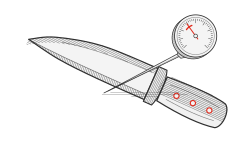 Buying guide · One bone, two widthsT-bone vs porterhouseSame bone, same two muscles: the 32 mm tenderloin rule, where each is cut, names by country and cooking.
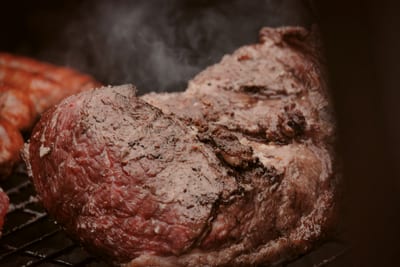 Cooking · Low oven, sear lastReverse searLow oven first, sear last: one even pink edge to edge, a crust in under a minute, and when it is not worth it.
- Buying guide · Two muscles on a bone vs onePorterhouse vs ribeyeThe widest-tenderloin T-bone against the marbled ribeye: cut, fat, size, cooking, names abroad.
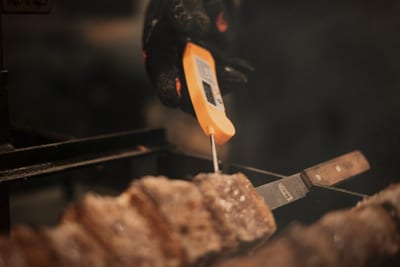 Cooking · Pull early, then restSteak temperature & doneness chartSix levels from blue to well done in °C and °F: when to pull, carryover by thickness, safety, and a printable chart.
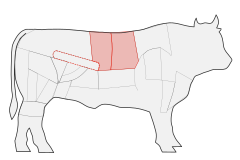 Cut · Short loin, hip endPorterhouseThe T-bone with the wider tenderloin: the short loin's hip end, bone-in, usually 4–5 cm / 1½–2 in thick.
Frequently asked questions
How long do you cook a porterhouse steak?
For a 4 cm / 1½ in porterhouse, about 30–40 minutes in a 120 °C / 250 °F oven and 2–3 minutes of searing (reverse sear), or 10–14 minutes on a two-zone grill for medium-rare. Thickness matters more than weight; always check with a thermometer.
What internal temperature for a porterhouse?
Measure in the thickest part of the strip, about 2 cm / ¾ in from the bone. For medium-rare, take it out of a low oven at 43–46 °C / 110–115 °F and sear to a final 53–56 °C / 127–133 °F; off a grill or pan, pull at 51–52 °C / 124–126 °F and rest it.
Which side of the porterhouse should face the heat?
The strip. Keep the tenderloin side toward the cooler part of the pan, grill or oven: it is leaner and smaller, so it cooks faster.
How many people does a porterhouse serve?
A porterhouse 4–5 cm / 1½–2 in thick weighs 0.9–1.4 kg / 2–3 lb and serves two, or three with sides. Plan 450–500 g / 16–18 oz bone-in per person.
Is a porterhouse the same as a T-bone?
It is the same cut from the hip end of the short loin, where the tenderloin is widest. Under the USDA specification the tenderloin of a porterhouse is at least 32 mm / 1¼ in wide; in Australia, "porterhouse" means a boneless striploin steak.
Should I cook a porterhouse in the oven or on the grill?
Both work. The oven (reverse sear) gives the most even result in a thick steak; the grill gives more smoke and char. Under 3 cm / 1¼ in, a hot pan or direct heat alone is enough.
Sources
3
- USDA Agricultural Marketing Service. Institutional Meat Purchase Specifications: Fresh Beef Series 100. Washington, DC, 2014. www.ams.usda.gov/sites/default/files/media/IMPS_100_Fresh_Beef%5B1%5D.pdf
- USDA Food Safety and Inspection Service. Safe Minimum Internal Temperature Chart. 2023. www.fsis.usda.gov/food-safety/safe-food-handling-and-preparation/food-safety-basics/safe-temperature-chart
- McGee, Harold. On Food and Cooking: The Science and Lore of the Kitchen, rev. ed. New York: Scribner, 2004.