
Main course · Pan-fried, with gravy
Cube steak
Cube steak is cooked one of two ways: fast in hot fat or slowly in liquid. For chicken-fried steak, dredge each steak in seasoned flour, dip it in egg and buttermilk, flour it again and shallow-fry it in oil at 175 °C / 350 °F for 3–4 minutes per side, then make cream gravy in the same pan. Without a coating, a steak 6–10 mm / ¼–⅜ in thick needs only 2–3 minutes per side in a very hot pan. Braised in tomato and onion at 150 °C / 300 °F for an hour or more it becomes Swiss steak. Either way it is cooked through, to at least 63 °C / 145 °F, never medium-rare.
At a glance
- Cut
- Cube steak: thin round, rump or sirloin steak, tenderized by machine
- Fried
- Breaded, oil at 175 °C / 350 °F, 3–4 min per side (steak 6–10 mm / ¼–⅜ in)
- Done
- Cooked through: at least 63 °C / 145 °F with a 3-minute rest (USDA)
- Gravy
- From the pan: 45 ml / 3 tbsp fat, 25 g / 3 tbsp flour, 480 ml / 2 cups milk
- Alternative
- Swiss steak: braised in tomato, 150 °C / 300 °F, 1 hour or more
A lean steak: fast in fat or long in liquid
A cube steak is a thin steak of round, rump or sirloin passed through a cubing machine, whose blades have already cut its fibers and connective tissue. It is lean, about 23 g of protein and 3–5 g of fat per 100 g / 3.5 oz raw, so it has no middle ground: either a few minutes per side in hot fat, or a long time in liquid. Left a few minutes too long in a pan it dries out and turns leathery.
This page gives the classic, chicken-fried steak, a cube steak breaded in seasoned flour, fried and served with cream gravy made in the same pan, and the oven alternative, Swiss steak. Unlike a pan-seared steak, it is never cooked to medium-rare. And unlike a milanesa, a hand-pounded slice 5 mm / ¼ in thick in a breadcrumb coating, the coating here is flour and the dish ends with gravy.
Ingredients
| Ingredient | Amount | Note |
|---|---|---|
| Cube steaks | 4, about 170 g / 6 oz each (680 g / 1½ lb) | 6–10 mm / ¼–⅜ in thick, from top round, rump or similar |
| Fine salt | 2 tsp / 12 g in all | half on the steaks, half in the flour |
| Black pepper | 1 tsp / 2 g, plus more for the gravy | freshly ground |
| All-purpose flour | 190 g / 6.5 oz / 1½ cups for the coating, 25 g / 3 tbsp for the gravy | plain, not self-rising |
| Eggs | 2 | beaten with the buttermilk |
| Buttermilk | 120 ml / ½ cup | or whole milk |
| Neutral oil | about 450–500 ml / 2 cups | 1 cm / ½ in deep in a 30 cm / 12 in skillet; high smoke point |
| Whole milk | 480 ml / 2 cups | for the gravy |
Method: chicken-fried steak with cream gravy
- Pat the steaks dry and season both sides with half of the salt and a little pepper. If a steak is thicker than 10 mm / ⅜ in or uneven, pound it with a mallet to an even 6–10 mm / ¼–⅜ in so that it cooks at the same speed throughout.
- Set up two shallow dishes: one with the 190 g / 6.5 oz / 1½ cups of flour mixed with the rest of the salt and the pepper, and one with the eggs beaten with the buttermilk. Keep one hand for the dry dish and the other for the wet one.
- Dredge each steak in the flour, dip it in the egg and let the excess drip off, then press it into the flour again until it is thickly coated all over. Shake off the loose flour.
- Rest the coated steaks on a rack for 10–15 minutes: the flour hydrates and bonds with the egg, so the coating stays on in the oil. Meanwhile heat the oven to 95 °C / 200 °F to keep the cooked steaks warm, for no more than 10–15 minutes.
- Pour about 1 cm / ½ in of oil into a 30 cm / 12 in skillet, preferably cast iron, and heat it to 175 °C / 350 °F. Without a thermometer, a pinch of flour should sizzle at once.
- Fry two steaks at a time, 3–4 minutes per side, turning once, until deep golden. A crowded pan drops the oil temperature and makes the coating greasy. Move each batch to a rack set over a tray in the warm oven, and check the first steak: no pink at the center, or 63 °C / 145 °F or more with a thermometer slid in from the side.
- For the gravy, carefully pour the oil into a heatproof container, leaving about 45 ml / 3 tbsp and the browned bits in the pan. Over medium heat whisk in 25 g / 3 tbsp of flour and cook for 1 minute until it smells toasty. Add 480 ml / 2 cups of whole milk a little at a time, whisking, then simmer for 3–5 minutes until it coats a spoon. Season with salt and plenty of black pepper. For the brown version often called country-fried steak, soften a sliced onion in the fat first and use 480 ml / 2 cups of beef stock instead of the milk.
- Serve at once, with the gravy spooned over or beside the steak so that the coating stays crisp, with mashed potatoes, green beans or biscuits.
Times by method
All three methods below assume a steak 6–10 mm / ¼–⅜ in thick. For anything outside that range, trust the doneness check rather than the clock.
| Method | Heat | Time | Done when |
|---|---|---|---|
| Pan-fried, no coating | very hot pan, 1 tbsp / 15 ml oil | 2–3 min per side | no pink at the center |
| Chicken-fried (breaded) | oil at 175 °C / 347 °F 350 °F, 1 cm / ½ in deep | 3–4 min per side | deep golden, no pink at the center |
| Swiss steak (braised) | oven at 150 °C / 302 °F 300 °F, covered | 1 hour or more | a fork goes in with no resistance |
How to know it is done
A cube steak is not pulled early to carry over the way a steak for medium-rare is. The three-minute rest happens in the warm oven while the gravy is made. Blades can carry surface bacteria into the center, so the USDA recommends cooking blade-tenderized beef to at least 63 °C / 145 °F with a three-minute rest; at 6–10 mm / ¼–⅜ in the steak reaches that point within the minutes it spends in the pan. A steak this thin is hard to probe: slide an instant-read thermometer in from the side, or cut into one and check that no pink remains. A braised steak is done when it is tender, not at a number; a fork-tender one usually reads 90–95 °C / 194–203 °F (see braising).
The oven version: Swiss steak
Swiss steak is cube steak braised in tomato and onion until it can be cut with a fork. The name is usually traced to "swissing", rolling or pounding meat to tenderize it, not to Switzerland. It uses the same four steaks plus 1 sliced onion, 2 cloves of garlic, 400 g / 14 oz of crushed tomatoes, 240 ml / 1 cup of beef stock, 1 tbsp of Worcestershire sauce (optional), 60 g / 2 oz / ½ cup of flour and 30 ml / 2 tbsp of oil.
- Season the steaks with salt and pepper and dredge them in the flour alone, shaking off the excess.
- Brown them in the oil in an ovenproof pot over medium-high heat, about 2 minutes per side, and set them aside.
- In the same pot soften the onion for 5 minutes, add the garlic for 30 seconds, then the tomatoes, stock and Worcestershire sauce, scraping up the browned bits. Heat the oven to 150 °C / 300 °F.
- Return the steaks to the pot and push them under the sauce. Cover and braise in the oven for 1 hour, then test one: if it is not yet fork-tender, give it up to 30 minutes more. The liquid should show only a few lazy bubbles; a hard boil dries the meat.
- Skim the fat. If the sauce is thin, simmer it uncovered for 10 minutes. Serve over mashed potatoes, rice or egg noodles. The pot can also stay on the stove over low heat for the same time.
Why cube steak turns out tough or soggy
Common mistakes: cooking it too long in the middle ground, since a lean steak 6–10 mm / ¼–⅜ in thick is done in 2–4 minutes per side and dries and toughens after that unless it goes into liquid for an hour. Oil below 175 °C / 350 °F lets the coating soak up fat; oil much hotter burns the coating before the steak is done. Wet steaks, no rest before frying or turning more than once make the coating slide off. A crowded pan cools the oil. And a bland gravy: add the milk slowly while whisking to avoid lumps, and season it more than seems necessary, because flour and milk taste of little.
Buying and serving
Look for a cube steak of even thickness, deep red and in one piece; in US stores the label often reads "beef round cube steak". You can also ask a butcher to cube a top round, an eye of round or a rump steak, so the cut is known. Allow one steak of about 170 g / 6 oz per person; the coating adds weight and fat, because the flour absorbs oil. The cut, its names around the world and the USDA labeling rule are in cube steak.
Keep reading
 Cut · Round, tenderized by machineCube steakA thin round steak cut by the blades of a cubing machine: a few minutes in the pan, or breaded and fried.
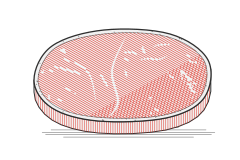 Cut · Rump, a working muscleRumpThe muscle group over the hip: rump steak, top sirloin, cuadril, alcatra, and what each country cuts.
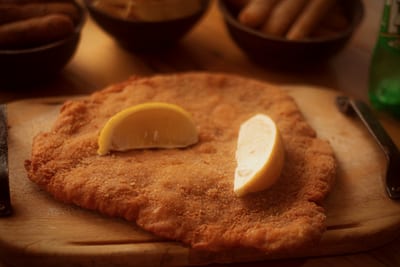 Main course · Italian rootsMilanesaA thin slice of beef, cut across the grain, breaded and fried: the cotoletta, remade with Río de la Plata beef.
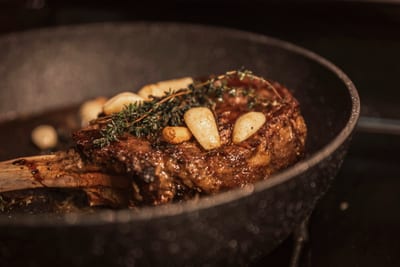 Main course · Stovetop, garlic butterPan-seared steakAny steak on the stove: a very hot skillet, garlic butter at the end and a sauce from the pan, in 6–8 minutes.
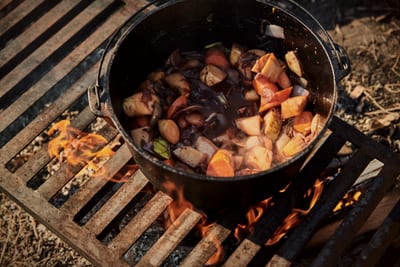 Cooking · Collagen to gelatinBraisingBrown, cover with a little liquid, simmer for hours: collagen turns to gelatin, fastest above 80 °C / 175 °F.
 Cooking · Salt and nitriteCuringSalt slows bacteria, nitrite keeps beef pink and blocks botulism: dry and wet cures, legal limits, cured beefs.
Frequently asked questions
How long do you cook cube steak?
In a very hot pan, 2–3 minutes per side for a steak 6–10 mm / ¼–⅜ in thick; breaded and fried in oil at 175 °C / 350 °F, 3–4 minutes per side; braised as Swiss steak, an hour or more in a 150 °C / 300 °F oven.
How do you keep cube steak from getting tough?
Cook it either briefly, a few minutes per side, or long and wet, braised for an hour or more. In between, a lean round steak dries out and turns leathery.
How do you keep the breading on chicken-fried steak?
Pat the steaks dry, press the flour on firmly and rest the coated steaks on a rack for 10–15 minutes before frying. Fry in oil at 175 °C / 350 °F, do not crowd the pan and turn each steak only once.
What is the difference between chicken-fried steak and country-fried steak?
The steak is cooked the same way; the usual difference is the gravy, cream gravy for chicken-fried steak and brown onion gravy for country-fried steak. Usage varies by region.
Can you cook cube steak medium-rare?
No. Blade tenderizing can carry surface bacteria into the center, so the USDA recommends at least 63 °C / 145 °F with a three-minute rest. At 6–10 mm / ¼–⅜ in the steak is cooked through within minutes anyway.
Sources
3
- USDA Food Safety and Inspection Service. Safe Minimum Internal Temperature Chart. 2023. www.fsis.usda.gov/food-safety/safe-food-handling-and-preparation/food-safety-basics/safe-temperature-chart
- USDA Agricultural Marketing Service. Institutional Meat Purchase Specifications: Fresh Beef Series 100. Washington, DC, 2014. www.ams.usda.gov/sites/default/files/media/IMPS_100_Fresh_Beef%5B1%5D.pdf
- McGee, Harold. On Food and Cooking: The Science and Lore of the Kitchen, rev. ed. New York: Scribner, 2004.