Cut · Round, tenderized by machine
Cube steak
Cube steak, or cubed steak, is not a place on the animal but a treatment: a thin steak, usually of top or bottom round, passed through a cubing machine whose blades cut its fibres and leave the square pattern that gives it its name. Sold as minute steak in Britain, Ireland, Canada and Australia, it cooks in a few minutes and is the usual cut for chicken-fried steak.
At a glance
- What it is
- A thin steak passed through a cubing machine
- Usual cut
- Top or bottom round; sometimes sirloin or chuck
- Best cooked
- Pan-fried 2–3 min a side, breaded, or braised
- Safe temperature
- 63 °C / 145 °F + 3 min rest (USDA)
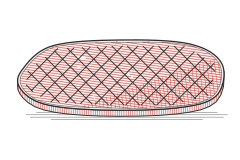
A steak tenderized by machine
A cubing machine, or cuber, pulls a slice of meat 1–2 cm thick between two sets of rotating blades set at an angle. The blades cut through the muscle fibres and the connective tissue without separating the slice, and a second pass at right angles leaves the grid of small squares typical of the cut. A tough, lean steak is turned into one that can be pan-fried in minutes.
Because the treatment, not the anatomy, defines it, a cube steak can come from several muscles. Most are cut from the round: the top round or the bottom round, sometimes the eye of round; a few from the top sirloin or the shoulder clod. Pounding a thin slice with a mallet gives a similar result by hand; that is how the Argentine and Italian milanesa and the Austrian schnitzel are prepared.
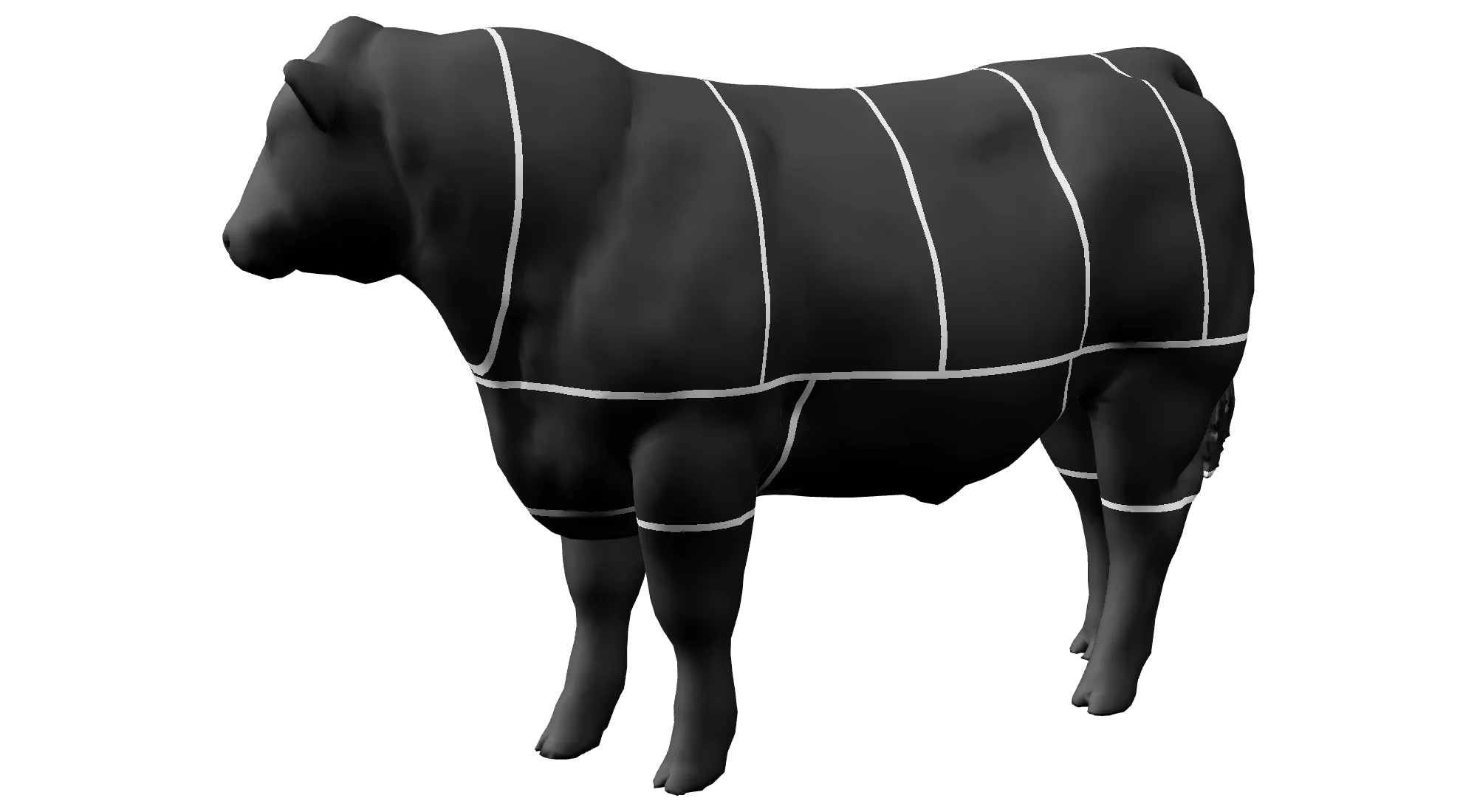
On the animal
 Loading
02 Rib
03 Loin
05 Topside
London broil (top round)Cube steak · this cut
06 Brisket
08 Silverside & knuckle
09 Shin
Tap a part to see its cutsDrag to turn · tap a partThe whole cow in 3D →
Why it is cooked through
On an intact steak, bacteria stay on the surface, which the sear reaches; that is why a whole steak can be eaten rare. Blades that pierce the meat can carry those surface bacteria into the centre. For that reason the US Department of Agriculture requires raw beef tenderized with blades or needles to be labelled "mechanically tenderized" and to carry cooking instructions, a rule in force since May 2016, and recommends cooking it to at least 63 °C / 145 °F in the centre with a three-minute rest.
In practice a cube steak is thin enough that it is cooked through in a few minutes anyway, and it is rarely served pink. The same caution applies to other blade-tenderized steaks, which look like ordinary steaks but are marked on the label.
How to cook it
Pan-fried, a cube steak 6–10 mm thick needs only a very hot pan with a little oil, 2–3 minutes a side, and salt and pepper; a quick pan sauce made with the browned bits finishes it. Because the cuts open the surface, it browns quickly and absorbs a marinade faster than an untreated steak.
Its most famous use is chicken-fried steak, a dish of the American South and Texas: the steak is dredged in seasoned flour, dipped in egg or buttermilk and floured again, shallow-fried at about 175 °C / 350 °F until golden and served with a cream gravy made in the same pan. With a brown onion gravy it is often called country-fried steak. Braised in tomato and onion for an hour or more it becomes Swiss steak, a name that refers to "swissing", rolling or pounding to tenderize, not to Switzerland.
What a kilo gives
There are no separate USDA yield figures for cube steak; its numbers are those of the cut it is made from. For top round, the usual source, the USDA's cooking-yield study measured an average of 72 % of the raw weight after broiling or grilling (20 samples, 62–83 %), so a kilo of raw cube steak gives roughly 700–750 g cooked. The lean meat carries about 23 g of protein and 3–5 g of fat per 100 g raw. Breading and frying add weight and fat: the flour coating absorbs oil, so a chicken-fried steak is far richer than the steak alone.
| Per kilo of raw cube steak (from top round) | Amount | Source |
|---|---|---|
| Cooked weight, pan-fried or grilled | ≈ 700–750 g | USDA cooking yields, 2012 (top round steak) |
| Protein (lean, raw) | ≈ 227–231 g | USDA FoodData Central, SR 23617 · 23636 |
| Fat (lean, raw) | ≈ 34–48 g | USDA FoodData Central, SR 23617 · 23636 |
Choosing one at the counter
A good cube steak is evenly thick, deep red and made from one piece; the label in US shops often names the source ("beef round cube steak"). Patches of fat or several pieces pressed together point to trimmings rather than a single steak. Butchers can cube a steak of the customer's choice on request, which is a way to buy a known cut.
Outside the US it is usually sold as minute steak; Spanish-speaking countries use the same thin cuts of the round for milanesas and bistec, pounded rather than cubed.
Names around the world
8
The same muscle, named by language and by trade system.
| English | Cube steak · cubed steak · minute steak |
| Español | Cube steak · bife tiernizado |
| Tiếng Việt | Thịt bò cube steak (dần máy) |
All the cuts' names, country by country →
Trade and national systems
| System | Name | Reference |
|---|---|---|
| United States | Cube steak · cubed steak · minute steak (regional) | USDA |
| United Kingdom · Ireland | Minute steak | |
| Canada | Minute steak · cube steak | |
| Australia / NZ | Minute steak | |
| Argentina | Bife para milanesa (approx.: pounded, not cubed) |
Frequently asked questions
What is cube steak?
A thin steak, usually from the round, tenderized by a cubing machine whose blades cut its fibres and leave a pattern of small squares.
What cut of meat is cube steak?
Most often top round or bottom round; sometimes eye of round, top sirloin or shoulder clod. The treatment, not the cut, makes it a cube steak.
Is cube steak the same as minute steak?
Mostly yes: in Britain, Ireland, Canada and Australia cubed or very thin quick-cooking steaks are sold as minute steak.
How long do you cook cube steak?
In a very hot pan, about 2–3 minutes per side for a steak 6–10 mm thick; breaded, about 3–4 minutes per side in oil at 175 °C / 350 °F.
Can you eat cube steak medium-rare?
It is not recommended: blade tenderizing can carry surface bacteria inside, so USDA advises at least 63 °C / 145 °F with a three-minute rest.
What is chicken-fried steak made of?
Cube steak dredged in seasoned flour, dipped in egg or buttermilk, floured again and fried, served with cream gravy.
Sources
8
- USDA Food Safety and Inspection Service. Safe Minimum Internal Temperature Chart. 2023. www.fsis.usda.gov/food-safety/safe-food-handling-and-preparation/food-safety-basics/safe-temperature-chart
- USDA Agricultural Marketing Service. Institutional Meat Purchase Specifications: Fresh Beef Series 100. Washington, DC, 2014. www.ams.usda.gov/sites/default/files/media/IMPS_100_Fresh_Beef%5B1%5D.pdf
- North American Meat Institute. The Meat Buyer's Guide, 8th ed. Washington, DC, 2014.
- McGee, Harold. On Food and Cooking: The Science and Lore of the Kitchen, rev. ed. New York: Scribner, 2004.
- USDA Food Safety and Inspection Service. "Descriptive Designation for Raw or Partially Cooked Needle- or Blade-Tenderized (Mechanically Tenderized) Beef Products." Final rule, 80 Fed. Reg. 28153, 18 May 2015 (in force 17 May 2016); 9 CFR 317.2(e)(3).
- Severson, Kim. "Turning to Cube Steak, and Back to Childhood." The New York Times, 4 March 2009.
- Showell, B. A.; Williams, J. R.; Duvall, M.; Howe, J. C.; Patterson, K. Y.; Roseland, J. M.; Holden, J. M. USDA Table of Cooking Yields for Meat and Poultry. Beltsville, MD: USDA Agricultural Research Service, Nutrient Data Laboratory, 2012. www.ars.usda.gov/ARSUserFiles/80400525/Data/retn/USDA_CookingYields_MeatPoultry.pdf
- USDA Agricultural Research Service. FoodData Central, SR Legacy (National Nutrient Database for Standard Reference). Beltsville, MD, 2019. fdc.nal.usda.gov
Related