Cut · Outside skirt, membrane on
Entraña
Entraña is the Argentine and Uruguayan name for the outside skirt, the costal part of the diaphragm, and for how the parrilla grills it: whole, often membrane on, coarse salt, 3–4 minutes a side over strong embers. The membrane crisps like a skin and keeps the juice in.
At a glance
- Primal
- Plate, inside the rib cage (diaphragm)
- Muscles
- Costal part of the diaphragm (outside skirt)
- Weight
- 600–900 g per piece, two per animal
- Best cooked
- Coarse salt, strong embers, 3–4 min a side
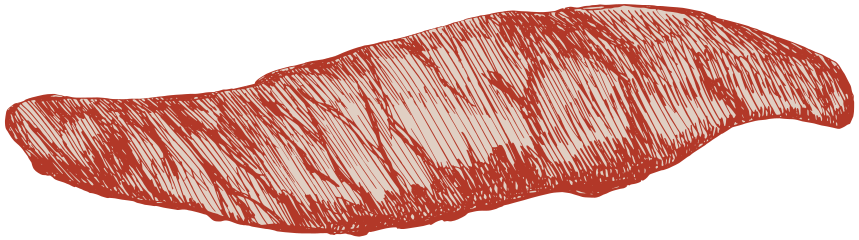 Skirt (machete)
Between muscle and offal
Anatomically the entraña is the outside skirt, the thick, marbled band of the diaphragm that lines the inside of the ribs. The general article on skirt steak covers the muscle, its inside-skirt twin and the names it takes elsewhere; this article covers the cut as it is known in the Río de la Plata, where it has a name, a place in the meal and a way of cooking of its own.
In Argentina and Uruguay the entraña sits on the border between muscle and offal. It is a skeletal muscle, but it is taken from inside the carcass together with the organs, and it has long been sold and grilled alongside the achuras: chinchulines (small intestine), mollejas (sweetbreads), riñones (kidneys). On many parrilla menus it still appears near the achuras rather than with the steaks.
It is not the same as the hanger steak, the thick pillar of the diaphragm with a sinew down its centre, which Rioplatense butchery does not treat as a separate named steak.
Two strips per steer
The entraña is lifted from the inside of the rib cage, on the plate, between roughly the sixth and twelfth ribs. Each side gives one piece of 600–900 g, a long, flat strip 1.5–2.5 cm thick. One face carries the telita, a thin, shiny membrane (part of the lining of the chest and abdomen); the other is usually trimmed of its heavier silverskin.
Because a steer yields only two entrañas, the cut has always been scarce compared with the vacío or the asado de tira. In both countries much of the production is exported, mostly to markets that buy it as outside skirt, which has made it one of the more expensive cuts at a local butcher.
Entraña, arrachera, harami: one cut, different kitchens
The same muscle is outside skirt in the United States, thin skirt in Australia, arrachera in Mexico, hampe in France, ハラミ harami in Japan and 안창살 anchangsal in Korea. Two traps for Spanish speakers: in Spain entraña gruesa, “thick entraña”, is the hanger, a different muscle; and a Mexican arrachera may be the outside or the inside skirt. The full table of names by country is in the skirt steak article.
What changes from one country to the next is the cooking. The Río de la Plata keeps the strip whole, salts it and grills it membrane side down; Mexico marinates it with citrus and chilli and chops it for tacos; Japan cuts it into bite-sized pieces for the yakiniku grill.
Cooking it: membrane down, off jugosa
The Rioplatense method is plain. The whole strip is salted with coarse salt (sal parrillera) shortly before it goes on, laid on the grill over strong embers, membrane side down first, and cooked 3–4 minutes a side until the outside browns and the membrane crisps like a skin. It is turned once and taken off jugosa, juicy, around 54 °C / 129 °F at the thickest point. Cooked past a punto (medium), it toughens quickly.
Whether to leave the membrane on is a matter of school. With the telita the meat is protected from the fire and keeps more juice, and the crisp skin is part of the appeal; peeled, it browns more evenly and is easier to slice. Some cooks score the membrane so the strip does not curl.
At an asado the entraña is usually served early, sliced across the grain into short pieces with lemon or chimichurri, between the sausages and the larger cuts. It also goes into a sandwich on bread, like the choripán, and at home it is cooked on a cast-iron griddle (plancha) the same way.
Even thickness, membrane intact
At a butcher in the Río de la Plata it is sold whole, by the piece, with or without the telita; elsewhere the same cut is sold as outside skirt (IMPS 121C), often peeled. A good entraña is uniformly thick, deep red, with fine fat between the fibre bundles and a membrane that is intact and not dried out.
Two cautions. Inside skirt, wider and thinner, is sometimes sold under the same name and cooks drier; and pieces from very large or old animals can be thick and tough at the edges. Frozen, vacuum-packed entraña is common and should be thawed slowly in the refrigerator.
Names around the world
20
The same muscle, named by language and by trade system.
| English | Outside skirt |
| Tiếng Việt | Diềm thăn |
| Español | Entraña |
| 한국어 | 안창살 |
| 日本語 | ハラミ |
| Français | Hampe |
| Italiano | Diaframma |
| Русский | Скёрт |
| 中文 | 外裙肉 |
| Português | Entranha |
All the cuts' names, country by country →
Trade and national systems
| System | Name | Reference |
|---|---|---|
| Argentina | Entraña · with membrane (con telita) or peeled | IPCVA |
| United States | Outside skirt | IMPS 121C |
| Australia / NZ | Thin skirt | |
| Mexico | Arrachera (outside or inside skirt, usually marinated) | |
| Spain | Entraña (entraña gruesa is the hanger) | |
| Brazil | Diafragma · entranha | Portaria 5/88 |
| France | Hampe | Larousse |
| Japan | ハラミ (harami) | JMGA |
| Korea | 안창살 (anchangsal) | KAPE |
| Hong Kong · Taiwan · China | 外裙肉 (outside skirt) |
Frequently asked questions
What is entraña in English?
Outside skirt steak, the costal part of the diaphragm. In the United States it is IMPS 121C; in France it is hampe and in Japan harami.
Is entraña the same as skirt steak?
Entraña is one of the two skirt steaks, the outside one, which is thicker and more marbled. The inside skirt is a different abdominal muscle and is not what Argentines call entraña.
Is entraña offal?
No, it is a muscle, but it comes from inside the carcass and in Argentina and Uruguay it has long been sold and grilled with the achuras (offal), so it is often listed with them.
How long to grill entraña?
About 3–4 minutes a side over strong embers, membrane side first, until around 54 °C / 129 °F at the thickest point, then sliced across the grain.
Is entraña the same as arrachera?
Both are skirt steak. Argentine entraña is the outside skirt, grilled whole with only salt; Mexican arrachera is skirt, outside or inside, usually marinated and chopped for tacos.
What is the difference between entraña and vacío?
Entraña is the diaphragm, a thin strip grilled fast in minutes. Vacío is the abdominal wall, a large piece with fat and membrane cooked slowly for one to two hours.
Should you remove the membrane from entraña?
Either way works. With the membrane (con telita) it is grilled membrane side down first and the membrane crisps; peeled, it browns more evenly and is easier to slice. For a pan or a marinade, peel it.
What is entraña called in Japan and Korea?
ハラミ (harami) in Japan and 안창살 (anchangsal) in Korea. Japanese サガリ (sagari) and Korean 토시살 (tosisal) are the hanger, a different muscle.
What is entraña gruesa?
In Spain, entraña gruesa is the hanger steak (onglet), the thick pillar of the diaphragm. Plain entraña, in Spain as in Argentina, is the outside skirt.
Sources
4
- Instituto de Promoción de la Carne Vacuna Argentina (IPCVA). Cortes de carne vacuna argentina — nomenclatura y usos. Buenos Aires. www.ipcva.com.ar
- Mallmann, Francis; Kaminsky, Peter. Seven Fires: Grilling the Argentine Way. New York: Artisan, 2009.
- USDA Agricultural Marketing Service. Institutional Meat Purchase Specifications: Fresh Beef Series 100. Washington, DC, 2014. www.ams.usda.gov/sites/default/files/media/IMPS_100_Fresh_Beef%5B1%5D.pdf
- Larousse Gastronomique, rev. ed. London: Hamlyn, 2009.
Related