Cut · Chuck, ribeye continued
Chuck eye steak
The chuck eye steak is cut where the longissimus dorsi, the muscle of the ribeye, continues forward past the fifth rib into the shoulder. Only the two or three steaks per side nearest the rib share the ribeye's marbling and flavour — at a lower price, and with a little more connective tissue to chew.
At a glance
- Primal
- Chuck (ribs 1–5)
- Muscles
- Longissimus dorsi (front end), spinalis, complexus
- Best cooked
- Grilled or pan-seared, 2.5–3 cm thick
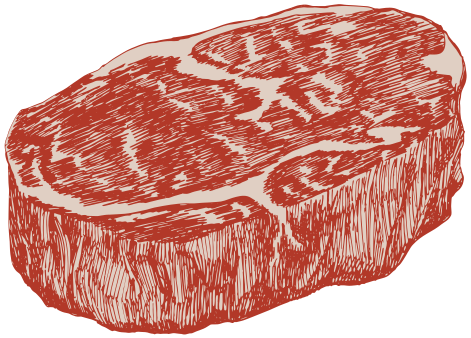 Chuck steak
The ribeye's eye, further forward
The longissimus dorsi, the long muscle along the back, does not stop where the rib primal begins. It continues forward through the first five ribs into the chuck, getting smaller and more mixed with other muscles as it goes. Cut from this section, the steak is called the chuck eye. Its centre is the same eye muscle as the ribeye, often with a small cap of spinalis and the complexus alongside, separated by seams of fat.
Only the steaks closest to the rib, around ribs 5 and 4, look and eat much like a ribeye. Each side of the carcass usually gives two or three such steaks. Further forward, towards the neck, the eye shrinks, more muscles with different grain directions join it, and connective tissue increases, so steaks from that end are chewier and better braised. This is why the name "chuck eye" covers steaks of quite different quality, and why the cut is often described as the poor man's ribeye.
Between the fifth and sixth ribs
In US fabrication the chuck is separated from the rib between the fifth and sixth ribs. The boneless chuck roll is then divided: the chuck eye roll (IMPS 116D) is its upper, central part, built around the forward longissimus, and steaks cut from it are listed as 1116D. The muscles underneath, including the serratus ventralis from which the Denver steak is cut, form the under blade.
Other systems keep the region whole or name it differently. Australian specifications sell the chuck roll and the steaks from its rib end without a separate chuck eye name. In Argentina the area is the aguja, and the steaks from its rib end are sold as bife de aguja, roughly comparable. In Japan the corresponding section is the kata rōsu (shoulder loin), sliced thin for sukiyaki and shabu-shabu; in Korea it is moksim, a common cut for grilling at the table.
The muscle-profiling studies of the chuck and round carried out in the United States in the early 2000s measured each of these muscles separately, and confirmed that the forward longissimus is among the more tender muscles of the chuck, with tenderness falling as it moves towards the neck.
Cooking it: like a ribeye, to 57–60 °C
A chuck eye from the rib end is cooked like a ribeye. A thickness of 2.5–3 cm (1–1¼ in) allows a dark crust over high heat while the centre stays medium-rare, about 54 °C / 129 °F before resting. Because it carries a little more connective tissue than a ribeye, many cooks prefer to take it to medium-rare or medium, around 57–60 °C / 135–140 °F, where more of the fat has softened.
Thicker chuck eyes respond well to the reverse sear: low heat in an oven or on the cool side of a grill until about 10 °C / 18 °F below the target, then a short, very hot sear. Resting for 5 minutes and slicing across the grain makes a noticeable difference with this cut, because the grain changes direction where the muscles meet.
Steaks from the neck end, or the whole chuck eye roll, are better roasted slowly or braised. Thin slices of the same region are the base of Japanese sukiyaki and of Korean grilled moksim.
How far forward was it cut
The useful question at the counter is how far forward the steak was cut. A chuck eye with a large, round eye, a visible cap and only one or two seams of fat comes from the rib end and will eat close to a ribeye. A steak where the eye is small and surrounded by several muscles running in different directions comes from further forward and is a braising piece.
Because each carcass gives only a few rib-end steaks, they are not always on display; butchers who break the chuck roll themselves can cut them on request. Marbling matters as much as in the ribeye: a chuck eye from a higher-graded carcass is juicier and more forgiving. For a closer match to the ribeye, the ribeye from the chuck end (ribs 6–8) is the next step along the same muscle.
Names around the world
15
The same muscle, named by language and by trade system.
| English | Chuck eye steak |
| Tiếng Việt | Nạc vai |
| Español | Bife de aguja (Argentina, aprox.) |
| 한국어 | 목심 (moksim) |
| 日本語 | 肩ロース (kata rōsu, approx.) |
| Français | Basses côtes |
| Italiano | Reale |
| Русский | Чак ролл |
| 中文 | 上脑 |
All the cuts' names, country by country →
Trade and national systems
| System | Name | Reference |
|---|---|---|
| United States | Chuck eye steak · chuck eye roll · "poor man's ribeye" | IMPS 116D / 1116D |
| Australia / NZ | Chuck roll (steaks from the rib end) | HAM |
| Argentina | Aguja · bife de aguja (approx.) | IPCVA |
| Brazil | Acém (approx.) | Portaria 5/88 |
| Japan | 肩ロース (kata rōsu, approx.) | JMGA |
| Korea | 목심 (moksim) | KAPE |
Frequently asked questions
What is a chuck eye steak?
A steak cut from the chuck where the ribeye muscle (longissimus dorsi) continues forward into the shoulder. The steaks next to the rib are similar to a ribeye.
Is chuck eye the same as ribeye?
It is the same muscle, but from further forward. Only the two or three steaks next to the rib are close to a ribeye; the rest are chewier.
Why is chuck eye called the poor man's ribeye?
Because the chuck eye steaks closest to the rib share the ribeye's muscle, marbling and flavour while being priced as chuck.
How do you cook a chuck eye steak?
Like a ribeye: 2.5–3 cm thick, high heat, to medium-rare (about 54 °C / 129 °F) or medium, then rested and sliced across the grain.
Sources
3
- USDA Agricultural Marketing Service. Institutional Meat Purchase Specifications: Fresh Beef Series 100. Washington, DC, 2014. www.ams.usda.gov/sites/default/files/media/IMPS_100_Fresh_Beef%5B1%5D.pdf
- North American Meat Institute. The Meat Buyer's Guide, 8th ed. Washington, DC, 2014.
- Von Seggern, D. D.; Calkins, C. R.; Johnson, D. D.; Brickler, J. E.; Gwartney, B. L. "Muscle profiling: characterizing the muscles of the beef chuck and round." Meat Science 71, no. 1 (2005): 39–51.
Related