Main course · Chuck, covered pot
Pot roast
Pot roast is an American dish of a whole, tough cut of beef, usually chuck, browned and then braised in a covered pot with a little liquid and root vegetables. Below the boil, the chuck's seams of collagen slowly turn to gelatin, until a fork pulls it apart.
At a glance
- Origin
- United States; European braising traditions
- Cut
- Chuck roast, 1.5 kg / 3.3 lb
- Oven
- 150 °C / 300 °F, covered
- Done
- Fork-tender, about 93 °C / 200 °F inside
- Serves
- 6
- Time
- 40 min active, about 4 h total
Not a roast but a braise
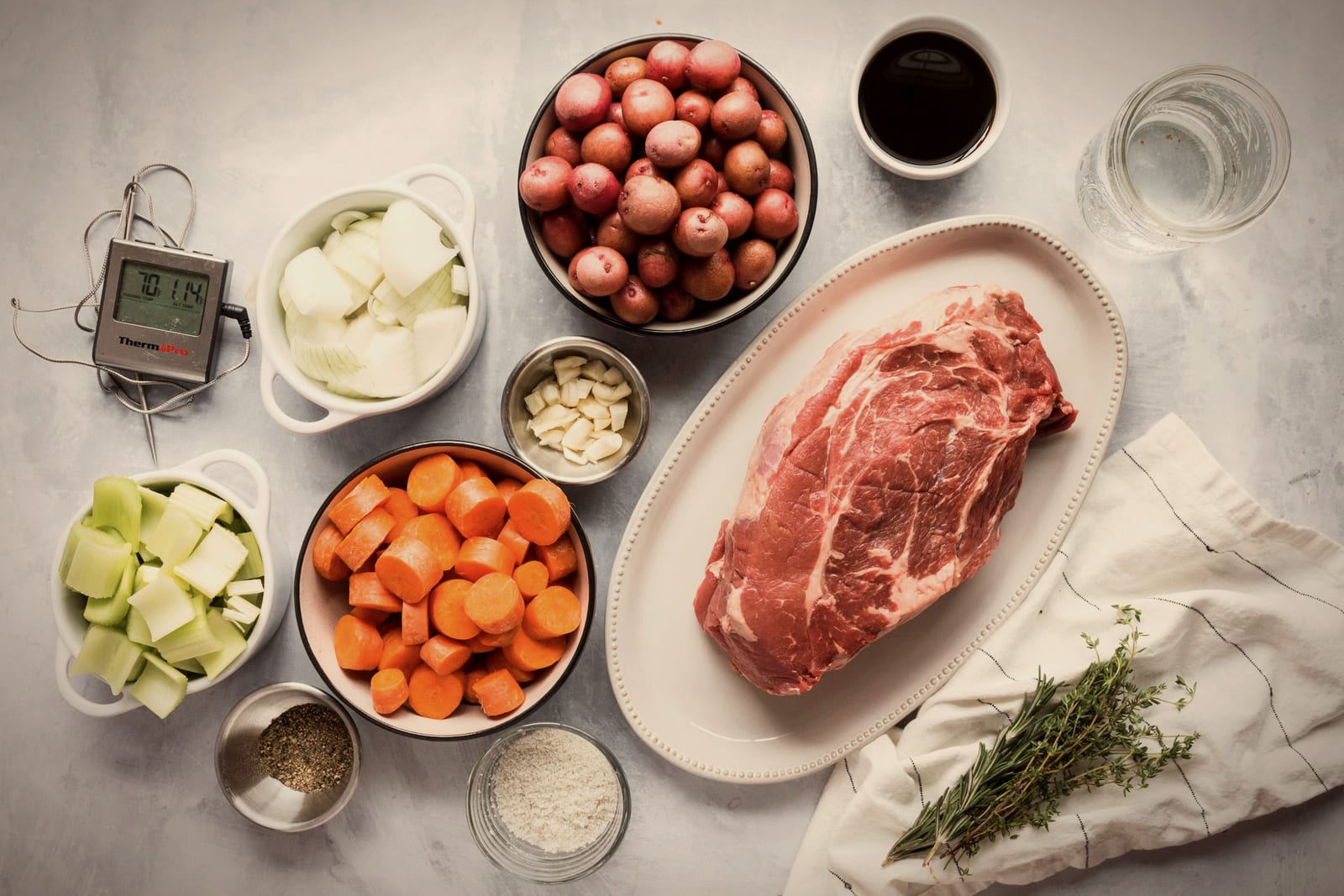
Despite the name, pot roast is not roasted: it is a braise. A single large piece of beef, typically 1.5–2 kg / 3–4½ lb, is seared on all sides, then cooked in a heavy covered pot with a small amount of liquid that comes only part of the way up the meat. The steam and gentle heat, kept below the boil, give the connective tissue time to turn into gelatin.
The usual cut is the chuck, from the shoulder, sold in the United States as chuck roast, chuck eye roast, shoulder roast or seven-bone roast. Its many seams of collagen and fat are what make it suited to the pot; lean cuts such as round dry out. Brisket and rump are used too. The dish is finished with vegetables cooked in the same pot and a gravy made from the braising liquid.
From European pots to Sunday dinner
Slow-cooking a large joint in a closed pot is an old European technique, carried to North America by English, French, German and Dutch settlers. The American dish takes its modern form in 19th-century household cookbooks, when the cast-iron pot and then the kitchen range made long, low cooking easy at home. It became a standard Sunday dinner in the 20th century, valued because it turned an inexpensive cut into a meal for a whole family, with leftovers for the week.
Yankee pot roast is the New England name for the version cooked with carrots, potatoes, onions and often turnips or parsnips added toward the end. The French bœuf à la mode, a larded beef braised in red wine with carrots and calf's foot, and the German Schmorbraten belong to the same family, and food historians generally treat the American pot roast as a descendant of these European braises.
Ingredients
| Ingredient | Amount | Note |
|---|---|---|
| Beef chuck roast | 1.5 kg / 3.3 lb | one piece, tied if loose |
| Salt | 15 g / ½ oz | about 1 tbsp coarse salt; season the day before if possible |
| Black pepper | to taste | freshly ground |
| Neutral oil | 2 tbsp / 30 ml | for searing |
| Onions | 2, about 300 g / 10 oz | in thick wedges |
| Garlic | 4 cloves | crushed |
| Tomato paste | 1 tbsp / 15 g | optional |
| Dry red wine or water | 250 ml / 1 cup | to deglaze |
| Beef stock | 500 ml / 2 cups | |
| Thyme and bay leaf | 3 sprigs, 2 leaves | |
| Carrots | 4, about 400 g / 14 oz | in large pieces |
| Waxy potatoes | 700 g / 1½ lb | halved |
| Butter and flour | 20 g / ¾ oz each | kneaded together, to thicken the gravy |
Method
- Season the beef with salt and pepper, ideally 12–24 hours ahead and refrigerated uncovered, so the salt has time to penetrate. Take it out of the refrigerator 30–60 minutes before cooking.
- Heat the oven to 150 °C / 300 °F. Pat the meat dry. In a heavy Dutch oven, heat the oil until it shimmers and brown the roast well on every side, 12–15 minutes in total. Set it aside.
- Lower the heat, add the onions and cook until they take color, about 8 minutes. Stir in the garlic and tomato paste for 1 minute, then add the wine and scrape the browned bits from the bottom.
- Return the beef with its juices, add stock until the liquid reaches about one third of the way up the meat, and add the thyme and bay. Bring to a simmer, cover tightly and place in the oven.
- Braise for 2½ hours, turning the meat once. Add the carrots and potatoes around it, cover again and cook 45–60 minutes more, until a fork slides into the beef with almost no resistance (about 93 °C / 200 °F inside) and the vegetables are tender.
- Move the meat and vegetables to a warm platter and cover loosely. Skim the fat from the liquid, bring it to a boil and whisk in the butter-flour paste in small pieces until the gravy coats a spoon. Taste for salt.
- Slice the beef thickly against the grain, or pull it into chunks, and serve with the vegetables and gravy.
Yankee, à la mode, Sauerbraten
Yankee pot roast adds turnips, parsnips or rutabaga and is often cooked on the stovetop rather than in the oven. Many 20th-century American recipes replaced the wine with water, coffee or canned soup, and the slow cooker became a common way to make the dish from the 1970s on; it works, but without searing the flavor is flatter, because the browned crust comes from the Maillard reaction.
Bœuf à la mode (France) is larded with strips of pork fat, marinated in red wine, braised with carrots and a calf's foot, and can be served cold in its own jelly. Sauerbraten (Germany) is marinated for several days in vinegar or wine with spices before it is braised; in the Rhineland the sauce is thickened with gingerbread and often sweetened with raisins. Italian stracotto and Spanish carne mechada are other members of the family. For the Burgundian stew of cubed beef in wine, see bœuf bourguignon.
Carved, with its gravy
Pot roast is carved at the table or in the kitchen and served with its vegetables and gravy, sometimes with mashed potatoes, egg noodles or bread to take up the sauce. Leftovers are commonly reheated in the gravy or used in sandwiches and hash. Common mistakes: using a lean cut, which turns dry and stringy; skipping the sear; covering the meat completely with liquid, which boils it; cooking at too high a temperature; and stopping too early, when the meat is cooked but the collagen has not yet softened.
Frequently asked questions
What is the best cut for pot roast?
Chuck, from the shoulder, is the standard cut because its collagen and fat keep it moist during a long braise; brisket and rump are common alternatives.
Why is my pot roast tough?
Usually because it has not cooked long enough: the meat must go well past the point of being cooked, to about 93 °C / 200 °F, for the connective tissue to soften.
Should pot roast be covered in liquid?
No. The liquid should reach about one third of the way up the meat; the rest cooks in the steam of the covered pot.
What is the difference between pot roast and roast beef?
Roast beef is cooked uncovered with dry heat, usually from a tender cut served pink; pot roast is a tough cut braised covered with liquid until fully tender.
Sources
4
- McGee, Harold. On Food and Cooking: The Science and Lore of the Kitchen, rev. ed. New York: Scribner, 2004.
- Larousse Gastronomique, rev. ed. London: Hamlyn, 2009.
- Smith, Andrew F. (ed.). The Oxford Companion to American Food and Drink. New York: Oxford University Press, 2007.
- Davidson, Alan. The Oxford Companion to Food. Oxford: Oxford University Press, 1999.
Related