Stew · Vietnam, red with annatto
Bò kho
Bò kho is a Vietnamese beef stew of brisket, shank or chuck simmered with lemongrass, star anise and cinnamon, coloured red with annatto oil. Two to three hours soften the meat until a spoon cuts it; the generous sauce is made for dipping a baguette (bánh mì).
At a glance
- Origin
- Vietnam, best known in the south
- Cuts
- Brisket, shank, chuck, tendon
- Flavour
- Lemongrass, star anise, cinnamon, annatto
- Serves
- 6, with bread or noodles
- Time
- 45 min active, about 3½ h in total
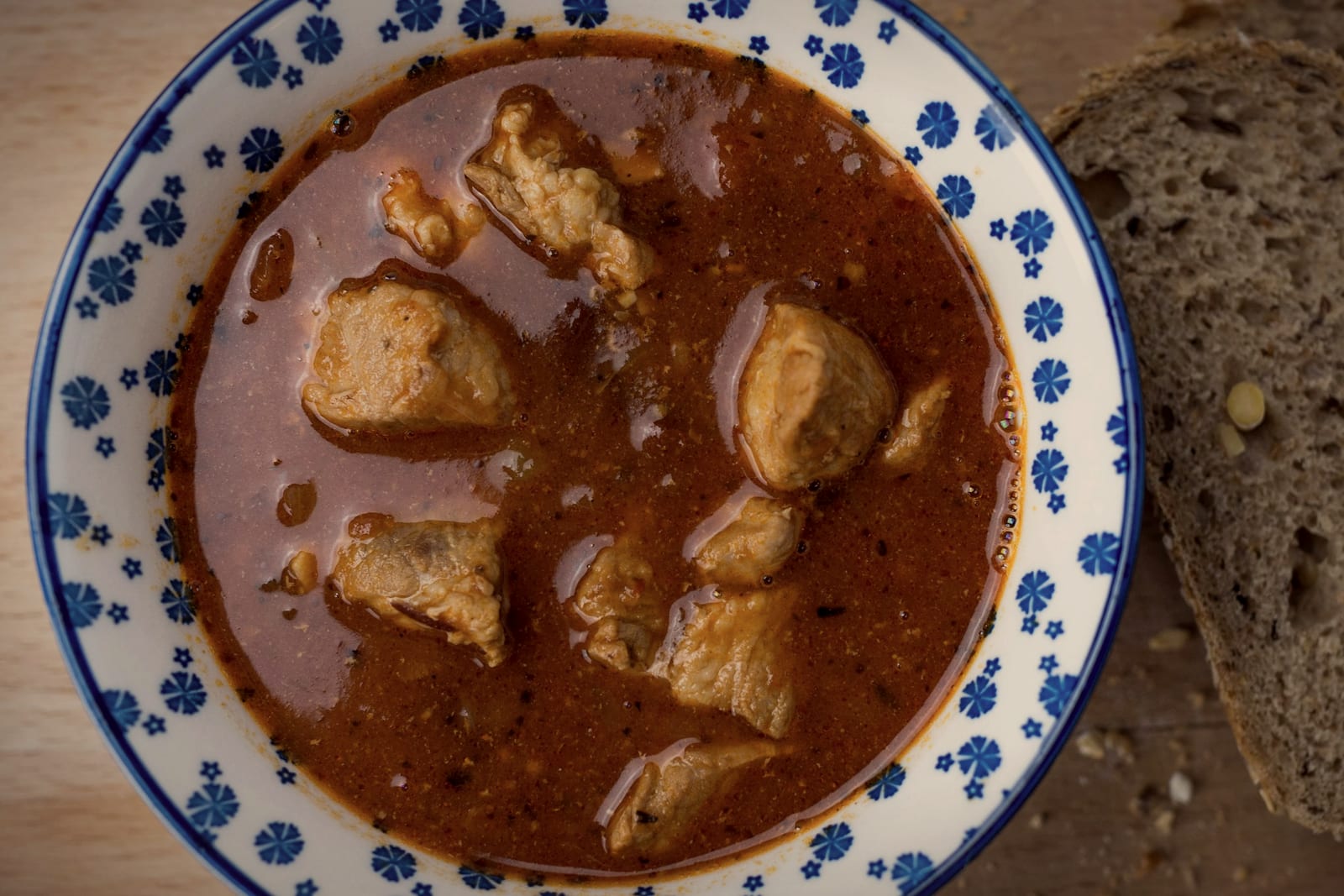
A kho loose enough for bread
Kho is a Vietnamese cooking method: food simmered slowly in a seasoned liquid until it reduces, as in caramelized pork (thịt kho) or fish in a clay pot (cá kho tộ). Bò kho is the beef version, but looser than most kho dishes: a generous, red-orange sauce, fragrant with lemongrass and star anise, made for dipping bread.
It uses tough, collagen-rich cuts — brisket and flank (nạm), shank (bắp bò), chuck, tendon (gân), sometimes short ribs — cut into large cubes, marinated, browned and then simmered for two to three hours until a spoon cuts them. Carrots are the usual vegetable. The colour comes from annatto seeds (hạt điều màu) fried in oil, sometimes with tomato paste; the depth from fish sauce, a little sugar and five-spice powder.
A southern breakfast, with a baguette
Bò kho is eaten throughout Vietnam but is most strongly associated with the south, where it is a breakfast dish of street stalls and markets, served with a crusty bánh mì. The use of beef, bread and carrots and the long braising are often linked to the French colonial period and compared with French stews such as bœuf bourguignon; the spices — star anise, cinnamon, five-spice — come from the Chinese repertoire, and the lemongrass and fish sauce are Vietnamese. The comparison is a common one, not a documented line of descent.
Southern cooks frequently add coconut water (nước dừa), which brings sweetness and body, a habit shared with other southern braises. Central and northern versions tend to be drier, spicier or less sweet.
Ingredients
| Ingredient | Amount | Note |
|---|---|---|
| Beef brisket, shank or chuck (mixed) | 1.5 kg / 3.3 lb | in 4 cm / 1½ in cubes; add tendon if available |
| Lemongrass | 4 stalks | 2 minced for the marinade, 2 bruised and knotted |
| Garlic, shallots | 4 cloves, 3 shallots (about 60 g / 2 oz) | minced |
| Ginger | 30 g / 1 oz | half grated, half sliced |
| Fish sauce | 60 ml / ¼ cup | |
| Sugar | 1 tbsp / 12 g | or rock sugar |
| Five-spice powder | 1½ tsp | |
| Annatto seeds | 1 tbsp / 10 g | fried in 3 tbsp / 45 ml oil, seeds discarded |
| Tomato paste | 1 tbsp / 15 g | optional |
| Star anise, cinnamon stick | 3 whole, 1 stick (8 cm / 3 in) | toasted |
| Coconut water | 1 L / 4 cups | or water; plus water as needed |
| Carrots | 500 g / 1.1 lb | in thick chunks |
| To serve: bánh mì or rice noodles, Thai basil, lime, salt and pepper |
Method
- Mix the beef with the minced lemongrass, garlic, shallots, grated ginger, fish sauce, sugar and five-spice. Marinate 1 hour, or overnight in the refrigerator.
- Fry the annatto seeds in the oil over low heat for 1–2 minutes until the oil is deep red; strain and discard the seeds.
- Heat the annatto oil in a heavy pot and brown the beef in batches over high heat. Return all the meat, add the tomato paste and stir 1 minute.
- Add the coconut water, the bruised lemongrass, sliced ginger, star anise and cinnamon, and enough water to just cover. Bring to a boil, skim, then lower to a gentle simmer, about 90–95 °C / 194–203 °F.
- Cover partially and simmer 2–2½ hours, until the meat is tender; tendon may take longer. Remove the star anise and cinnamon once the aroma is strong enough, so they do not dominate.
- Add the carrots for the last 30 minutes. Adjust with fish sauce and sugar; the sauce should be savory, slightly sweet and loose enough to dip bread into.
Over noodles, or drier and darker
Hủ tiếu bò kho and mì bò kho serve the stew over rice or egg noodles with extra broth, like a noodle soup. Some households add potato, daikon or sweet potato; others thicken the sauce lightly with tapioca starch. A drier, darker bò kho close to a caramelized kho exists in some families. Similar spiced braises of beef in the region include the Indonesian rendang, which is cooked until dry.
Thai basil, lime and torn bread
The stew is ladled into bowls with Thai basil (húng quế) and sawtooth coriander, and a small dish of salt, pepper and lime on the side; the bread is torn and dipped. As with most braises, it improves when made a day ahead: the fat sets on top and is easy to remove, and the collagen in the sauce gives it more body.
Common mistakes: using lean, tender cuts, which turn dry and stringy instead of soft; boiling hard instead of simmering, which tightens the meat; leaving the star anise and cinnamon in from start to finish, which makes the sauce taste medicinal; adding the carrots at the beginning, so they collapse; and skipping the browning, which gives a flat, pale stew. Collagen needs time above about 70 °C / 158 °F to turn into gelatin, as McGee explains.
Frequently asked questions
What cut of beef is best for bò kho?
Tough cuts with connective tissue: brisket, flank, shank, chuck and tendon, which become tender after two to three hours of simmering.
What gives bò kho its red colour?
Annatto seeds fried in oil, sometimes helped by tomato paste.
What do you eat bò kho with?
In the south, with a crusty bánh mì for dipping; it is also served over rice or egg noodles as hủ tiếu bò kho or mì bò kho.
Sources
4
- McGee, Harold. On Food and Cooking: The Science and Lore of the Kitchen, rev. ed. New York: Scribner, 2004.
- Nguyen, Andrea. Into the Vietnamese Kitchen: Treasured Foodways, Modern Flavors. Berkeley: Ten Speed Press, 2006.
- Phan, Charles. Vietnamese Home Cooking. Berkeley: Ten Speed Press, 2012.
- Vu Hong Lien. Rice and Baguette: A History of Food in Vietnam. London: Reaktion Books, 2016.
Related