Sauce · France, tarragon
Béarnaise sauce
Béarnaise is a warm emulsion of egg yolks and butter with a tarragon, shallot and vinegar reduction: the French sauce for grilled steak. Around 70 °C / 158 °F the yolks begin to curdle, so it is served warm, never hot.
At a glance
- Origin
- Saint-Germain-en-Laye, France, c. 1836
- Family
- Emulsified butter sauce (hollandaise family)
- Yield
- About 250 ml / 1 cup, for 4–6
- Time
- 30 min
- Critical temperature
- Yolks thicken at 60–65 °C / 140–149 °F; curdle above about 70 °C / 158 °F
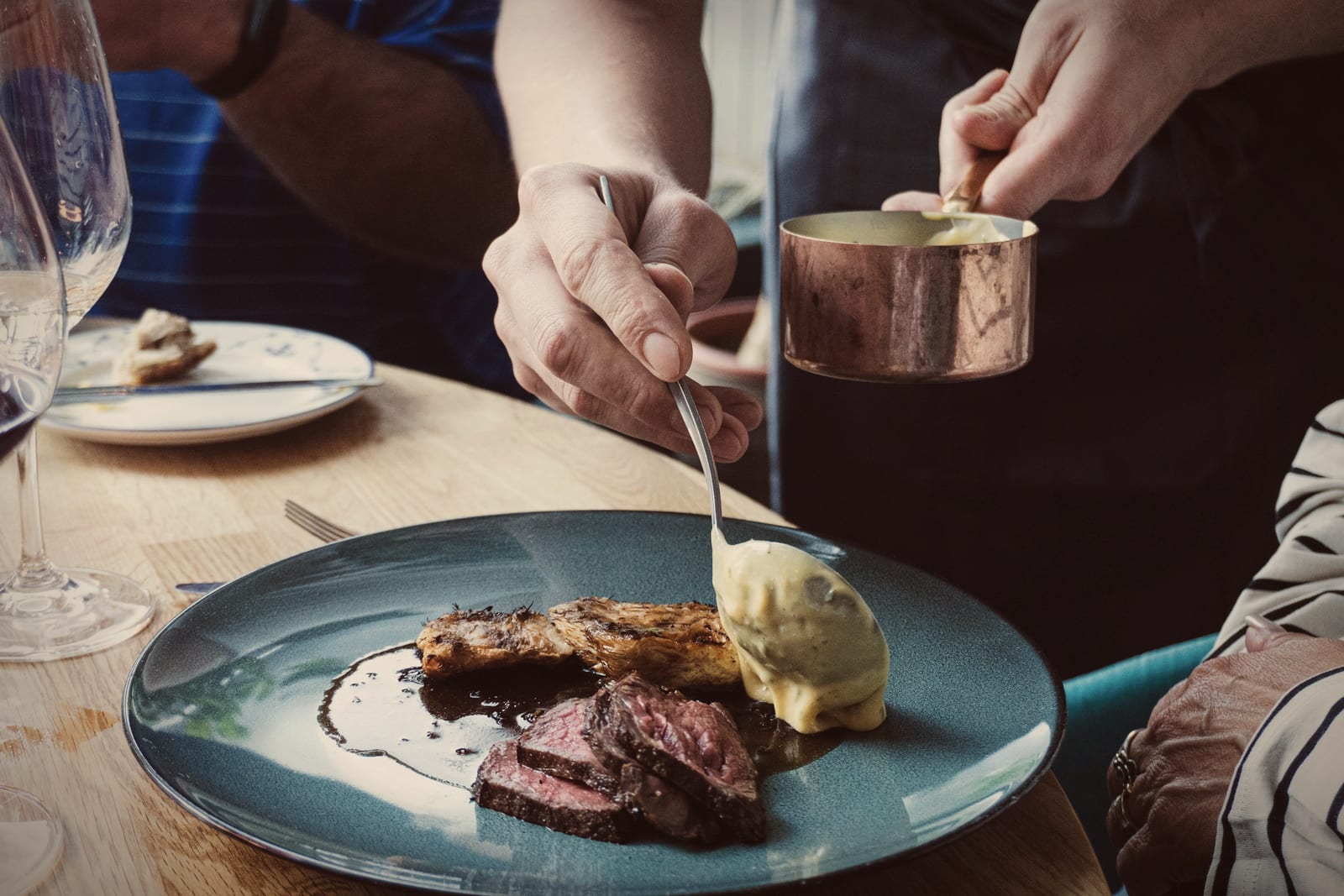
Hollandaise's cousin, with tarragon
Béarnaise belongs to the family of warm emulsified butter sauces, like hollandaise. Egg yolks are cooked gently with an acidic reduction until thick, then whisked with butter, drop by drop at first, so that the fat stays suspended in tiny droplets. What distinguishes béarnaise from hollandaise is the flavor base: a reduction of wine vinegar, white wine, shallot, tarragon and crushed pepper, and fresh tarragon and chervil added at the end.
It is served warm, never hot, with grilled beef — especially tenderloin and striploin — and with steak frites.
Saint-Germain-en-Laye, around 1836
The usual attribution is to the chef Jules Collinet at the Pavillon Henri IV, a restaurant at Saint-Germain-en-Laye near Paris, around 1836. The name honors the Béarn region, birthplace of King Henri IV, after whom the restaurant was named; the sauce itself is not a regional dish of Béarn.
Auguste Escoffier codified it in Le Guide culinaire (1903) and listed its derivatives. Larousse Gastronomique gives it among the classic sauces. Because it uses egg yolks, many kitchens prefer pasteurized yolks or hold the sauce for only a short time, as recommended by food-safety codes.
Why it splits past 70 °C
Harold McGee explains that yolk proteins thicken the sauce when they begin to set, at about 60–65 °C / 140–149 °F, while lecithin and other emulsifiers in the yolk coat the butterfat droplets and keep them apart. If the mixture passes about 70 °C / 158 °F, the proteins coagulate into curds and the sauce breaks. If butter is added too fast, or the sauce is too cold, there is not enough water and emulsifier to hold the fat, and it separates. The acid of the reduction helps protect the yolks from curdling.
Ingredients
| Ingredient | Amount | Note |
|---|---|---|
| White wine vinegar | 60 ml / ¼ cup | or tarragon vinegar |
| Dry white wine | 60 ml / ¼ cup | |
| Shallot | 1, about 40 g / 1½ oz | finely chopped |
| Tarragon | 3 tbsp chopped, divided | stems for the reduction, leaves to finish |
| Chervil | 1 tbsp chopped | to finish; optional |
| Black peppercorns | ½ tsp | crushed |
| Egg yolks | 3 | pasteurized if preferred |
| Butter | 200 g / 7 oz | clarified or melted and warm, or cold and diced |
| Salt, cayenne | to taste |
Method
- Put the vinegar, wine, shallot, tarragon stems and half the chopped tarragon, and the crushed pepper, in a small pan. Reduce over medium heat to about 2 tablespoons / 30 ml. Strain (or not, for a rustic sauce) and let cool slightly.
- Melt and clarify the butter, or have it warm, about 50 °C / 122 °F.
- In a heatproof bowl over barely simmering water, whisk the yolks with the reduction and a tablespoon of water until thick and pale, and the whisk leaves trails: 60–65 °C / 140–149 °F. Remove from the heat if the bowl gets too hot.
- Off the heat, add the butter a few drops at a time, whisking constantly; once it thickens, add it in a thin stream. Leave the milky whey at the bottom of clarified butter behind.
- Season with salt and a pinch of cayenne and stir in the remaining tarragon and the chervil. Keep warm, around 55–60 °C / 131–140 °F, for no more than about an hour.
Choron, Foyot and paloise
Escoffier lists derivatives: sauce Choron adds tomato purée; sauce Foyot (or Valois) adds meat glaze; sauce paloise replaces tarragon with mint and is served with lamb. A blender version pours hot butter onto the yolks and reduction with the motor running. To rescue a split sauce, whisk a fresh yolk, or a spoonful of hot water, in a clean bowl and add the broken sauce gradually.
Beside the steak, not over it
Serve the sauce warm in a sauceboat or a spoonful beside the steak, not poured over it, so the crust stays crisp. It also goes with grilled fish and asparagus. Common mistakes: overheating the yolks, adding the butter too fast, letting the sauce cool until it sets, and reheating it directly over heat.
Frequently asked questions
Why did my béarnaise split?
Either the yolks overheated and curdled, or the butter was added too fast. A curdled sauce can sometimes be saved by whisking it gradually into a fresh yolk or a little hot water.
What is the difference between béarnaise and hollandaise?
Both are yolk-and-butter emulsions; hollandaise is flavored with lemon, béarnaise with a reduction of vinegar, wine, shallot and tarragon.
Can béarnaise be made ahead?
It can be held warm, at about 55–60 °C / 131–140 °F, for up to an hour. It does not reheat well once cold.
What does béarnaise go with?
Grilled steak above all, especially tenderloin and striploin; also fish, eggs and asparagus.
Sources
3
- McGee, Harold. On Food and Cooking: The Science and Lore of the Kitchen, rev. ed. New York: Scribner, 2004.
- Larousse Gastronomique, rev. ed. London: Hamlyn, 2009.
- Escoffier, Auguste. Le Guide culinaire. Paris, 1903; English ed. The Complete Guide to the Art of Modern Cookery, trans. H. L. Cracknell and R. J. Kaufmann. London: Heinemann, 1979.
Related