
Main course · Shoulder steak, pan or grill
Flat iron steak
A flat iron is the top blade muscle of the shoulder, the infraspinatus, opened along its central sinew with the sinew lifted out, which leaves two flat steaks about 2 cm / ¾ in thick (225–340 g / 8–12 oz each). In shear-force studies it ranks among the most tender beef muscles, and its even thickness makes it one of the most predictable steaks to cook: 3–4 minutes a side over high heat, in a smoking pan or on a hot grill, off the heat at 52–54 °C / 126–129 °F for medium-rare, rested 5 minutes and sliced against the grain. Past medium, about 60 °C / 140 °F, its fine marbling melts out and the meat firms up.
At a glance
- Cut
- Top blade (infraspinatus), central sinew removed
- Size
- About 2 cm / ¾ in, 225–340 g / 8–12 oz
- Heat
- High: 3–4 min a side, pan or grill
- Medium-rare
- Off the heat at 52–54 °C / 126–129 °F
- Key
- Never past medium; slice against the grain
A tender steak from the shoulder
The flat iron comes from the infraspinatus, a hand-sized muscle on the outer face of the shoulder blade, specified in the United States as the top blade (IMPS 114D). Through its middle runs a thick, flat band of connective tissue. Cut across, as in the older top blade steak, every slice keeps a line of gristle; opened lengthwise with the sinew lifted off, the muscle gives two clean, flat steaks. This recipe starts from that point, as a steak sold as a flat iron should.
If the piece comes whole with the sinew in, as the oyster blade in Australia or the feather blade in Britain, it can be opened along the sinew and the band lifted off, or kept whole and braised. A well-cut flat iron shows at most a thin, silvery mark on one face where the band was, and no line of gristle through the meat.
Pan or grill
Both work, because the flat iron is thin and even: the outside browns in the same few minutes the center takes to reach medium-rare. A heavy pan gives an all-over crust and keeps the browned juices for a butter baste or a pan sauce; a grill gives char and smoke. Either way the heat must be high, or the surface grays before it browns. The general methods, for any steak, are in pan-seared steak and how long to grill steak; this page adds what is specific to the flat iron.
Ingredients
| Ingredient | Amount | Note |
|---|---|---|
| Flat iron steaks | 2 steaks, about 2 cm / ¾ in thick (225–340 g / 8–12 oz each) | serves 2; central sinew already removed |
| Coarse salt | about 1 % of the weight (5–7 g) | 40 minutes to a day ahead |
| Black pepper | to taste | after cooking |
| Refined oil with a high smoke point | 1 tbsp | for the pan, or to brush the steaks for the grill |
| Butter | 30 g / 1 oz | optional, pan only, the last 1–2 minutes |
| Garlic and thyme or rosemary | 2 cloves, a few sprigs | optional, with the butter |
| Flaky salt | to finish | after slicing |
Method
- Check the steaks: no line of gristle through the meat and an even thickness. If one face still carries a patch of silverskin, slide a thin knife under it and lift it off.
- At least 40 minutes ahead, or the day before, pat the steaks dry and salt them on all sides with about 1 % of their weight. Leave them uncovered on a rack in the refrigerator. Avoid salting 3–40 minutes before cooking, when the surface is wet with brine (see salting steak).
- Pan: heat a heavy 25–30 cm / 10–12 in cast-iron or carbon-steel pan over medium-high heat for 5–10 minutes, until a drop of oil smokes on contact. Grill: build a hot, direct fire of about 230–290 °C / 450–550 °F at the grate; the steaks stay over direct heat the whole time.
- Pat the steaks dry again. In the pan, add the oil just before the steaks and lay them in away from you; on the grill, brush them lightly with oil. Leave them until they release, 45–60 seconds.
- Cook 3–4 minutes a side, 6–8 minutes in total, turning once halfway, or every 30–60 seconds for a more even center. In the pan, for the last 1–2 minutes lower the heat to medium, add the butter, garlic and herbs and spoon the foam over the steaks.
- Take them off at 52–54 °C / 126–129 °F in the center for medium-rare, reading with an instant-read thermometer pushed in from the side. Rest them on a rack for 5 minutes.
- Slice against the grain, into strips about 1 cm / ⅜ in thick: look at the lines of the grain on the surface and cut across them. Pour the resting juices over and finish with flaky salt and pepper.
Temperatures
The flat iron is at its best rare to medium-rare. Past medium, about 60 °C / 140 °F, the fine marbling melts out, the meat firms up and the tenderness that is the point of the cut is lost. A thin steak rises only a little while resting: 1–2 °C / 2–4 °F at 1.5 cm / ½ in, 2–4 °C / 4–7 °F at 2.5 cm / 1 in. The full chart is the steak temperature chart.
| Doneness | Take off the heat | After a 5-minute rest |
|---|---|---|
| Rare | 47–48 °C / 118 °F 117–118 °F | 50–52 °C / 126 °F 122–126 °F |
| Medium-rare (recommended) | 52–54 °C / 129 °F 126–129 °F | 54–57 °C / 135 °F 129–135 °F |
| Medium (upper limit) | 56–57 °C / 135 °F 133–135 °F | 59–61 °C / 142 °F 138–142 °F |
| USDA safe minimum (whole cuts) | — | 63 °C / 145 °F 145 °F with a 3-minute rest |
Times by thickness
Total times for medium-rare, for a steak straight from the refrigerator, in a well-preheated heavy pan or over a hot, direct fire. Most flat irons are about 2 cm / ¾ in, and the cut's own figure, 3–4 minutes a side, falls inside the ranges below. The thermometer decides.
| Thickness | Heavy pan (total) | Grill, direct heat (total) | Rest |
|---|---|---|---|
| 1.5 cm / ½ in | 3–5 min | 3–5 min | 2–3 min |
| 2–2.5 cm / ¾–1 in | 6–8 min | 6–10 min | 5 min |
Marinades, rubs and strips
The flat surface browns evenly and the meat has enough fat to carry flavor, so the flat iron takes marinades and spice rubs well. A soy-based marinade can stay on for 2–12 hours in the refrigerator, a citrus or vinegar one 1–8 hours. Dry the steak well before cooking: a wet surface steams, and sugar in a marinade burns at searing heat (see steak marinade).
Sliced into thin strips before cooking, the flat iron also works in stir-fries. For a shoulder steak with more marbling and less tenderness, see Denver steak vs flat iron.
Common mistakes
Most disappointing flat irons come from four habits. Cooking it past medium, which melts out the marbling. A pan or grill that is not hot enough, so the thin steak cooks through before it browns. Slicing with the grain, or in thick slabs. And buying a top blade steak cut across the muscle by mistake: with a line of sinew through the middle it is a different steak and cooks differently (see oyster blade).
Keep reading
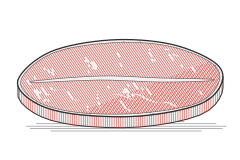
 Cut · Chuck, sinew removedFlat iron steakThe top blade opened along its sinew into two flat, tender steaks, 2 cm / ¾ in thick: a 2000s American invention.
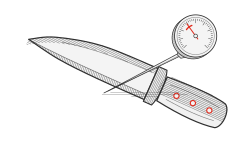
 Cut · Shoulder blade, with sinewOyster bladeThe whole shoulder-blade muscle and its sinew: braised in the West, sliced thin on Korean and Japanese grills.
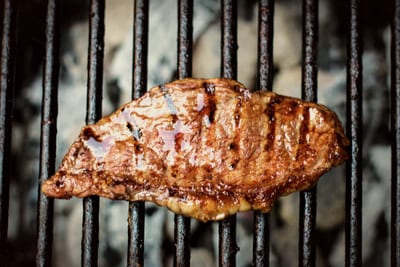
 Buying guide · Two steaks from the shoulderDenver steak vs flat iron steakTwo chuck steaks from different muscles: the Denver, more marbled, and the flat iron, more tender.
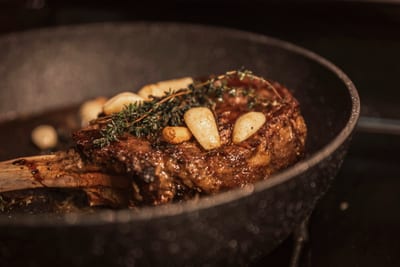 Main course · Stovetop, garlic butterPan-seared steakAny steak on the stove: a very hot skillet, garlic butter at the end and a sauce from the pan, in 6–8 minutes.
 Sauce · Marinade for grill and panSteak marinadeOil, soy, lime, garlic and sugar: the basic marinade, how long each kind needs, and why it only reaches the surface.
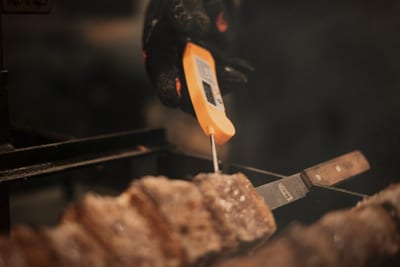 Cooking · Pull early, then restSteak temperature & doneness chartSix levels from blue to well done in °C and °F: when to pull, carryover by thickness, safety, and a printable chart.
Frequently asked questions
How long do you cook a flat iron steak?
About 3–4 minutes a side, 6–8 minutes in total, for a steak about 2 cm / ¾ in thick in a smoking-hot pan or over a hot grill, to medium-rare. Take it off at 52–54 °C / 126–129 °F and rest it 5 minutes.
What temperature should flat iron steak be cooked to?
Pull it at 52–54 °C / 126–129 °F for medium-rare; it finishes around 54–57 °C / 129–135 °F after resting. Past medium, about 60 °C / 140 °F, the marbling melts out. The USDA safe minimum for whole cuts is 63 °C / 145 °F with a 3-minute rest.
Is flat iron steak better in a pan or on the grill?
Both suit it. A heavy pan gives an even crust and juices for a butter baste or a pan sauce; a grill gives char and smoke. Either way, use high heat and keep the steak over it the whole time.
Do you need to remove the vein from a flat iron steak?
Not from a steak sold as a flat iron: the thick central sinew has already been lifted out. A top blade steak cut across the muscle keeps a line of sinew; the whole muscle with its sinew is the oyster blade in Australia and the feather blade in Britain.
How do you slice flat iron steak?
After a 5-minute rest, against the grain, into strips about 1 cm / ⅜ in thick. Look at the lines of the grain on the surface and cut across them.
Sources
3
- USDA Agricultural Marketing Service. Institutional Meat Purchase Specifications: Fresh Beef Series 100. Washington, DC, 2014. www.ams.usda.gov/sites/default/files/media/IMPS_100_Fresh_Beef%5B1%5D.pdf
- McGee, Harold. On Food and Cooking: The Science and Lore of the Kitchen, rev. ed. New York: Scribner, 2004.
- USDA Food Safety and Inspection Service. Safe Minimum Internal Temperature Chart. 2023. www.fsis.usda.gov/food-safety/safe-food-handling-and-preparation/food-safety-basics/safe-temperature-chart