Main course · Korea, sliced thin
Bulgogi
Bulgogi, Korean for "fire meat", is beef sliced 2–3 mm thick, marinated in soy, sugar, sesame oil, garlic and grated Korean pear, then grilled over charcoal or pan-cooked. On a hot surface the sugar caramelizes in a minute or two, so the slices brown before they dry out.
At a glance
- Origin
- Korea; from neobiani of the Joseon court
- Cut
- Sirloin, ribeye, tenderloin or top round, 2–3 mm thick
- Marinade
- Soy, sugar, Korean pear, garlic, sesame oil
- Serves
- 4
- Time
- 25 min active; marinate 30 min–4 h
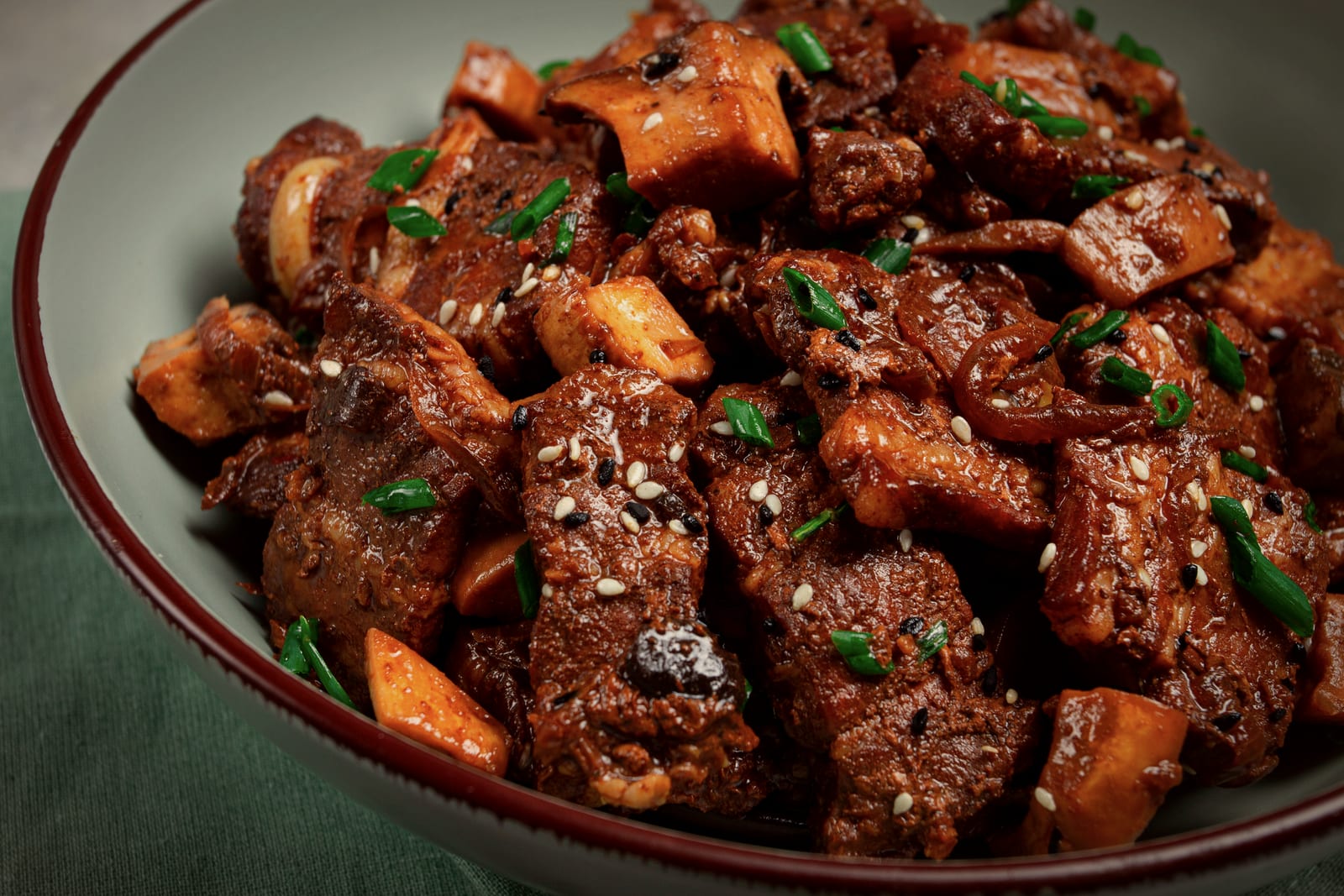
Thin slices, a sweet-savoury marinade
In bulgogi, tender beef is cut across the grain into thin slices and soaked in a sweet-savoury marinade. The sugar and soy caramelize quickly on a hot surface, so the meat browns in a minute or two while staying juicy. It is eaten with rice, wrapped in lettuce with garlic and soybean paste (ssam), and accompanied by kimchi and other side dishes (banchan).
The usual cuts in Korea are sirloin (deungsim), tenderloin (ansim) and top round (udun); in other countries ribeye and striploin are common. Korean Hanwoo beef is graded by marbling under Korea's national system (see grading systems).
From the neobiani of the Joseon court
The direct precursor of bulgogi is neobiani, thin slices of seasoned beef grilled for the royal court and the aristocracy of the Joseon dynasty (1392–1897); the name is usually explained as "widely sliced". Some food historians trace the line further back to maekjeok, a skewered, pre-seasoned meat associated with the ancient kingdom of Goguryeo, though the evidence for that link is thin.
The word bulgogi appears only in the first half of the 20th century, and its origin as a name is debated; it became widespread after the Korean War (1950–1953), when cheaper beef, restaurant culture and, later, export to Korean communities abroad made it a national dish. In Seoul, bulgogi came to be cooked on a domed pan with a moat that collects the marinade and juices, eaten with noodles soaked in the broth.
Ingredients
| Ingredient | Amount | Note |
|---|---|---|
| Beef sirloin, ribeye or tenderloin | 600 g / 1.3 lb | sliced 2–3 mm / ⅛ in, across the grain |
| Soy sauce | 60 ml / ¼ cup | |
| Sugar | 25 g / 2 tbsp | or 1 tbsp sugar + 1 tbsp honey |
| Korean pear (or Asian pear) | ½, about 150 g / 5 oz | grated with its juice |
| Onion | ½, about 80 g / 3 oz | half grated into the marinade, half sliced |
| Garlic | 4 cloves, about 15 g / ½ oz | minced |
| Toasted sesame oil | 1 tbsp / 15 ml | |
| Rice wine (cheongju or mirin) | 1 tbsp / 15 ml | optional |
| Spring onions | 3, about 45 g / 1½ oz | cut in 4 cm / 1½ in lengths |
| Toasted sesame seeds and black pepper | 1 tbsp / 8 g; ¼ tsp | |
| Mushrooms (shiitake, oyster) and carrot | 150 g / 5 oz | optional, for pan cooking |
| Lettuce, ssamjang, cooked rice | to serve |
Method
- Partly freeze the beef, 30–60 minutes, so that it can be sliced thinly and evenly across the grain.
- Mix the soy sauce, sugar, grated pear, grated onion, garlic, sesame oil, rice wine and pepper until the sugar dissolves.
- Add the beef and massage the marinade into it. Refrigerate for 30 minutes to 4 hours; much longer, and the pear and salt make thin slices soft and mushy.
- To grill: heat a charcoal grill or grill pan until very hot. Spread the slices in one layer and cook 1–2 minutes per side, until browned at the edges and just cooked through.
- To pan-cook: heat a wide pan with a little oil over high heat, add the sliced onion, spring onions and mushrooms, then the beef in batches with a little marinade, stirring until the liquid reduces to a glaze, 3–5 minutes.
- Finish with the remaining spring onion and the sesame seeds, and serve at once.
Charcoal in Ulsan, broth in Seoul
Regional styles differ in cut and fire. Eonyang bulgogi, from Ulsan, and Gwangyang bulgogi, from South Jeolla, are grilled over charcoal on a wire grill, the latter seasoned just before cooking. Seoul style is cooked with broth on a domed pan or as a shallow stew (ttukbaegi bulgogi). Bulgogi made into patties, tteokgalbi-like, and pork bulgogi (dwaeji bulgogi, often with chili paste) are related dishes. Outside Korea, bulgogi appears in burgers, tacos and rice bowls. The rib version of the same marinade is galbi.
The pear is traditional and is often credited with tenderizing the meat. Asian pears contain a modest protease activity, but on thin slices their main contribution is sweetness and moisture; kiwi, which has a much stronger enzyme, is sometimes used instead and quickly turns meat mushy.
Rice, lettuce wraps and banchan
Bulgogi is a main dish served family-style with rice, lettuce and perilla leaves for wrapping, ssamjang (soybean and chili paste), raw or grilled garlic, and kimchi. Common mistakes: slicing the meat thick or with the grain; marinating overnight, which makes it mushy; crowding the pan, so the meat boils grey instead of browning; and cooking over a heat too low to caramelize the sugar, or too high for too long, which burns it.
Frequently asked questions
What does bulgogi mean?
Bul means fire and gogi means meat: "fire meat", from cooking over an open flame or charcoal.
What cut of beef is best for bulgogi?
Tender cuts that slice thinly: sirloin, ribeye, tenderloin or top round, cut 2–3 mm across the grain.
Why is pear used in bulgogi marinade?
Grated Korean pear adds sweetness and moisture and is traditionally credited with tenderizing; on thin slices its enzyme effect is modest.
What is the difference between bulgogi and galbi?
Bulgogi uses thin boneless slices; galbi uses beef short ribs, cut across the bones or butterflied, with a similar marinade or with salt.
Sources
4
- Korea Institute for Animal Products Quality Evaluation (KAPE). Beef cuts and grading. www.ekape.or.kr
- McGee, Harold. On Food and Cooking: The Science and Lore of the Kitchen, rev. ed. New York: Scribner, 2004.
- Pettid, Michael J. Korean Cuisine: An Illustrated History. London: Reaktion Books, 2008.
- Maangchi; Chattman, Lauren. Maangchi's Real Korean Cooking: Authentic Dishes for the Home Cook. Boston: Rux Martin / Houghton Mifflin Harcourt, 2015.
Related