Cut · Chuck, the shoulder
Chuck roast & chuck steak
A chuck roast is a thick piece of the chuck, the shoulder and neck of the animal over the first five ribs, sold as a 7-bone, blade, arm or chuck roll roast; a chuck steak is the same meat sliced 2–3 cm thick. Hard-working muscles give it deep flavour, marbling and plenty of collagen, so it is cooked slowly with moisture until the collagen turns to gelatin and the meat pulls apart.
At a glance
- Primal
- Chuck: neck, shoulder and ribs 1–5
- Muscles
- Many: triceps (clod), serratus, longissimus, complexus…
- Best cooked
- Braised or pot-roasted 3–4 h, to 90–96 °C
- Cooking yield
- About 64–66 % of raw weight, braised (USDA)
- Per 100 g raw
- 21 g protein · 4–6 g fat (lean, USDA)
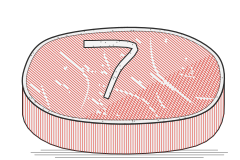
The shoulder, in one piece or in slices
The chuck is the front of the forequarter: the neck, the shoulder blade and the upper arm, together with the first five ribs. It is the heaviest primal of the carcass and the busiest, made of many muscles that move the head and carry the animal's weight. Their seams of fat and their connective tissue are what make a chuck roast both flavoursome and tough when cooked fast.
"Chuck roast" is a family name rather than one cut. A 7-bone roast is cut across the blade end, where the shoulder blade shows in section like the numeral 7. A blade roast comes from the same end without that cross-section; an arm roast from the lower part, around the round arm bone. A boneless chuck roll (IMPS 116A) is the long muscle group above the blade, rolled and tied; a shoulder clod or shoulder pot roast (IMPS 114) is the large triceps of the upper arm, leaner and more even. A chuck steak is any of these sliced 2–3 cm (about 1 in) thick, often with a piece of bone.
| Chuck roast | Where in the shoulder | What to expect |
|---|---|---|
| 7-bone roast | Cross-cut of the blade end, with the bone | Several muscles, rich, very gelatinous |
| Blade roast | Blade end, above the bone | Marbled; contains the flat iron muscle |
| Arm roast | Lower shoulder, round arm bone | Leaner, one large muscle and its seams |
| Chuck roll (116A) | Boneless, above the blade, ribs 1–5 | Marbled; the chuck eye at its rib end |
| Shoulder clod (114) | Boneless triceps of the upper arm | Lean and even; slices neatly |
On the animal
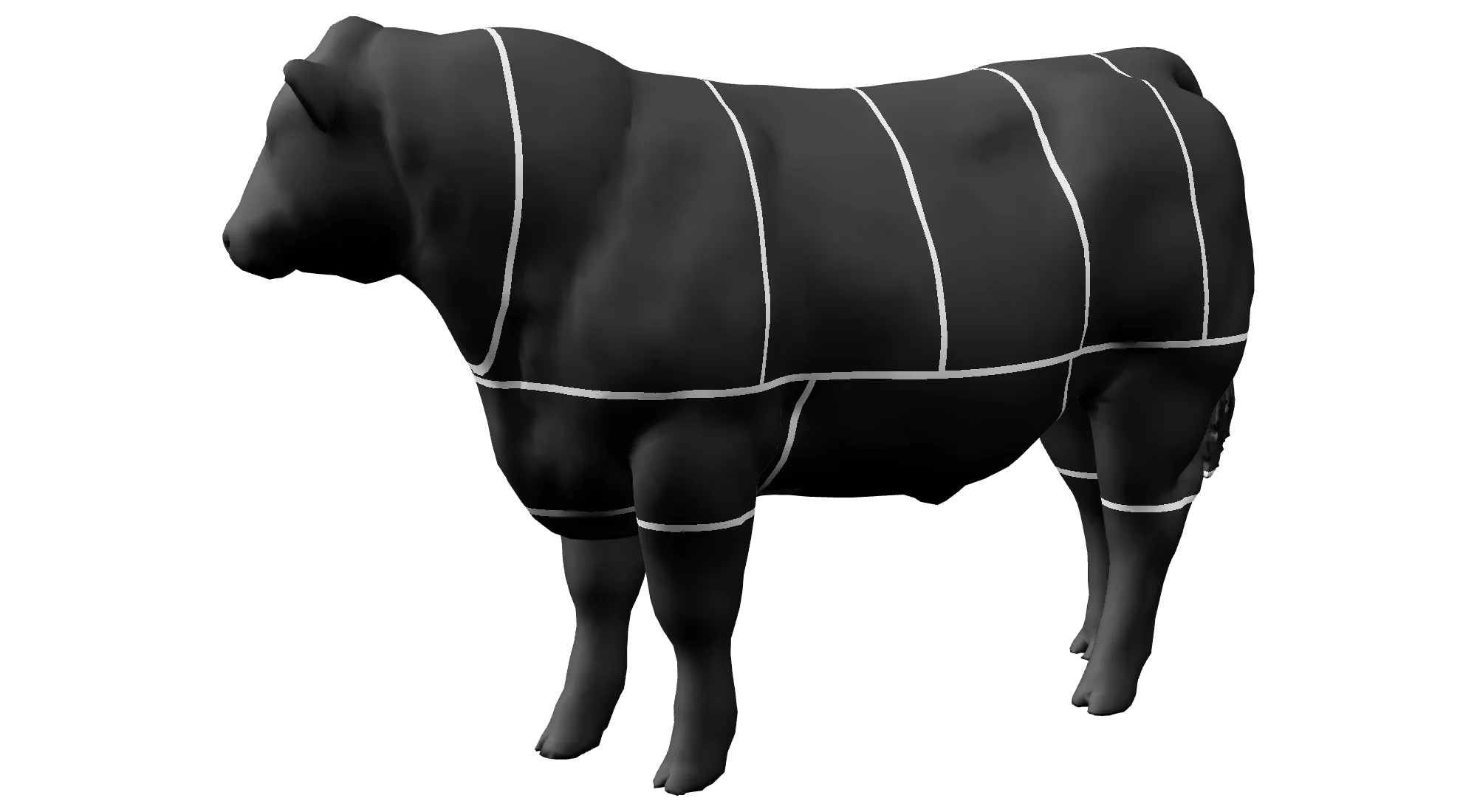 Loading
01 Chuck & blade
Chuck eye steakChuck roast & chuck steak · this cutDenver steakFlat iron steakOyster blade
02 Rib
03 Loin
05 Topside
06 Brisket
08 Silverside & knuckle
09 Shin
Tap a part to see its cutsDrag to turn · tap a partThe whole cow in 3D →
What sits inside the chuck
Several of the best-known modern steaks are single muscles taken out of the chuck. The chuck eye steak is the rib end of the chuck roll, where the ribeye's muscle continues forward. The Denver steak is cut from the serratus ventralis under the blade, and the flat iron and the oyster blade come from the infraspinatus on the outside of the blade. Muscle-profiling studies of the chuck in the early 2000s measured each of these separately and are the reason they are now sold on their own.
What is left after those cuts are lifted out, or when the shoulder is sold whole, is the chuck roast. Its mix of muscles is also why chuck is the classic meat for ground beef: around 80 % lean and 20 % fat, it gives the burger blend sold as ground chuck.
Cooking it: low heat, moisture, 90–96 °C
Collagen begins to shrink and squeeze out moisture at about 60 °C / 140 °F, but it only turns into gelatin with time at higher temperatures. A chuck roast is therefore taken well past "well done": braised in a covered pot with a little liquid at 150–160 °C / 300–320 °F in the oven, or on a low hob, for 3 to 4 hours for a 1.5–2 kg piece, until the inside reaches 90–96 °C / 194–205 °F and a fork turns in it without resistance. A slow cooker needs 8–10 hours on low.
Browning the meat first adds flavour through the Maillard reaction; the liquid (stock, wine, beer, tomato) only needs to come a third of the way up, so the top roasts while the bottom braises. Resting 15–20 minutes in the liquid lets the gelatin set slightly and the meat reabsorb some juice. The same piece cut into cubes is the base of beef stew; whole, it is the American pot roast.
Chuck steaks follow the same rule: braised, or sliced thin and cooked fast, as in Korean grilling, Japanese sukiyaki or Mexican diezmillo for tacos. A thick chuck steak grilled like a ribeye stays chewy, except for the cuts lifted out above.
What a kilo gives
A chuck roast loses more weight than a steak, because the long cook drives out water and renders fat. In the USDA's cooking-yield study, boneless chuck under blade pot roasts kept on average 64 % of their raw weight after braising (33 samples, 61–78 %), and boneless shoulder pot roasts 66 % (71 samples, 55–81 %). A kilo of raw boneless chuck therefore gives about 650 g of cooked meat; with the bone in, less. Raw, the lean carries about 21 g of protein and 4–6 g of fat per 100 g, more fat in the under blade than in the leaner shoulder clod.
| Per kilo of raw boneless chuck | Amount | Source |
|---|---|---|
| Cooked weight, braised (under blade) | ≈ 640 g (610–780 g) | USDA cooking yields, 2012 |
| Cooked weight, braised (shoulder clod) | ≈ 660 g (550–810 g) | USDA cooking yields, 2012 |
| Protein (lean, raw) | ≈ 210–216 g | USDA FoodData Central, SR 13293 · 13647 |
| Fat (lean, raw) | ≈ 41–61 g | USDA FoodData Central, SR 13293 · 13647 |
Choosing one at the counter
For braising, look for visible seams of fat and connective tissue running through the piece; a roast that looks very lean and uniform (the clod or the arm) slices more neatly but needs careful timing so it does not dry out. An even thickness of at least 5 cm cooks evenly. Bone-in roasts such as the 7-bone add gelatin to the sauce. Higher grades carry more marbling, which keeps the meat moister after hours of cooking.
Labels vary by shop. "Chuck roast" and "pot roast" are used for almost any of the pieces above; "chuck tender" or "mock tender" is the small supraspinatus muscle, lean and best braised despite the name. For a grilling steak from the same region, ask for the chuck eye from the rib end or a Denver steak.
Names around the world
22
The same muscle, named by language and by trade system.
| English | Chuck roast · pot roast · chuck steak · 7-bone roast · blade roast |
| Español | Aguja · paleta · diezmillo · espaldilla |
| Tiếng Việt | Nạc vai bò (chuck) |
| Português | Acém · paleta |
| Français | Paleron · macreuse · train de côtes |
| Italiano | Spalla · copertina di spalla |
| 日本語 | 肩ロース (kata rōsu) · 肩 (kata) |
| 한국어 | 목심 (moksim) |
All the cuts' names, country by country →
Trade and national systems
| System | Name | Reference |
|---|---|---|
| United States | Chuck roast · pot roast · 7-bone roast · blade roast · arm roast · chuck steak | IMPS 113 / 114 / 116A |
| United Kingdom | Chuck and blade · braising steak · chuck roll | AHDB · USMEF 2013 |
| Australia / NZ | Chuck · chuck roll · blade (clod) | HAM · USMEF 2013 |
| Argentina | Aguja · paleta (shoulder clod: carnaza de paleta) | USMEF 2013 |
| Mexico | Diezmillo · rollo de diezmillo · planchuela (clod) | USMEF 2013 |
| Spain | Aguja · espaldilla (clod) | USMEF 2013 |
| Colombia · Peru | Lomo de aguja (Colombia) · asado de aguja (Peru) | USMEF 2013 |
| Chile | Huachalomo · sobrecostilla · posta de paleta | USMEF 2013 |
| Brazil | Acém · agulha · miolo da paleta (clod) | USMEF 2013 |
| France | Train de côtes · paleron · macreuse | USMEF 2013 |
| Italy | Spalla · copertina di spalla | USMEF 2013 |
| Japan | 肩ロース (kata rōsu, chuck roll) · 肩 (kata, shoulder) · チャックロール (US import) | JMGA · USMEF 2013 |
| Korea | 목심 (moksim, chuck roll) · 척롤 (US import) | KAPE · USMEF 2013 |
| Vietnam | Nạc vai |
Frequently asked questions
What is chuck roast?
A thick, usually boneless or 7-bone piece from the chuck, the beef shoulder over the first five ribs. It is marbled and full of collagen and is cooked slowly with moisture.
Is chuck roast the same as pot roast?
Pot roast is the dish; chuck roast is the cut most often used for it. Shops often label chuck roasts "pot roast".
How long does it take to cook a chuck roast?
About 3–4 hours for 1.5–2 kg, covered at 150–160 °C / 300–320 °F, or 8–10 hours on low in a slow cooker, until it reaches 90–96 °C / 194–205 °F inside.
What internal temperature should chuck roast reach?
For slicing, about 85–90 °C / 185–194 °F; to pull apart with a fork, 93–96 °C / 200–205 °F. Below that the collagen has not turned to gelatin.
What is the difference between chuck roast and chuck steak?
Only the thickness: a chuck steak is the same shoulder meat sliced 2–3 cm thick. Both are tough when cooked fast, except single muscles such as the chuck eye or Denver steak.
Chuck roast vs brisket: which is better?
Both are braised for hours. Brisket is one long-fibred muscle from the chest that slices well; chuck mixes several muscles and more marbling and pulls apart more easily.
What is chuck called in Spanish?
Aguja in Argentina, Spain and Uruguay, diezmillo in Mexico, huachalomo in Chile; the shoulder clod is paleta, espaldilla or planchuela.
Sources
11
- USDA Agricultural Marketing Service. Institutional Meat Purchase Specifications: Fresh Beef Series 100. Washington, DC, 2014. www.ams.usda.gov/sites/default/files/media/IMPS_100_Fresh_Beef%5B1%5D.pdf
- North American Meat Institute. The Meat Buyer's Guide, 8th ed. Washington, DC, 2014.
- AUS-MEAT Limited. Handbook of Australian Meat, 7th ed. (International Red Meat Manual). Brisbane, 2005. www.ausmeat.com.au
- Agriculture and Horticulture Development Board (UK). Beef Meat Purchasing Guide. Kenilworth, 2016. ahdb.org.uk
- McGee, Harold. On Food and Cooking: The Science and Lore of the Kitchen, rev. ed. New York: Scribner, 2004.
- Korea Institute for Animal Products Quality Evaluation (KAPE). Beef cuts and grading. www.ekape.or.kr
- Japan Meat Grading Association. Beef Carcass Grading Standard. Tokyo, 1988 (rev. 2014). www.jmga.or.jp
- Huerta-Leidenz, Nelson. International Nomenclature Guide of Beef Cuts for the U.S.A. and Other Countries Targeted by the U.S. Meat Export Federation. Denver: U.S. Meat Export Federation, 2013. www.usa-beef.org/wp-content/uploads/2020/07/1064.GUIDE_beef-cuts_ingl%C3%A9s_09oct13.pdf
- Showell, B. A.; Williams, J. R.; Duvall, M.; Howe, J. C.; Patterson, K. Y.; Roseland, J. M.; Holden, J. M. USDA Table of Cooking Yields for Meat and Poultry. Beltsville, MD: USDA Agricultural Research Service, Nutrient Data Laboratory, 2012. www.ars.usda.gov/ARSUserFiles/80400525/Data/retn/USDA_CookingYields_MeatPoultry.pdf
- USDA Agricultural Research Service. FoodData Central, SR Legacy (National Nutrient Database for Standard Reference). Beltsville, MD, 2019. fdc.nal.usda.gov
- Von Seggern, D. D.; Calkins, C. R.; Johnson, D. D.; Brickler, J. E.; Gwartney, B. L. "Muscle profiling: characterizing the muscles of the beef chuck and round." Meat Science 71, no. 1 (2005): 39–51.
Related