Breed · Netherlands, the dairy cow
Holstein
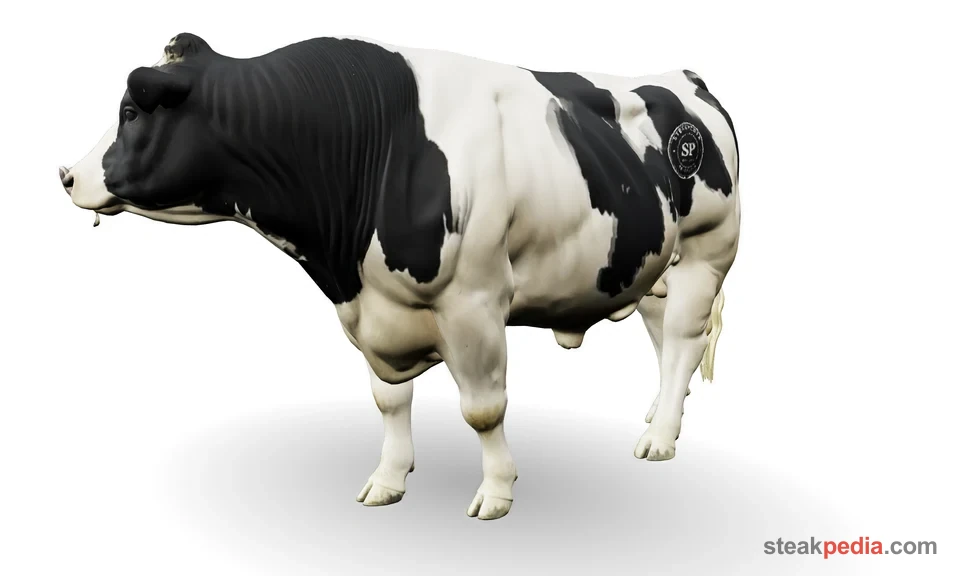
The Holstein-Friesian, usually just the Holstein, is a black-and-white dairy breed from Friesland, in the Netherlands. It is not a beef breed, yet it matters for beef: the steers, surplus calves and cull cows of dairy herds are a large source of meat in Japan, the European Union and New Zealand.
At a glance
- Origin
- Friesland, Netherlands
- Color
- Black and white (also red and white)
- Horned / polled
- Horned
- Type
- Dairy; beef as a by-product of dairy herds
- US breed association
- 1885
 Loading 3D…↻ Drag to turn · scroll to zoom
Look closer
Tap a numbered point on the animal, or a name above, to look closer.
Illustrative 3D model made with AI, not a real animal. Each model carries its own Steakpedia mark and serial number, engraved in the model.
A black-and-white dairy breed from Friesland
The Holstein-Friesian is a dairy breed that originated in Friesland, in the Netherlands. Its coat is black and white; the University of Delaware’s history of the breed also notes red-and-white animals, whose color comes from a recessive gene that shows only when both parents carry it. Steakpedia’s breed table lists the Holstein as horned.
The same history describes a high-milk-producing breed that does well on limited feed. Milk is what the breed is selected for, and beef is a by-product of that purpose, which is the subject of the rest of this page.
From the Netherlands to the United States
According to the University of Delaware, Winthrop Chenery of Massachusetts bought a cow from a Dutch sailing master in 1852 and imported more cows in 1857, 1859 and 1861; other breeders soon followed. The Holstein-Friesian Association of America was formed in 1885 to maintain herd books and record pedigrees, and has been Holstein Association USA, Inc. since 1994.
The names can confuse. The same source treats Friesian cattle as a separate type that tends to be smaller than the Holstein. In daily use, “Holstein” usually means the large dairy cow that descends from this American line.
Why a dairy breed matters for beef
A dairy herd has to keep calving to keep giving milk. That produces male calves that are not kept for milking and, at the end of their milking life, cull cows. Both enter the beef supply. In Japan, a chapter by Komatsu and Malau-Aduli (2014) describes part of the country’s beef as a by-product of the dairy industry, with Holsteins as major contributors (about 14.6% of the national herd).
European Union. Eurostat data for 2016, processed for the SustainBeef project, say cull cows from milk-producing herds are the main type of meat from females. Male dairy calves are fattened as veal calves in Spain, France and the Netherlands, while Ireland and the United Kingdom produce young bulls or steers; in France, calves for slaughter are mostly from dairy cattle, to produce veal.
New Zealand. Beef + Lamb New Zealand describes cull cows as a significant source of the country’s exported beef, and dairy farmers pay the beef levy on cull cows, heifers and bulls at slaughter.
Japan: Holstein steers and the Wagyu cross
Hiroshi Takahashi’s 2015 paper for the FFTC lists the main cattle fattened for beef in Japan as Wagyu, Wagyu-Holstein F1 and Holstein steers. Castrated dairy steers are usually by-products of dairy farming. An F1 is a first cross; for how a Wagyu sire gives about half the genetics, see Wagyu.
The same paper describes a Hokkaido program, Tokachi Wakaushi, that fattens Holstein steers to about 13.5 months, against 20 months for regular Holstein steers. Its production cost is about 20% lower and its sale price 10–15% higher. It began in 1996; in 2002, 4 farmers supplied 1,400 head, and in 2014, 6 farmers supplied 5,500 steers. Wagyu, by comparison, need roughly 30 months or more of feeding to produce marbled beef.
How the carcass compares
One feedlot trial at Michigan State University (Jaborek, Schweihofer and others, 2024) compared beef × Holstein steers with straight Holstein steers. Dressing percentage was 59.1% against 57.9%, a numerical, not significant, difference; hot carcass weight was similar. The crosses had a ribeye about 20% larger and about 0.16 in (4 mm) more fat at the 12th rib, and so a lower, more desirable USDA Yield Grade. Marbling and USDA Quality Grade were similar, and the authors suggested more days on feed might help.
The trial compares two groups of fed steers; it does not compare Holstein with Angus or any other beef breed, and Steakpedia does not rank breeds. A grade from a system such as USDA or MSA says more about eating quality than the breed does (see Grading systems).
Myths about dairy-breed beef
Holstein beef means old dairy cow. Dairy-herd beef comes from different animals: cull cows, young steers and beef × Holstein crosses. The Japanese program above shows that finishing time alone, 13.5 against 20 months, changes cost and price.
A breed name sets the quality. As with any breed, age, finishing, handling and aging matter, and so does the grade. For how pasture or grain changes the meat, see Grass-fed vs grain-fed.
Keep reading
- Breed · Scotland, black or redAngusThe Scottish breed behind much of the world’s steak: why it marbles, black and red, and what “Certified Angus” means.
- Standards · USDA, A5, MSA, EUROPBeef grading systemsUSDA, A5, MSA stars, Korea’s 1++ and EUROP side by side: what each grade measures and what it doesn’t.
- Production · The final monthsGrass-fed vs grain-fed beefPasture vs feedlot beef: flavor, fat, days on grain, and what the science does and doesn’t say.
- Regional brand · Tajima, HyōgoKobe beefWhat makes beef “Kobe”, the certification rules, and why most “Kobe” sold abroad never was.
Frequently asked questions
Is Holstein cattle eaten as beef?
Yes. Holstein steers, cull dairy cows and beef × Holstein crosses all enter the beef supply. In Japan, Holstein steers and Wagyu-Holstein F1 are among the main cattle fattened for beef.
What is a cull dairy cow?
A cow taken out of a milking herd, for instance at the end of her milking life. In the European Union, cull cows from milk-producing herds are the main type of meat from females.
What is a Wagyu × Holstein F1?
A first cross between Wagyu and Holstein, with about half Wagyu genetics. It is one of the main types of cattle fattened for beef in Japan.
Where does the Holstein breed come from?
From Friesland, in the Netherlands. A Massachusetts breeder, Winthrop Chenery, imported the first cow to the United States in 1852.
Are there red Holsteins?
Yes. Some Holsteins are red and white; the color comes from a recessive gene that appears when both parents carry it.
Sources
6
- University of Delaware, College of Agriculture and Natural Resources, Animal Science. History of dairy cow breeds: Holstein. sites.udel.edu/canr-animalscience/?p=507
- Komatsu, M.; Malau-Aduli, A. E. O. “Japanese beef production.” In Cottle, D.; Kahn, L. (eds), Beef Cattle Production and Trade, 143–160. Collingwood, Victoria: CSIRO Publishing, 2014. www.publish.csiro.au/pid/7084.htm
- Takahashi, Hiroshi. A new vision of growth for the beef industry and the expected roles of agricultural cooperatives in Hokkaido, Japan. FFTC Agricultural Policy Platform, Food and Fertilizer Technology Center, 2015. ap.fftc.org.tw/article/943
- Jaborek, Jerad; Schweihofer, Jeannine; et al. Growth performance, carcass traits and feeder calf value of beef × Holstein and Holstein feedlot steers. Michigan State University, MSU Beef Cattle Teaching and Research Center, 2024; summarized by Farms.com, May 13, 2024. www.farms.com/news/growth-performance-carcass-traits-and-feeder-calf-value-of-beef-holstein-and-holstein-feedlot-steers-210508.aspx
- SustainBeef project (INRAE). WP2.1.1 Beef production: national statistics, from Eurostat data for 2016, processed by Inra and SMART-LERECO. Published Sept. 16, 2021. sustainbeef.hub.inrae.fr/project/wp2.1-description-of-beef-production-systems/wp2.1.1-beef-production-national-statistics
- Beef + Lamb New Zealand. Dairy beef (programmes and partnerships). beeflambnz.com/node/183