Breed · Zebu cattle, built for heat
Brahman
The Brahman, or American Brahman, is a humped beef breed developed on the United States Gulf Coast from zebu cattle imported from India and, later, Brazil. It is recognized by a large hump over the shoulders, loose skin and a gray or red coat, and it is valued for tolerating heat and ticks. It is also the Brahman share in several well-known crossbreds, including the Santa Gertrudis and the Braford.
At a glance
- Origin
- US Gulf Coast, from Indian zebu cattle
- Color
- Gray or red
- Horned / polled
- Horned
- First herd book
- 1924
- Key trait
- Heat and tick tolerance; hump and loose skin
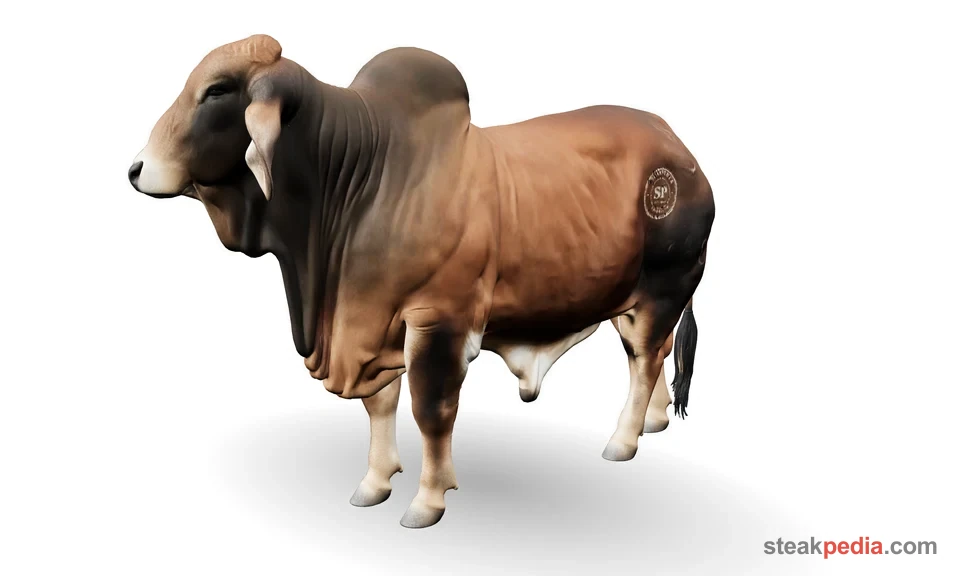 Loading 3D…↻ Drag to turn · scroll to zoom
Look closer
Tap a numbered point on the animal, or a name above, to look closer.
Illustrative 3D model made with AI, not a real animal. Each model carries its own Steakpedia mark and serial number, engraved in the model.
A hump, loose skin and a gray or red coat
The Brahman is a Bos indicus (zebu) breed. The Handbook of Texas calls the large hump over the shoulders its most distinctive feature. Most animals are gray or red, with a black muzzle, hooves and switch (the tuft of the tail), and a well-developed dewlap: the fold of loose skin hanging from the lower jaw to the chest. The breed is registered as horned.
Mature bulls weigh roughly 1,600–2,200 lb (about 725–1,000 kg / 1,598–2,205 lb) and cows 1,000–1,400 lb (about 450–635 kg / 992–1,400 lb), according to the same source.
From India to Texas
Indian cattle reached the United States in the nineteenth century. In 1854 the British government shipped bulls to Richard Barrow in Louisiana, and crosses descended from his cattle were shipped to Hays County, Texas, in 1860. In 1885 two bulls, Khedive and Richard III, were imported from India to New Orleans. Over thirty zebu breeds exist, but four shaped the American Brahman: the Guzerat, Gir, Nellore and Krishna Valley.
In 1906 about eighteen of fifty-one cattle selected in India for the Pierce estate died of surra, a blood disease, in quarantine in New York. The US Department of Agriculture then barred imports of Indian cattle until 1946, so later animals came in through Brazil and Canada.
Brazil, 1924 and a herd book
In 1924–1925, according to a breed encyclopedia summary, about 210 bulls and 18 cows, mainly of Guzerá type with some Gir and Nelore, were brought from Brazil through Mexico. Sources differ on the totals: the Handbook of Texas records a 1924 shipment of ninety zebu from Brazil at Eagle Pass, and eighteen more bulls from Brazil in 1946.
The American Brahman Breeders Association was formed in 1924 and started a herd book. Its recording secretary, J. W. Sartwelle, proposed the name “Brahman”. The herd book was closed to all but the offspring of registered parents in 1939, and in 1991 the Gir, Guzerat, Indu-Brasil, Nelore and Tabapua books were separated from the American Red and Gray Brahman book.
Why it copes with heat and ticks
The Handbook of Texas attributes the breed’s heat tolerance to sweat glands spread over the whole body, and says a muscular skin membrane helps the animal shake off insects. It describes strong tick resistance, and cattle that can travel far from water and so graze a wider range. Another summary adds good tolerance of humidity and of poor feeding.
These traits explain where the breed went: into the warm, humid and tick-infested country of the Gulf Coast, northern Australia, and the tropical north of South America. They are also the reason it was used to make crossbreds.
The crosses it made
Santa Gertrudis. Bred on the King Ranch in Texas from a Brahman bull and Shorthorn cows, it is three-eighths Brahman and five-eighths Shorthorn, and the US Department of Agriculture recognized it as a distinct breed in 1940.
Braford and Charbray. The Handbook of Texas lists the Braford as three-eighths Brahman and five-eighths Hereford, and the Charbray as three-eighths Brahman and five-eighths Charolais. It gives the Beefmaster as half Brahman, with roughly equal parts Shorthorn and Hereford.
Brangus, Simbrah and Brahmousin. A breed encyclopedia summary lists Brahman × Angus (Brangus), Brahman × Simmental (Simbrah) and Brahman × Limousin (Brahmousin) as established breeds.
Brahman beef, and what a breed name says
Zebu beef is always tough. On average it is less tender, but not always, and aging changes the picture. A USDA study of 1,667 steers and heifers, fed and managed alike, found that beef from Bos indicus crosses was less tender than beef from Bos taurus at every marbling level. A later study of composites with three-eighths Brahman blood found slower aging and lower tenderness at every point from 4 to 35 days, but beef that was relatively tender after 21 days of aging. The authors linked the toughness to higher calpastatin activity, an enzyme that slows the breakdown of muscle protein after slaughter, with marbling similar to the other group.
A Brahman look means Brahman beef. The share of Brahman blood varies from one animal and one program to another, so a breed name on a label says less than a grade from a system such as USDA or MSA (see Grading systems). Pasture or grain also changes the meat (see Grass-fed vs grain-fed).
Keep reading
- Breed · England, red, white or roanShorthornThe roan English breed that kept the first herd book and helped found the Pampas herds.
- Breed · France, the white giantCharolaisThe white-to-cream French breed of Charolles, built for size and muscle and used worldwide as a sire.
- Breed · Scotland, black or redAngusThe Scottish breed behind much of the world’s steak: why it marbles, black and red, and what “Certified Angus” means.
- Breed · England, the white faceHerefordThe white-faced English breed that built the grass-fed herds of Argentina, Uruguay and Australia.
Frequently asked questions
Where does the Brahman breed come from?
From the US Gulf Coast, where it was developed from zebu cattle imported from India and, later, Brazil. The American Brahman Breeders Association formed in 1924.
Why do Brahman cattle have a hump?
The hump over the shoulders is the breed’s most distinctive feature and comes from its zebu (Bos indicus) ancestry. It is a trait of the animal, not of the meat.
Is Brahman beef tough?
On average it is less tender than beef from Bos taurus breeds, according to USDA research. Studies on composites with some Brahman blood found it relatively tender after about 21 days of aging.
What is the difference between Brahman and Angus?
The Brahman is a humped zebu breed, gray or red and horned, valued for tolerating heat and ticks. Angus is a British Bos taurus breed, solid black or red, always polled and valued for marbling. They are crossed to make the Brangus.
What breeds is the Santa Gertrudis made from?
Three-eighths Brahman and five-eighths Shorthorn. It was developed on the King Ranch in Texas and recognized by the USDA in 1940.
Sources
5
- Leatherwood, Art. “Brahman Cattle.” Handbook of Texas Online. Texas State Historical Association. www.tshaonline.org/handbook/entries/brahman-cattle
- Leatherwood, Art. “Santa Gertrudis Cattle.” Handbook of Texas Online. Texas State Historical Association. www.tshaonline.org/handbook/entries/santa-gertrudis-cattle
- “American Brahman.” Wikipedia, citing Porter, V., Alderson, L., Hall, S. J. G. and Sponenberg, D. P. Mason’s World Encyclopedia of Livestock Breeds and Breeding, 6th ed. Wallingford: CABI, 2016. en.wikipedia.org/wiki/American_Brahman
- Wheeler, T. L., Cundiff, L. V. and Koch, R. M. “Effect of marbling degree on beef palatability in Bos taurus and Bos indicus cattle.” Journal of Animal Science 72, no. 12 (1994): 3145–3151. academic.oup.com/jas/article-abstract/72/12/3145/4706548
- O’Connor, S. F., Tatum, J. D., Wulf, D. M., Green, R. D. and Smith, G. C. “Genetic effects on beef tenderness in Bos indicus composite and Bos taurus cattle.” Journal of Animal Science 75, no. 7 (1997): 1822–1830. doi.org/10.2527/1997.7571822x