Breed · Hereford × Brahman, built for heat
Braford
Braford is a composite beef breed made by crossing Hereford with Brahman cattle. It keeps the Hereford’s red body and white face but carries a share of Brahman blood for tolerance of heat and parasites, which is why it is bred across the warm northern ranges of Argentina, Brazil, Australia and the southern United States.
At a glance
- Origin
- Florida (USA) and Queensland (Australia), 1940s
- Parent breeds
- Hereford × Brahman (3/8 Brahman, 5/8 Hereford is the usual standard)
- Color
- Red body, white face, white underline
- Horned / polled
- Both
- Strong in
- Argentina (north), Brazil, Australia, southern USA
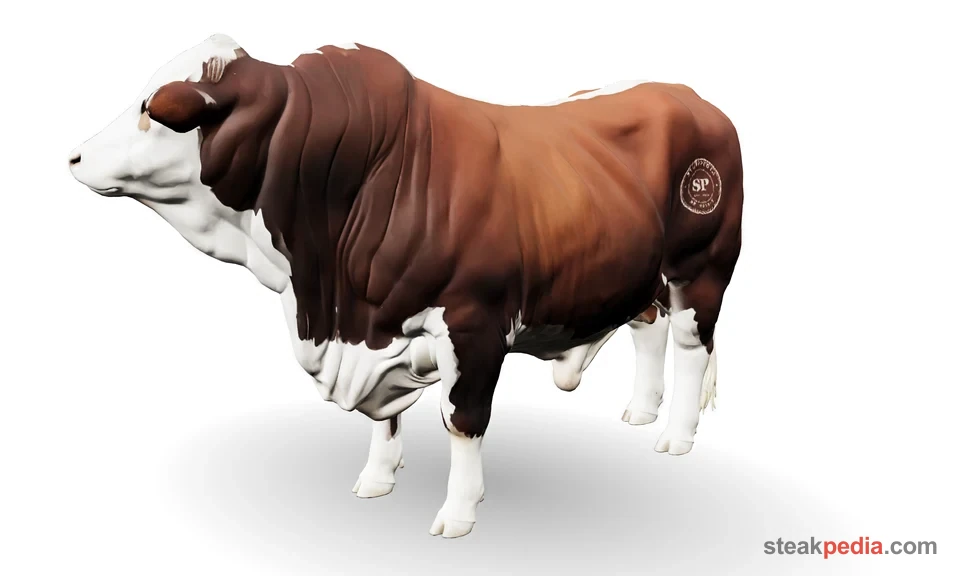 Loading 3D…↻ Drag to turn · scroll to zoom
Look closer
Tap a numbered point on the animal, or a name above, to look closer.
Illustrative 3D model made with AI, not a real animal. Each model carries its own Steakpedia mark and serial number, engraved in the model.
A Hereford coat with a Brahman share
The Braford looks like a stockier Hereford: a red body with a white face and white underline. The Australian breed is described as having a small hump, loose skin and a short red-and-white coat, and both horned and polled animals are found. Breeders in Brazil prefer the “camiseta” pattern, a red body with a white face and pigmented skin around the eyes; eye pigmentation was one of the reasons the breed was created, since white-faced cattle are prone to eye problems under strong sun.
It is a composite: a stabilized cross of a British breed (Hereford) and a tropical one (Brahman, a Bos indicus breed). The most sought-after blend in the United States and under the Mercosur standard is 3/8 Brahman and 5/8 Hereford. The Brahman share brings rusticity and a high resistance to external parasites; the Hereford share brings the beef type and the color pattern.
Two origins: Florida and Queensland
The American Braford was developed by Alto Adams Jr. on his ranch in St. Lucie County, Florida. He began crossing Hereford bulls with Brahman cows in 1947, after Hereford bulls proved poorly suited to southern Florida’s climate. Today the United Braford Breeders registers the breed in the United States.
The Australian line is separate. It began in 1946 at “Edengarry”, north of Rockhampton in Queensland, when the Rea brothers put Brahman bulls into their Hereford herd to fight drought and cattle ticks; the breed was developed between 1946 and 1952. The Australian Braford is closer to half Hereford and half Brahman, so US and Australian animals are not the same recipe.
Argentina and Brazil
Argentina. The Asociación Braford Argentina was founded on Aug. 14, 1984 to build a beef biotype for the harsh climate of the north. The Argentine breed was formed from Hereford crossed with Brahman and Nelore, and it is used mainly in the northeast (NEA) and northwest (NOA). It sits beside the British breeds that built the export herd; see Argentine beef, and Angus for another of those breeds.
Brazil. The first Braford calves were born in the late 1960s on a ranch in Rosário do Sul, Rio Grande do Sul, from Hereford × Tabapuã crosses. The Brazilian Hereford and Braford association (ABHB) and Embrapa Pecuária Sul began organizing the breed in the 1980s; it was recognized as a breed in formation in 1993 and as a breed in 2003.
Australia and the United States. In Australia the Braford is a beef breed of the tropical north, and Australian genetics have also been exported to South America and elsewhere. In the United States it is bred mostly in the South.
Pasture, heat and how the cross is used
Brafords are bred for ranges where hot summers, ticks and sparse forage hold back the British breeds, and they are raised mostly on pasture. The Brazilian association reports steers slaughtered at 14 to 18 months at 380 to 480 kg / 838 to 1,058 lb, depending on feed. Breeders also use Braford as a base for crossing: the American breed is described as strong in maternal traits such as fertility, calving ease and milk, and as not being a terminal sire line.
For what pasture or grain does to the meat, see Grass-fed vs grain-fed.
A breed name says less than a grade
Braford is a range of blood grades, not one fixed recipe: 3/8 Brahman is the preferred standard, the Australian breed is closer to half, and breeders produce other grades for other environments. A breed name on a label therefore says little about what is on the plate. The eating quality comes from age, finish, marbling and aging, which is why a grade from a system such as USDA or MSA is more informative (see Grading systems).
Tenderness: the Brahman share, age and aging
Braford beef is tough. Not by default, but the Brahman share matters. A USDA study of about 1,700 steers and heifers found that beef from cattle with Bos indicus influence was less tender than beef from Bos taurus cattle at every marbling level, and Brahman-influenced cattle are also harder to marble. A Braford with 3/8 Brahman blood carries a moderate share, and the Brazilian association describes the carcasses as well covered in fat with marbling. Age at slaughter, finish and aging still decide a lot.
A white face means Braford. The white face is a Hereford trait that most crossbred calves inherit, so it shows Hereford ancestry, not a Braford. The blood grade (such as 3/8) is recorded in the herd book, not visible on the animal.
Keep reading
- Breed · Scotland, black or redAngusThe Scottish breed behind much of the world’s steak: why it marbles, black and red, and what “Certified Angus” means.
- Origin · Argentina, the PampasArgentine beefThe Pampas, British breeds on grass, the frozen-meat boom, the Hilton quota and the criollo cuts.
- Production · The final monthsGrass-fed vs grain-fed beefPasture vs feedlot beef: flavor, fat, days on grain, and what the science does and doesn’t say.
- Standards · USDA, A5, MSA, EUROPBeef grading systemsUSDA, A5, MSA stars, Korea’s 1++ and EUROP side by side: what each grade measures and what it doesn’t.
Frequently asked questions
What is a Braford?
A composite beef breed from Hereford and Brahman cattle, usually 3/8 Brahman and 5/8 Hereford, bred to keep Hereford beef type while tolerating heat and ticks.
Where does Braford come from?
It was developed separately in Queensland, Australia (from 1946) and in Florida, USA (from 1947). Argentina and Brazil later built their own Braford populations, with associations founded in the 1980s.
What is the difference between Braford and Hereford?
Both are red with a white face, but the Braford carries Brahman blood, so it is stockier, tolerates heat and external parasites better, and may show a small hump. The Hereford is a pure British breed that does best in temperate climates.
Is Braford beef good for steak?
Yes, when the animal is young and well finished. Brahman influence lowers tenderness on average, so look at the grade and the aging rather than the breed name.
Sources
6
- Associação Brasileira de Hereford e Braford (ABHB). Braford: breed description and history. Bagé, Brazil. www.abhb.com.br/as-racas/braford
- Asociación Braford Argentina. Historia. Buenos Aires. www.braford.org.ar/historia
- The Cattle Site. Braford. Breeds of beef cattle. www.thecattlesite.com/breeds/beef/45/braford
- United Braford Breeders. Braford cattle registry. Foreman, Arkansas. www.brafords.org
- Australian Braford. Wikipedia, citing the Australian Braford Society. en.wikipedia.org/wiki/Australian_Braford
- Wheeler, T. L., L. V. Cundiff and R. M. Koch. 1994. Effect of marbling degree on beef palatability in Bos taurus and Bos indicus cattle. Journal of Animal Science 72(12): 3145–3151. USDA Meat Animal Research Center. pubmed.ncbi.nlm.nih.gov/7759364