Breed · England, red, white or roan
Shorthorn
Shorthorn is a cattle breed from the Tees valley in northeast England, red, white or roan in color, and the first breed to have a herd book. Once called the Durham, it was exported across the English-speaking world and the Río de la Plata, and its blood sits behind some forty other breeds.
At a glance
- Origin
- Northeast England (Tees valley)
- Color
- Red, white or roan
- Horned / polled
- Both horned and polled
- First herd book
- 1822 (Coates’s Herd Book)
- Strong in
- UK, Ireland, USA, Argentina, Uruguay
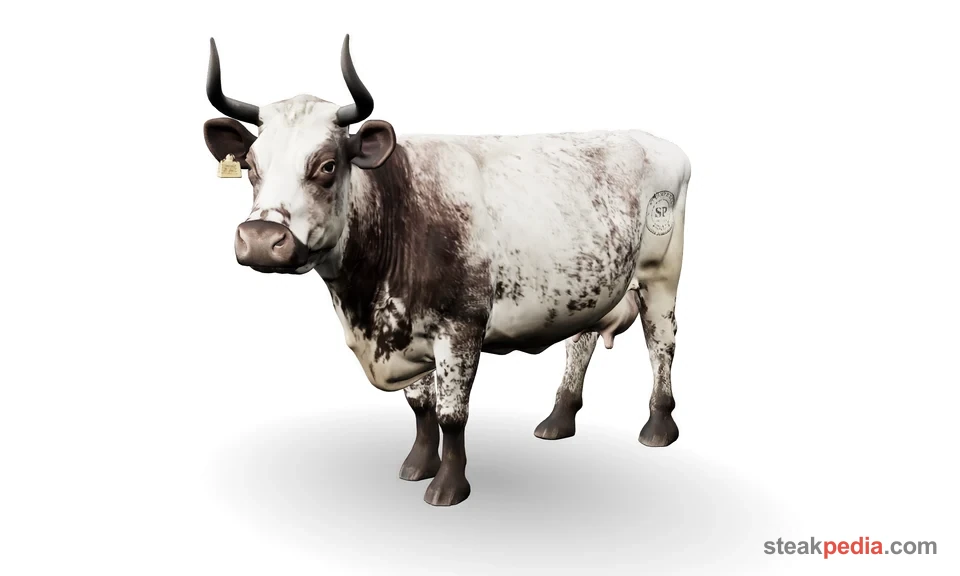 Loading 3D…↻ Drag to turn · scroll to zoom
Look closer
Tap a numbered point on the animal, or a name above, to look closer.
Illustrative 3D model made with AI, not a real animal. Each model carries its own Steakpedia mark and serial number, engraved in the model.
Red, white or roan, and no fixed pattern
The Shorthorn is a medium-sized, deep and muscular breed, described by the UK Rare Breeds Survival Trust as hardy, sure-footed and calm; Beef Shorthorn cows typically weigh 500–600 kg / 1,102–1,323 lb. Its coat is red, white or roan, a mix of red and white hairs. Unlike the Hereford, it has no fixed color pattern, so a Shorthorn cannot be recognized by a single marking.
Both horned and polled (hornless) animals exist. In the United States the American Shorthorn Association was allowed by a 1949 court decree to register both Shorthorns and Polled Shorthorns. British Beef Shorthorns also grow a thick double coat with a woolly winter undercoat that they shed in summer.
The Collings, Comet and the first herd book
The breed developed from the Teeswater and Durham cattle of northeast England. Charles and Robert Colling, working in the late eighteenth century, applied Robert Bakewell’s line breeding to them, and most Shorthorns in Britain and the United States trace to their herds. Charles Colling’s bull Comet, born in 1804, sold in 1810 for 1,000 guineas, the first bull recorded at that price.
In 1822 George Coates published the first volume of Coates’s Herd Book, with 710 bulls and 850 cows: the first pedigree herd book for cattle anywhere. The Shorthorn Society of Great Britain and Ireland, formed in 1874, bought its copyright and still publishes it. The first Shorthorn-type cattle reached the United States in 1783, where they were called Durhams.
Beef Shorthorn and Dairy Shorthorn
The Shorthorn was a dual-purpose breed for most of its history, and two lines of breeders pulled it apart. Thomas Bates built milking strains; the Booth family, working on the beef side, aimed for a beefier animal. The saying went “Bates for the pail, Booth for the butcher.” Animals taken to Scotland from the Booth herd in 1817 are credited with starting the Beef Shorthorn.
British beef breeders opened their own section of the herd book in 1958, and the Beef Shorthorn has been kept as a separate breed since. The Dairy Shorthorn is now a small breed of its own. When a label or a menu says “Shorthorn” beef, it means the beef line.
Argentina: the bull Tarquino
Argentina. By tradition the first purebred British bull in Argentina was the Shorthorn Tarquino, brought in 1823 by the Scot John Miller to his estancia La Caledonia in Cañuelas, Buenos Aires Province. There is no exact arrival record, and the Asociación Argentina de Shorthorn puts the introduction between 1823 and 1826. Crossed with the native criollo cattle, Shorthorn began the improvement of the national herd. It was Argentina’s leading breed until the 1960s, before Hereford and Angus overtook it. See Argentine beef.
Uruguay. The breed is also kept in Uruguay, with the other British breeds of the Río de la Plata. Elsewhere it is found mainly in English-speaking countries: the UK, Ireland, the United States, Canada, Australia, New Zealand and South Africa.
On grass, and as a suckler cow
Beef Shorthorns are described as docile, with good calving ease and milk. When finished on fertile grass or with supplementary feed they can reach market weight at 20 to 30 months, and breed sources say the meat stays well marbled and flavorful even on unimproved grazing. These are breed-association descriptions, not carcass studies.
Its calm temperament and maternal traits make it a popular sire and dam line for crossbreeding, and its genetics have gone into more than forty other breeds. For the effect of pasture or grain on the meat, see Grass-fed vs grain-fed.
A breed name says less than a grade
Shorthorn means well marbled. Associations describe Beef Shorthorn as well marbled, but that is a description of the breed on average. Marbling in a given animal depends on its genetics, age and finishing, and a breed name on a label says less about eating quality than a grade from a system such as USDA or MSA (see Grading systems).
Beef Shorthorn and Dairy Shorthorn are the same. They share the same ancestors and the herd book of 1822, but they have been bred as separate lines since 1958 in Britain. Check which one a label means before comparing it with Hereford or Angus.
Keep reading
- Breed · Scotland, black or redAngusThe Scottish breed behind much of the world’s steak: why it marbles, black and red, and what “Certified Angus” means.
- Origin · Argentina, the PampasArgentine beefThe Pampas, British breeds on grass, the frozen-meat boom, the Hilton quota and the criollo cuts.
- Production · The final monthsGrass-fed vs grain-fed beefPasture vs feedlot beef: flavor, fat, days on grain, and what the science does and doesn’t say.
- Standards · USDA, A5, MSA, EUROPBeef grading systemsUSDA, A5, MSA stars, Korea’s 1++ and EUROP side by side: what each grade measures and what it doesn’t.
Frequently asked questions
Where does the Shorthorn breed come from?
From the Tees valley in northeast England, developed from Teeswater and Durham cattle by breeders such as Charles and Robert Colling in the late eighteenth century.
What color is a Shorthorn?
Red, white or roan, which is a mix of red and white hairs. There is no fixed pattern, and both horned and polled animals exist.
What is the difference between Beef Shorthorn and Dairy Shorthorn?
They share the same origin and the 1822 herd book, but British breeders split them: the Beef Shorthorn has had its own section of the herd book since 1958, while the Dairy Shorthorn was bred for milk.
What did the Shorthorn do in Argentina?
It was the first British breed to improve the criollo herd, starting with the bull Tarquino around 1823, and it was the country’s leading breed until the 1960s, when Hereford and Angus overtook it.
Sources
5
- Beef Shorthorn Cattle Society. Beef Shorthorn history. United Kingdom. www.beefshorthorn.org/about-beef-shorthorn/beef-shorthorn-history
- Rare Breeds Survival Trust. Beef Shorthorn (watchlist breed). United Kingdom. www.rbst.org.uk/watchlist-breed/beef-shorthorn
- Heritage Shorthorn Society. Breed history. United States. www.heritageshorthorn.org/shorthorn-history
- Asociación Argentina de Criadores de Shorthorn. Historia de la raza. Buenos Aires. www.shorthorn.org.ar/historia.html
- La Nación. Se cumplen 200 años: la historia de un toro británico que cambió la ganadería argentina. Buenos Aires, January 13, 2023. www.lanacion.com.ar/economia/campo/se-cumplen-200-anos-la-historia-de-un-toro-britanico-que-cambio-la-ganaderia-argentina-nid13012023