Breed · France, the white giant
Charolais
Charolais is a French beef breed from the Charolais district around Charolles, in Burgundy, and from the Nivernais to its northwest. Its coat runs from white to cream, and it is known for a large frame, fast growth and heavy muscling. Exported from France and then through Mexico, it became one of the main sire breeds of the Americas.
At a glance
- Origin
- Charolais and Nivernais, France
- Color
- White to cream
- Horned / polled
- Horned or polled
- First herd book
- 1864
- Strong in
- France, Mexico, USA, Canada
 Loading 3D…↻ Drag to turn · scroll to zoom
Look closer
Tap a numbered point on the animal, or a name above, to look closer.
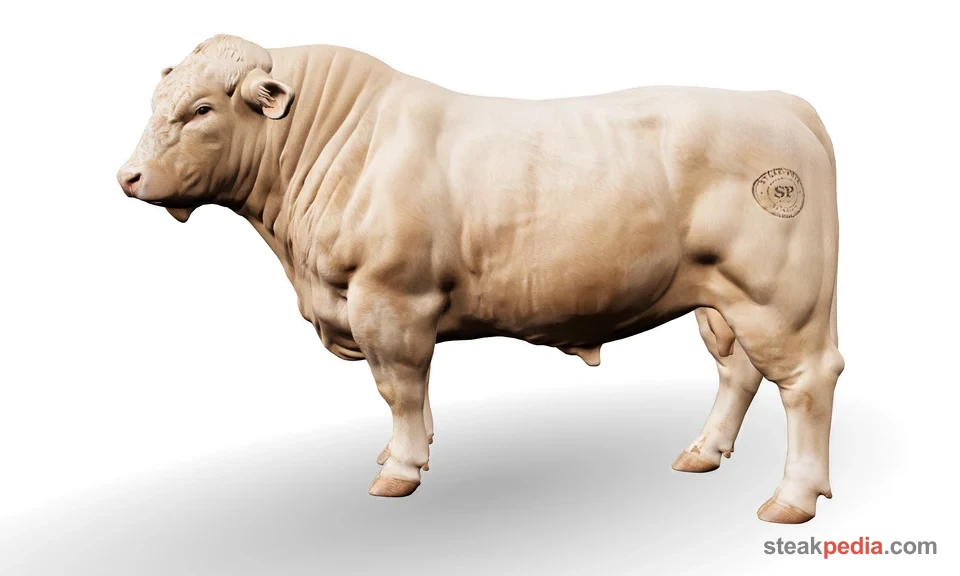
Illustrative 3D model made with AI, not a real animal. Each model carries its own Steakpedia mark and serial number, engraved in the model.
White to cream, and built for muscle
The Charolais is a large beef breed with a white to cream coat; in the breed the face carries the same pale color as the body, not a contrasting patch. It is registered as horned or polled (hornless). The breed is described by Oklahoma State University as a large-framed animal with fast growth and heavy muscling.
Oregon State University Extension groups the Charolais with the Continental breeds of Europe, which are larger and more heavily muscled than the British breeds and give more cutable carcasses (more saleable meat for the same weight), at the cost of some eating-quality traits. It describes the Charolais as very large-framed and heavy-muscled, with moderate marbling despite its high cutability.
Charolles and the Nivernais, 1864: a French herd book
The breed is named for the Charolais district around Charolles, in what is now the department of Saône-et-Loire in Bourgogne-Franche-Comté. Its range also reached into the Nivernais, northwest of Charolles. The two types developed as branches of the same cattle.
The first herd book dates to 1864, set up by Nivernais breeder Count Charles de Bouillé. Breeders in Charolles opened their own book in 1882, and the two merged in 1919, with the Nivernais book absorbing the Charolles one. Charolais cattle were exported early: according to the Canadian Charolais Association, the first reached the Western Hemisphere in Brazil in 1879.
Mexico, the United States and Canada
Mexico. The American-International Charolais Association dates the arrival of Charolais in North America to 1910, when the first animals landed in Mexico. Mexican herds were crossed with zebu (Brahman) cattle, which produced the Charbray.
United States. The first Charolais came from Mexico to the United States in 1934. After a foot-and-mouth disease outbreak in Mexico in the mid-1940s, the United States, Canada and Mexico set up a permanent quarantine against cattle from affected countries, and for years North American herds grew from the animals already on the continent, upgraded by crossing with other breeds. The American-International Charolais Association was formed on July 15, 1957, and absorbed the American Charbray Breeders Association in 1967.
Canada. The Canadian Charolais Association was formed in 1959 and recognized as a breed association under the Livestock Pedigree Act in 1960. The first cattle imported from Europe arrived in the spring of 1967, after the quarantine station at Grosse Île, Quebec, began operating in 1966.
A sire breed, and the crosses it made
Charolais bulls are widely used in crossbreeding, including on Angus and Hereford cows, to add growth and muscling to the marbling and hardiness of the British breeds. Charolais genetics also sit behind several derived breeds: the Charbray (Charolais × Brahman), the Charford and Char-Swiss in the United States, and Brazil’s Canchim, which is 5/8 Charolais and 3/8 Indu-Brasil.
For how Angus and Hereford fit into the same crosses, see their pages.
In France: Bœuf de Charolles and Label Rouge
Bœuf de Charolles. This is the French appellation d’origine contrôlée (AOC) since 2010, and a protected designation of origin (AOP) since 2014, for beef from the Charolais and Brionnais country. The herds must be Charolais entered in the herd book; at least 80% of the farm’s area must be grass, two-thirds of it natural meadow; fermented fodder such as silage is banned; stocking cannot exceed 1.8 livestock units per hectare (rising to 2 depending on how parcels are rotated); and bulls carrying the culard (double-muscling) gene have been banned since Jan. 1, 2015.
Label Rouge Charolais. This quality label requires pure Charolais or first-generation crosses from a Charolais sire, born, raised, slaughtered and cut in France, with at least six months a year on pasture. It is a different, wider scheme than the appellation.
A breed name says less than a grade
Charolais beef is just big, lean muscle. The breed is leaner and more heavily muscled than the British breeds, but it is not marbling-free: extension sources describe its marbling as moderate. Eating quality still depends on age, finishing, handling and aging, and on a grade from a system such as USDA or MSA (see Grading systems).
A white animal is a Charolais. A pale coat shows Charolais ancestry at most. A “Charolais” label on beef normally means a share of Charolais genetics set by that program; only a scheme like the Bœuf de Charolles appellation, with its herd-book and feeding rules, tells you how the animal was raised. For how pasture or grain changes the meat, see Grass-fed vs grain-fed.
Keep reading
- Breed · England, the white faceHerefordThe white-faced English breed that built the grass-fed herds of Argentina, Uruguay and Australia.
- Production · The final monthsGrass-fed vs grain-fed beefPasture vs feedlot beef: flavor, fat, days on grain, and what the science does and doesn’t say.
- Standards · USDA, A5, MSA, EUROPBeef grading systemsUSDA, A5, MSA stars, Korea’s 1++ and EUROP side by side: what each grade measures and what it doesn’t.
- Breed · Zebu cattle, built for heatBrahmanThe humped zebu breed of the US Gulf Coast, built for heat and ticks and the Brahman half of many tropical crosses.
Frequently asked questions
Where does the Charolais breed come from?
From the Charolais district around Charolles, in Saône-et-Loire, France, and from the neighboring Nivernais. The first herd book dates to 1864.
Is Charolais beef good for steak?
Yes. The breed is known for heavy muscling and a high yield of saleable meat, with moderate marbling. Eating quality depends more on age, finishing, handling and aging than on breed.
What is the difference between Charolais and Angus?
Charolais is a large, white-to-cream Continental breed valued for growth and muscle, and may be horned or polled; Angus is a smaller British breed, solid black or red and always polled, valued for marbling.
What is Bœuf de Charolles?
A French appellation (AOC since 2010, AOP since 2014) for beef from herd-book Charolais raised in the Charolais and Brionnais country, mostly on grass, with silage banned.
Sources
7
- American-International Charolais Association. Our history. Kansas City, Missouri. charolaisusa.com/about/history
- Canadian Charolais Association. History of the Charolais breed. Calgary, Alberta. charolais.com/history
- Oklahoma State University, Department of Animal and Food Sciences. Breeds of Livestock — Charolais cattle. breeds.okstate.edu/cattle/charolais-cattle.html
- Oregon State University Extension Service. Common beef breeds of Oregon. Corvallis, Oregon. osu-wams-blogs-uploads.s3.amazonaws.com/blogs.dir/2753/files/2016/09/Common-Beef-Breeds-of-Oregon.pdf
- Institut national de l’origine et de la qualité (INAO). Cahier des charges de l’appellation d’origine « Bœuf de Charolles ». Montreuil, France. extranet.inao.gouv.fr/fichier/CDCBoeufDeCharolles2013.pdf
- Boeuf-charolais.com. Labels et certifications du bœuf charolais (AOP Bœuf de Charolles, Label Rouge). boeuf-charolais.com/labels-certifications.html
- FAO. Domestic Animal Diversity Information System (DAD-IS): Charolais, Charbray, Canchim; summarized in “Charolais cattle”, Wikipedia. en.wikipedia.org/wiki/Charolais_cattle