Breed · France, the golden-red lean breed
Limousin
Limousin is a French beef breed from the Limousin and Marche regions of central France, with a golden-red coat and a reputation for lean, high-yielding carcasses and low marbling. Its herd book dates to November 1886, and its bulls are widely used in crossbreeding; the Australian breed society counts it in 70 countries.
At a glance
- Origin
- Limousin and Marche, France
- Color
- Golden-red
- Horned / polled
- Horned or polled
- First herd book
- 1886
- Found in
- About 70 countries
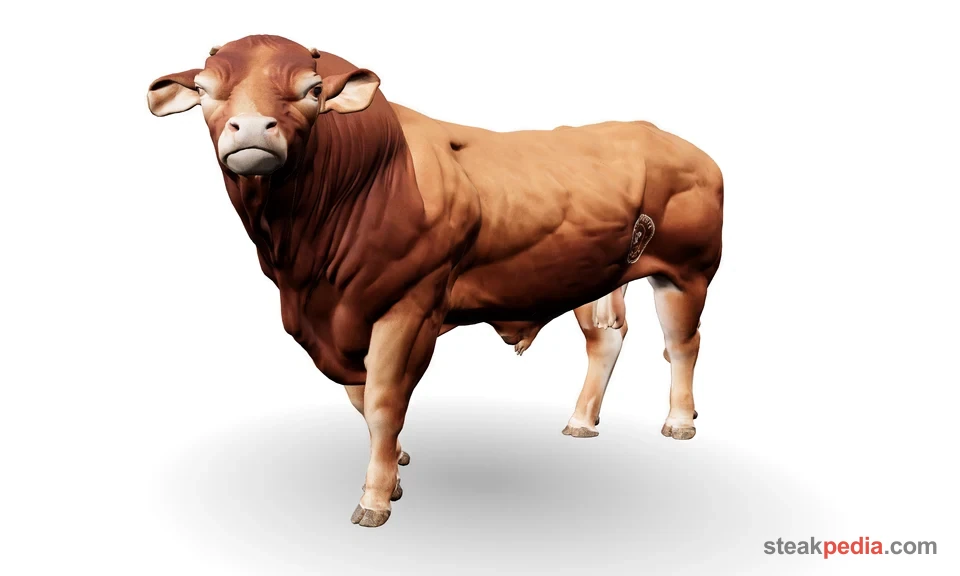 Loading 3D…↻ Drag to turn · scroll to zoom
Look closer
Tap a numbered point on the animal, or a name above, to look closer.
Illustrative 3D model made with AI, not a real animal. Each model carries its own Steakpedia mark and serial number, engraved in the model.
Golden-red, medium-sized and lean
The Limousin is a Continental beef breed, golden-red in color. Oklahoma State University describes the breeders’ aim as a dark golden-red hide with wheat-colored underpinnings, and notes that the medium size of the cattle, compared with other European breeds, was and is an outstanding trait of the breed. It is registered as horned or polled.
Two French Continental breeds are easy to confuse by name but not by sight. The Charolais is white to cream, comes from Burgundy, has a herd book from 1864 and is described as very large-framed with moderate marbling. The Limousin is golden-red, comes from the Limousin and Marche regions, has a herd book from 1886 and is classed with low marbling.
Limousin and Marche, and the 1886 herd book
The breed comes from the Limousin and Marche regions of central France. The Australian Limousin society describes the homeland as rugged granite country with hot summers and harsh winters. According to Oklahoma State, Limousin animals topped other breeds in the first carcass competitions held at Poissy, near Paris, in 1857, 1858 and 1859.
The first Limousin herd book was established in November 1886. The Canadian Limousin Association reports that a commission led by Louis Michel examined 1,800 animals from 150 farms between 1887 and 1890 and accepted 674 of them. The French herd book was reorganized in 1923 and again in 1937.
Why it is called a lean, high-yielding breed
The Limousin is associated with a lean carcass and a high proportion of saleable meat. The North American Limousin Foundation describes the breed’s strengths as moderate cow size, a strong ribeye area, overall muscle and cutability, which it says improve red meat yield. The Canadian association adds that early performance testing recorded an easy calving record, with the smallest average birth weight of all the Continental breeds tested, and that Limousin won the carcass competition at Agribition in Canada for 25 consecutive years, from 1976 to 2001.
Part of the breed’s lean profile has a known genetic marker: a variant of the myostatin gene called F94L. An Australian study presented in 2008 found it in 98.3% of purebred Limousins, and the next most frequent among 15 other breeds tested (1,081 unrelated cattle) was 3%. It is not the same change that causes double muscling in the Belgian Blue. In a 2019 paper in the Journal of Animal Science, the F94L allele was associated with lower marbling scores and thinner fat, a larger ribeye area and a better visual yield grade.
Crosses and spread
North America. The first Limousin genetics reached Canada in November 1968, with the bull Prince Pompadour imported from France; in April 1969, 11 bulls and 5 heifers followed. Semen from Prince Pompadour became available in the United States in July 1969, and the first live Limousin bull imported permanently into the United States, Kansas Colonel, born and raised in Canada, arrived in the fall of 1971. Direct French exports to the United States were limited by French animal-disease regulations. The North American Limousin Foundation had recorded more than 500,000 animals by 1985.
Argentina. The Asociación Argentina de Criadores de Limousin was founded on July 21, 1966, and describes itself as the first association of the breed established outside France. It also keeps registries for crosses, including Limflex (Limousin with British breeds) and Indusin (Limousin with Brangus, Braford, Brahman or Nelore).
Lim-Flex. In North America, Lim-Flex is a Limousin × Angus or Red Angus hybrid. Its association says it aims at the benefits of hybrid vigor, and cites 2024 research reporting better feed efficiency and fewer Yield Grade 4 and 5 carcasses than straight English counterparts, with similar shares of Prime and upper two-thirds Choice. For the British parents of such crosses, see Angus and Hereford.
The meat: lean, little marbling, and what the label says
Limousin beef is double-muscled. The F94L variant common in the breed is not the myostatin change behind the double muscling of the Belgian Blue, and the researchers who found it reported no harmful effects on birth weight or calving difficulty. A Limousin is a muscular, medium-sized animal, not a double-muscled one.
Lean means tough. Lean and tender are different measures. In the same Australian work, animals with two copies of F94L needed 11% less force to cut a sample of the eye round and 6% less for the loin in a laboratory shear test, as reported in a trade account of the study; effects on tenderness in other studies are smaller and can be tangled up with other genes, so the question is not closed.
A breed name guarantees the eating quality. The breed is classed with low marbling, so a Limousin steak will usually carry less intramuscular fat than a steak from a breed bred for marbling. How tender and juicy it is still depends on age, finishing, handling and aging, and on the grade from a system such as USDA or MSA (see Grading systems). For how pasture or grain changes the meat, see Grass-fed vs grain-fed.
Keep reading
- Breed · Scotland, black or redAngusThe Scottish breed behind much of the world’s steak: why it marbles, black and red, and what “Certified Angus” means.
- Breed · England, the white faceHerefordThe white-faced English breed that built the grass-fed herds of Argentina, Uruguay and Australia.
- Production · The final monthsGrass-fed vs grain-fed beefPasture vs feedlot beef: flavor, fat, days on grain, and what the science does and doesn’t say.
- Standards · USDA, A5, MSA, EUROPBeef grading systemsUSDA, A5, MSA stars, Korea’s 1++ and EUROP side by side: what each grade measures and what it doesn’t.
Frequently asked questions
Where does the Limousin breed come from?
From the Limousin and Marche regions of central France. The first herd book was established in November 1886.
Is Limousin beef lean?
Yes. The breed is known for a lean carcass, a strong ribeye area and a high yield of meat, and it is classed with low marbling.
What is the difference between Limousin and Charolais?
Both are French Continental breeds. Limousin is golden-red, from the Limousin and Marche regions, with a herd book from 1886 and low marbling; Charolais is white to cream, from Burgundy, with a herd book from 1864 and moderate marbling.
Is Limousin beef tender?
Tenderness depends on age, finishing, handling and aging more than on breed. One Australian study reported lower shear force in animals carrying two copies of the F94L variant, but results from other studies are smaller and mixed.
What is Lim-Flex?
A Limousin × Angus or Red Angus hybrid registered in North America, aimed at combining the muscling of the Limousin with the marbling of the Angus.
Sources
8
- Oklahoma State University, Department of Animal and Food Sciences. Breeds of Livestock — Limousin cattle. breeds.okstate.edu/cattle/limousin-cattle
- North American Limousin Foundation. NALF history. Centennial, Colorado. nalf.org/about-nalf/history
- Canadian Limousin Association. The Limousin story. Medicine Hat, Alberta. www.limousin.com/association/our-story
- Australian Limousin Breeders Society. About the breed: origin of the breed. limousin.com.au/about-the-breed/origin-of-the-breed
- Asociación Argentina de Criadores de Limousin. Entry in the Argentine Beef directory (Argentine Beef Promotion Institute). argentinebeef.org.ar/en/exportadores/productores/asociacion-argentina-de-criadores-de-limousin
- North American Limousin Foundation. Lim-Flex. Centennial, Colorado. nalf.org/lim-flex
- Bennett, Gary L.; Tait, Richard G., Jr.; Shackelford, Steven D.; Wheeler, Tommy L.; King, David A.; Casas, Eduardo; Smith, Timothy P. L. "Enhanced estimates of carcass and meat quality effects for polymorphisms in myostatin and µ-calpain genes." Journal of Animal Science 97, no. 2 (2019): 569–577. doi.org/10.1093/jas/sky451
- The Cattle Site. Limousin gene discovery pinpoints trait benefits. News report on the F94L findings presented at the International Society for Animal Genetics conference, May 2008. www.thecattlesite.com/news/24685/limousin-gene-discovery-pinpoints-trait-benefits