Soup · Hungary, a soup
Goulash
Goulash (Hungarian gulyás) is a beef dish seasoned with onion and paprika that in Hungary is a soup, named after the cattle herdsmen of the plain. Shin is the classic cut, because its collagen gives body to the broth; the thick stew known abroad as goulash is closer to Hungarian pörkölt.
At a glance
- Origin
- Hungary, herdsmen of the plain
- Name
- Gulyás = cattle herdsman
- Cut
- Shin or chuck
- Key spice
- Sweet Hungarian paprika, caraway
- Serves
- 6
- Time
- 40 min active, 2½ h total
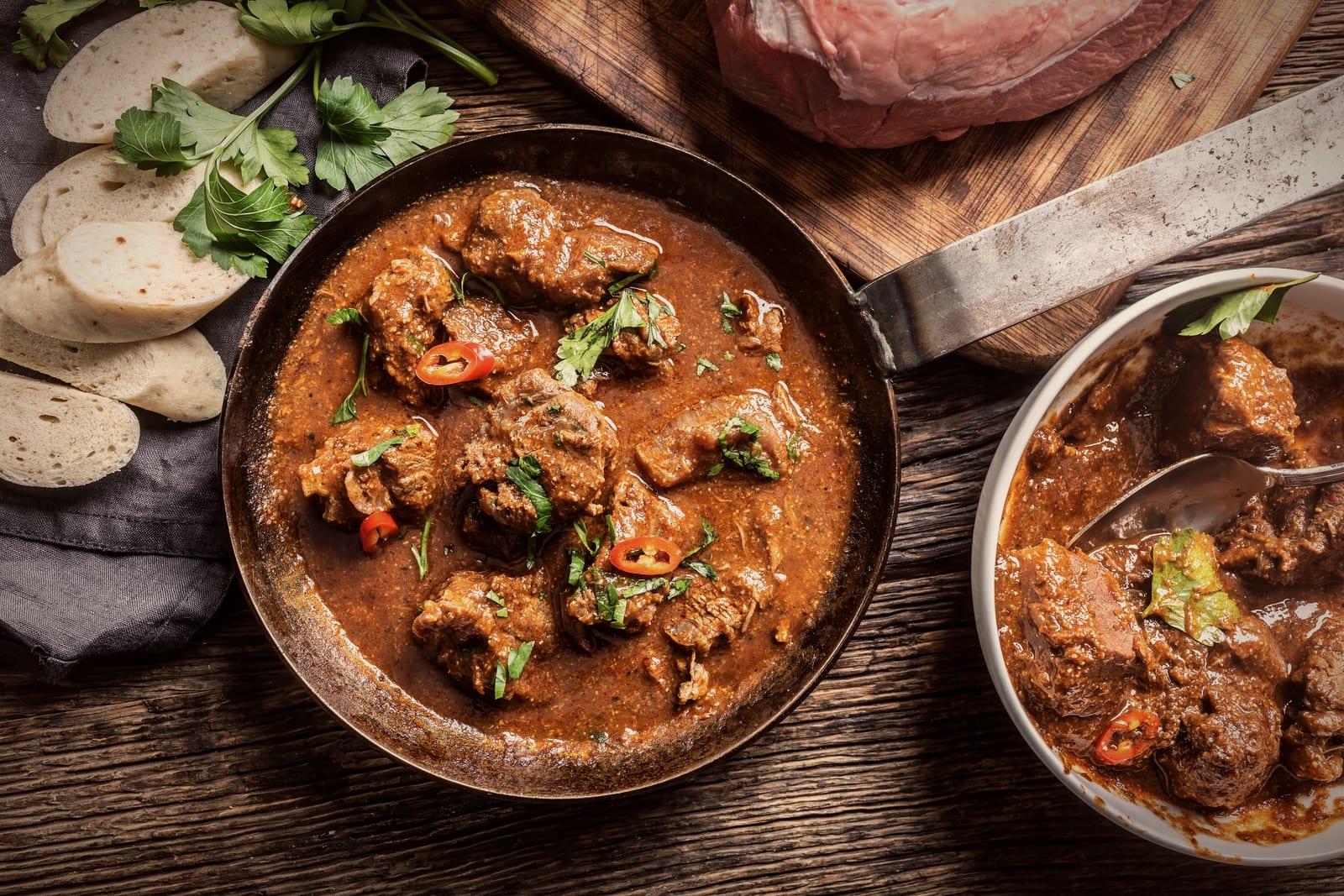
A soup in Hungary, a stew abroad
In Hungary, gulyás or gulyásleves (goulash soup) is a brothy dish of cubed beef, onions cooked in lard, sweet paprika and caraway, with potatoes, root vegetables and often small pinched dumplings called csipetke. It is eaten from a bowl with a spoon.
The thick, gravy-like stew that much of the world calls goulash corresponds to Hungarian pörkölt: meat braised with a large quantity of onion and paprika in very little liquid, served with nokedli (small dumplings). Add sour cream and it becomes paprikás; cut the meat in strips and it is tokány. The cuts are the same for all of them: shin (lábszár), whose collagen gives body to the liquid, or chuck and blade from the shoulder.
Named for the herdsmen, paprika later
The word gulyás means herdsman of cattle (gulya, a herd). On the Great Hungarian Plain these herdsmen cooked meat with onions in a kettle (bogrács) over an open fire; dried, cooked meat could also be carried and rehydrated. The dish was therefore first named after the people who made it: gulyáshús, "herdsman's meat".
Paprika is a later addition. Capsicum peppers reached Hungary from the Americas, probably via the Ottoman world, in the 16th and 17th centuries, but paprika became common in cooking only in the late 18th and 19th centuries. In the 19th century goulash was taken up as a national symbol, contrasted with the German and French food of the Habsburg court, and it moved from the plain into urban restaurants. George Lang's The Cuisine of Hungary (1971) traces this history and insists on the distinction between gulyás and pörkölt.
Ingredients
| Ingredient | Amount | Note |
|---|---|---|
| Beef shin or chuck | 800 g / 1.75 lb | in 2 cm / ¾ in cubes |
| Lard or oil | 2 tbsp / 30 g | lard is traditional |
| Onions | 2, about 300 g / 10 oz | finely chopped |
| Sweet Hungarian paprika | 2 tbsp / 15 g | fresh; a little hot paprika optional |
| Caraway seeds | 1 tsp | crushed |
| Garlic | 2 cloves | crushed |
| Tomato | 1, about 120 g / 4 oz | chopped |
| Green pepper (Hungarian wax) | 1 | sliced |
| Carrot and parsley root (or parsnip) | 1 of each, about 100 g / 3½ oz each | diced |
| Potatoes | 500 g / 1.1 lb | diced |
| Water or light stock | 2 L / 8 cups | |
| Csipetke: flour and egg | 100 g / ¾ cup flour, 1 egg, pinch of salt | a stiff dough |
| Salt | to taste |
Method
- Melt the lard in a heavy pot and cook the onions over medium heat until soft and golden, about 10 minutes.
- Add the beef and stir until it loses its raw color on all sides, about 5 minutes.
- Take the pot off the heat and stir in the paprika: it burns within seconds in hot fat and turns bitter. Add the caraway, garlic and a splash of water at once.
- Return to low heat, cover and let the meat stew in its own juices for 30–40 minutes, adding a little water whenever the liquid runs low.
- Add the tomato, green pepper, carrot and parsley root and the water or stock. Simmer gently, partly covered, for about 1 hour, until the meat is almost tender.
- Meanwhile knead the flour, egg and salt into a stiff dough and pinch off pea-sized pieces of csipetke.
- Add the potatoes and simmer 15–20 minutes, then the csipetke for the last 5 minutes. Adjust the salt; the soup should be thin, deep red and slightly glossy with fat.
Bogrács, Saftgulasch, Fiakergulasch
Hungarian cooks distinguish bográcsgulyás, made outdoors in a kettle over wood, from the kitchen version. Close relatives include babgulyás with beans, and székelygulyás, usually of pork, with sauerkraut and sour cream. In Austria, Gulasch (Viennese Saftgulasch) is a pörkölt-style stew with a great deal of onion, finished with a little vinegar and marjoram; Fiakergulasch, named after Vienna's cab drivers, adds a fried egg, a sausage and a gherkin. In Germany, Gulasch is usually a stew thickened with flour and served with dumplings or noodles, and Gulaschsuppe is a standard of pubs and ski huts. The Czech guláš, eaten with bread dumplings, is another thick version.
Very hot, with bread and hot peppers
Gulyás is served very hot in deep bowls, with bread and, for those who want it, fresh hot peppers or a spoon of hot paprika paste on the side. Sour cream is not traditional in gulyás itself. Common mistakes: burning the paprika, which makes the whole pot bitter; using stale paprika that has lost its color and aroma; using lean cuts, which dry out; thickening the soup with flour, which turns it into a different dish; and adding the potatoes too early, so they dissolve.
Frequently asked questions
Is goulash a soup or a stew?
In Hungary, gulyás is a soup. The thick paprika stew known abroad as goulash is closer to Hungarian pörkölt.
What is the difference between goulash and pörkölt?
Gulyás has plenty of liquid, potatoes and vegetables; pörkölt is meat braised with onion and paprika in very little liquid.
What does gulyás mean?
It means cattle herdsman; the dish was named after the herders of the Hungarian plain who cooked it in a kettle.
Was paprika always in goulash?
No. Paprika became common in Hungarian cooking in the late 18th and 19th centuries; earlier herdsmen's meat was seasoned mainly with onion and salt.
Sources
3
- Larousse Gastronomique, rev. ed. London: Hamlyn, 2009.
- Lang, George. The Cuisine of Hungary. New York: Atheneum, 1971.
- Davidson, Alan. The Oxford Companion to Food. Oxford: Oxford University Press, 1999.
Related