Main course · The bistro plate
Steak frites
Steak frites is a pan-fried or grilled beef steak served with deep-fried potatoes, the everyday plate of the French bistro and the Belgian brasserie, usually with butter or béarnaise. The fries are fried twice: soft inside, crisp outside.
At a glance
- Origin
- France and Belgium, 19th–20th century
- Cuts
- Entrecôte, bavette, onglet, faux-filet
- Serves
- 2
- Time
- 1 h (fries soaked and fried twice)
- Frying
- 160 °C / 320 °F, then 185 °C / 365 °F
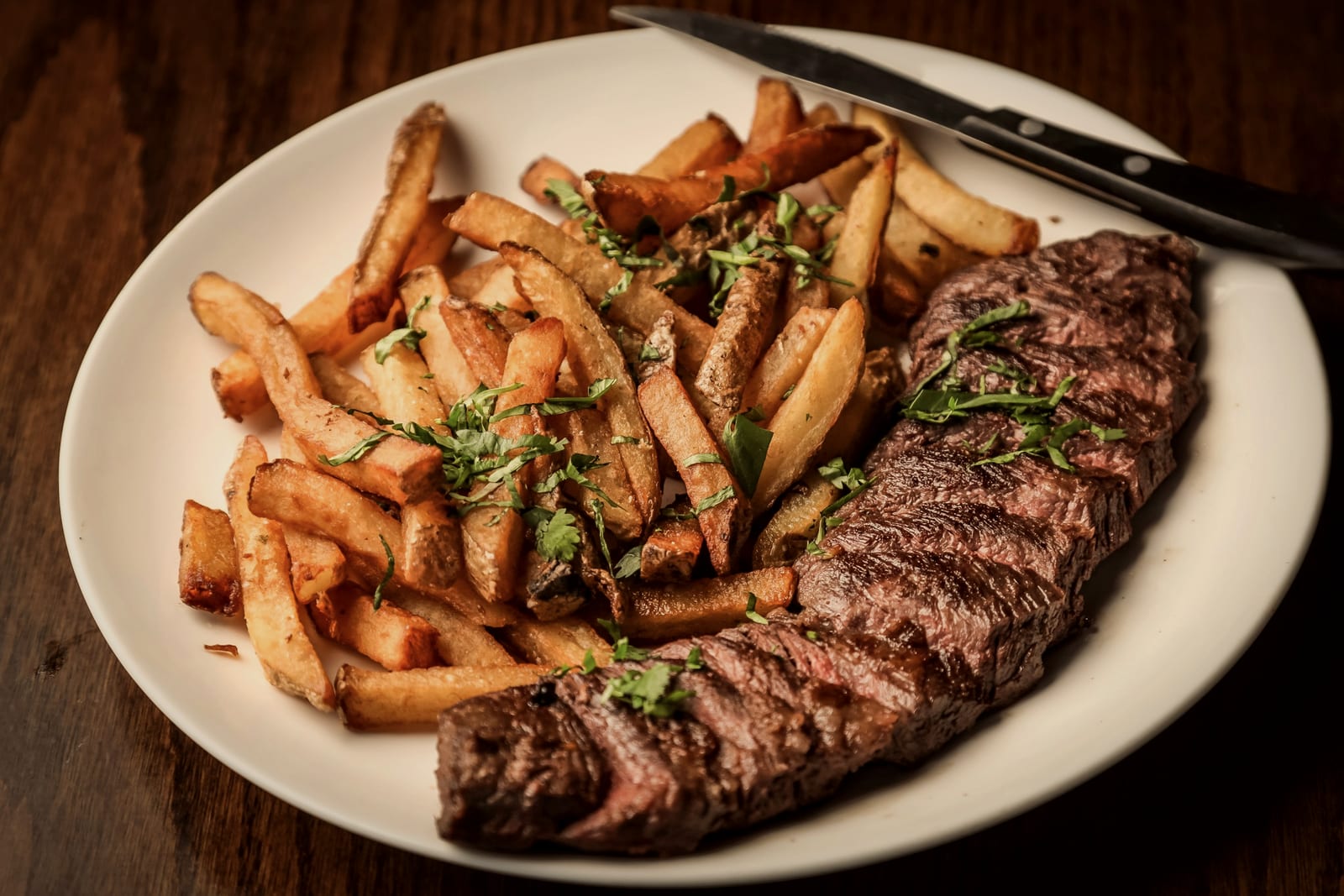
Less a recipe than a pairing
Steak frites is less a recipe than a pairing: a steak, often a cheaper, flavorful cut, cooked fast in a hot pan or on a grill, and a pile of fries cooked in two stages so that they are soft inside and crisp outside. A sauce or a flavored butter completes the plate, with a green salad or watercress on the side.
The usual cuts are the entrecôte (ribeye), the faux-filet or contre-filet (striploin), the bavette (flank or flap) and the onglet (hanger). French diners traditionally order it saignant (rare) or à point (medium-rare); bleu is barely seared.
Who fried the potatoes first
Both France and Belgium claim fried potatoes. The Belgian story of villagers on the Meuse frying potatoes in place of fish in the 17th century is unsupported by documents; fried potato sticks sold by street vendors are recorded in Paris and in Belgium in the 19th century. The steak-and-fries pairing became a fixture of bistros and brasseries by the early 20th century; Belgium regards steak-frites as a national dish.
In 1957 the French critic Roland Barthes devoted an essay of Mythologies, "Le bifteck et les frites", to the dish as a symbol of French identity, calling the fries the "alimentary sign of Frenchness". The combination has since spread worldwide; in Argentina and Uruguay the equivalent is bife con papas fritas.
Ingredients
| Ingredient | Amount | Note |
|---|---|---|
| Beef steaks | 2 × 250–300 g / 9–10½ oz | entrecôte, bavette or onglet, 2.5 cm / 1 in thick |
| Floury potatoes | 800 g / 1¾ lb | Bintje, Russet or Maris Piper |
| Frying fat | 2 L / 2 qt | beef dripping (Belgian tradition) or peanut oil |
| Butter | 20 g / ¾ oz | for basting |
| Coarse salt, black pepper | to taste | |
| Sauce | per person | béarnaise, au poivre, or maître d'hôtel butter |
| Watercress or green salad | 1 bunch | optional |
Method
- Peel the potatoes and cut them into sticks about 1 cm / ⅜ in thick. Rinse and soak in cold water for 30 minutes to remove surface starch; dry thoroughly.
- First fry: cook the potatoes in batches at 160 °C / 320 °F for 5–7 minutes, until soft but pale. Drain and let cool for at least 20 minutes.
- Take the steaks out of the refrigerator 30 minutes before cooking, pat dry and salt them.
- Sear the steaks in a very hot heavy pan with a little oil, 2–4 minutes per side depending on thickness, basting with butter in the last minute. A core of 50 °C / 122 °F is saignant; 54–57 °C / 129–135 °F is medium-rare. Rest for 5 minutes.
- Second fry: while the steaks rest, fry the potatoes at 185 °C / 365 °F for 2–3 minutes, until golden and crisp. Drain and salt immediately.
- Slice the bavette or onglet against the grain; serve entrecôte whole. Plate with the fries and the sauce on the side.
Beef fat in Belgium, green sauce in Paris
In Belgium, fries are fried in beef fat (blanc de bœuf) and served with mayonnaise. In Paris, the formula of a single dish — steak with fries and a secret green sauce, served without a menu — made entrecôte restaurants famous; their sauces derive from the café de Paris butter created in Geneva in the mid-20th century. In Argentina and Uruguay the steak is often a bife de chorizo (striploin) and may come a caballo, topped with fried eggs.
Béarnaise, poivre or butter
The steak is served hot, with fries on the same plate or apart in a cone. The standard sauces are béarnaise, au poivre and parsley-and-lemon maître d'hôtel butter. Common mistakes: frying once at a single temperature (the fries are either greasy or burnt), crowding the oil, and slicing the bavette with the grain, which makes it chewy.
Frequently asked questions
What cut of steak is used for steak frites?
In France, entrecôte (ribeye), faux-filet (striploin), bavette (flank or flap) and onglet (hanger) are the most common.
Why are fries fried twice?
The first, lower-temperature fry cooks the inside; the second, hotter fry dries and browns the surface, making it crisp.
Is steak frites French or Belgian?
Both countries claim it. Fried potatoes are documented in both in the 19th century, and both serve steak frites as a national dish.
Sources
3
- Larousse Gastronomique, rev. ed. London: Hamlyn, 2009.
- McGee, Harold. On Food and Cooking: The Science and Lore of the Kitchen, rev. ed. New York: Scribner, 2004.
- Barthes, Roland. "Le bifteck et les frites." In Mythologies. Paris: Éditions du Seuil, 1957.
Related