Starter · France, the brasserie
Steak tartare
Steak tartare is raw, lean beef finely chopped and seasoned with shallot, capers, mustard and often a raw egg yolk, a dish of the French brasserie. With no heat to kill bacteria, it depends on a whole muscle cut just before serving and kept below 5 °C / 41 °F.
At a glance
- Origin
- France, early 20th century
- Cut
- Tenderloin, or lean top round / rump
- Serves
- 4 as a main, 6–8 as a starter
- Time
- 25 min, served at once
- Keep at
- Below 5 °C / 41 °F until plating
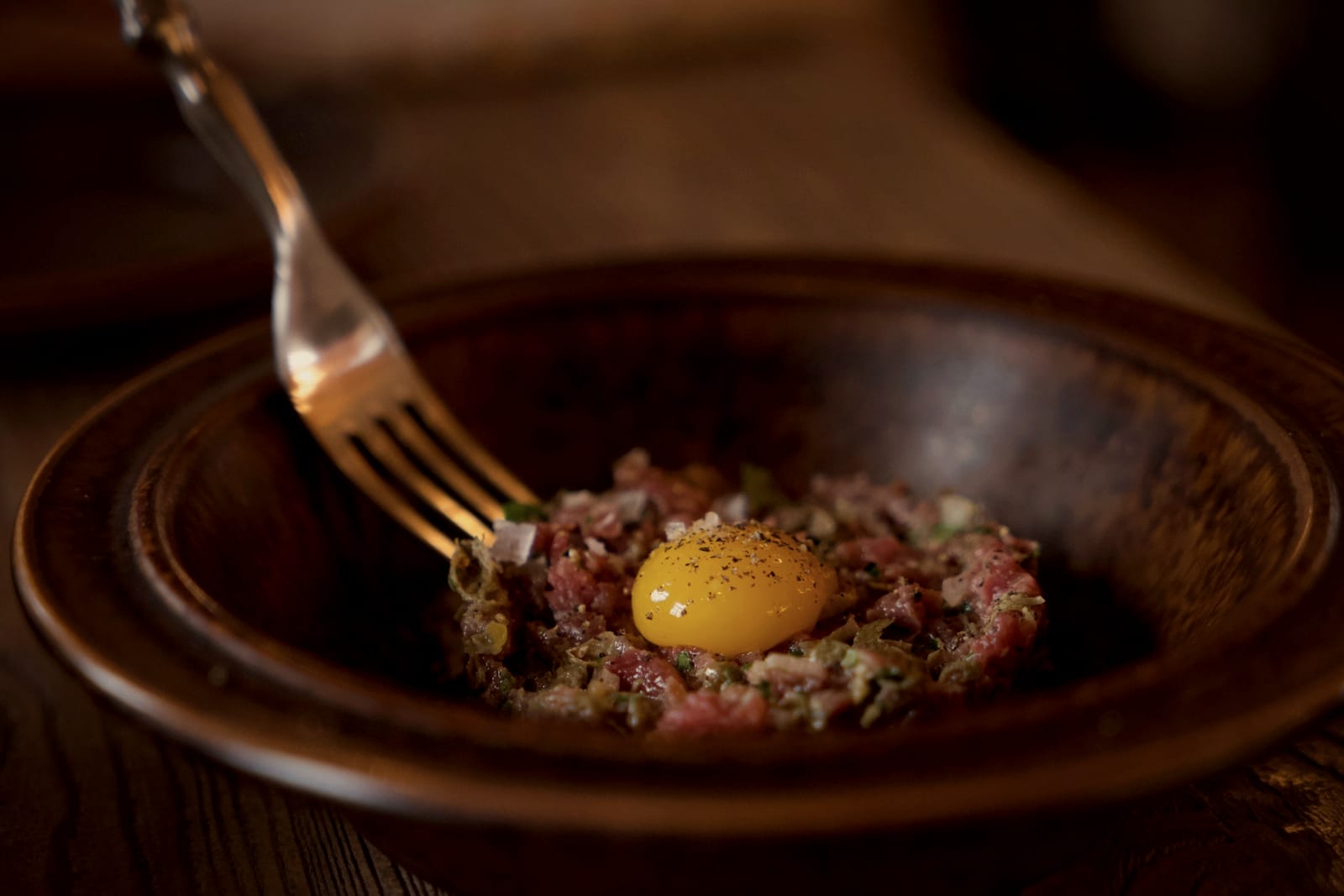
Cut by hand, seasoned at the last moment
Tartare is beef that is never cooked: a lean, sinew-free muscle is cut by hand into small dice or minced, then seasoned at the last moment. The traditional brasserie service brings the meat shaped into a patty with a raw yolk in its centre, surrounded by small heaps of condiments that the diner or the waiter mixes in.
Because there is no heat to kill microorganisms, the dish is defined as much by hygiene as by flavor: the choice of cut, its freshness, the temperature during preparation and the time between cutting and eating.
The Tatar saddle, a legend
The name is often linked to a legend that the Tatar horsemen of Central Asia tenderized raw meat under their saddles. No historical source supports this; the story spread through 19th-century European writing and Jules Verne's novel Michel Strogoff (1876) helped popularize it.
In French cuisine, the early 20th-century beefsteak à l'américaine — raw minced beef with an egg yolk — and the steak à la tartare, served with a sauce tartare, gradually merged. Escoffier's Le Guide culinaire describes the Tartar version as the American one without the yolk, served with tartar sauce. By mid-century the two names referred to the same dish.
Safety: bacteria live on the surface
Pathogenic bacteria such as E. coli O157:H7 and Salmonella live on the surface of meat, not inside an intact muscle. Grinding or chopping spreads that surface through the whole mass. For this reason, as Harold McGee explains, tartare is made from a whole piece cut just before serving, never from pre-ground beef.
Practical rules: buy whole-muscle beef from a trusted, inspected supplier; keep it below 5 °C / 41 °F; trim and discard the outer surface with a clean knife on a clean board; chop and serve within minutes; and never hold mixed tartare for later. The USDA recommends cooking ground beef to 71 °C / 160 °F, and the FDA Food Code requires restaurants to warn customers that raw meat and eggs increase the risk of foodborne illness. Pregnant women, young children, older adults and people with weakened immune systems are advised not to eat it.
Ingredients
| Ingredient | Amount | Note |
|---|---|---|
| Beef tenderloin or lean top round | 500 g / 1.1 lb | very fresh, whole piece, well chilled |
| Egg yolks | 4 | very fresh, or pasteurized |
| Shallot | 1, about 40 g / 1½ oz | finely chopped |
| Capers | 2 tbsp / 20 g | rinsed, chopped |
| Cornichons | 4, about 30 g / 1 oz | finely chopped |
| Flat-leaf parsley | 2 tbsp | chopped |
| Dijon mustard | 1 tbsp / 15 g | |
| Worcestershire sauce | 1 tsp | to taste |
| Tabasco, ketchup | a few drops / 1 tsp | optional, brasserie style |
| Salt, black pepper, olive oil | to taste |
Method
- Chill the beef, the bowl and the knife. Trim the surface, silverskin and fat from the meat.
- Cut the beef into thin slices, then strips, then dice of 3–5 mm / ⅛–¼ in. Hand-cutting keeps the texture; a grinder warms and compresses the meat.
- In a cold bowl set over ice, mix the mustard, Worcestershire, a drop of Tabasco, salt and pepper; add the shallot, capers, cornichons and parsley.
- Fold in the beef and a little olive oil just before serving. Taste and adjust the seasoning.
- Shape into four rounds on cold plates with a ring mould, make a hollow in each and place a yolk in it. Serve immediately.
Filet américain, yukhoe, kitfo
Belgium serves filet américain, a smooth, mayonnaise-bound version spread on bread. Italy has carne cruda all'albese, from Piedmont, seasoned only with olive oil, lemon and sometimes truffle. Germany's Mett is raw pork, a different dish. Korea's yukhoe combines raw beef with pear, sesame and egg yolk; Ethiopia's kitfo is minced raw beef with spiced butter. Thin slices of raw beef are a separate preparation: carpaccio.
Frites, and seasoning at the table
In France tartare is served with frites and a green salad, often with toasted bread. Seasoning at the table, préparé en salle, is part of the classic brasserie ritual.
Frequently asked questions
Is steak tartare safe to eat?
The risk is low but not zero. It depends on whole-muscle beef from a trusted source, trimmed, kept below 5 °C / 41 °F and cut just before serving. People at higher risk are advised to avoid raw meat.
What cut of beef is used for steak tartare?
Tenderloin is the classic; lean, sinew-free cuts such as top round or rump are also used.
Can you use ground beef for tartare?
No. Pre-ground beef carries surface bacteria throughout; tartare is cut from a whole piece at the last moment.
Why is it called tartare?
From the 'à la tartare' style with tartar sauce; the story of Tatar riders tenderizing meat under their saddles is a legend.
Sources
5
- McGee, Harold. On Food and Cooking: The Science and Lore of the Kitchen, rev. ed. New York: Scribner, 2004.
- Larousse Gastronomique, rev. ed. London: Hamlyn, 2009.
- USDA Food Safety and Inspection Service. Safe Minimum Internal Temperature Chart. 2023. www.fsis.usda.gov/food-safety/safe-food-handling-and-preparation/food-safety-basics/safe-temperature-chart
- Escoffier, Auguste. Le Guide culinaire. Paris, 1903; English ed. The Complete Guide to the Art of Modern Cookery, trans. H. L. Cracknell and R. J. Kaufmann. London: Heinemann, 1979.
- U.S. Food and Drug Administration. Food Code 2022, §3-603.11 Consumer Advisory. College Park, MD, 2022. www.fda.gov/food/fda-food-code/food-code-2022
Related